Home / Publications / The C–Br bond as a main reason for conformational isomerism

The C–Br bond as a main reason for conformational isomerism

Vera Vladilenovna Belyaeva 1
Vera Vladilenovna Belyaeva
Irina Petrovna Tsyrendorzhieva 1
Irina Petrovna Tsyrendorzhieva
Tatiana Anatol'evna Podgorbunskaya 2
Tatiana Anatol'evna Podgorbunskaya
Vladimir Isaakovich Rakhlin 1
Vladimir Isaakovich Rakhlin
Published 2020-11-03
CommunicationVolume 30, Issue 6, 744-746
0
Share
Cite this
GOST
 | 
Cite this
GOST Copy
Belyaeva V. V. et al. The C–Br bond as a main reason for conformational isomerism // Mendeleev Communications. 2020. Vol. 30. No. 6. pp. 744-746.
GOST all authors (up to 50) Copy
Belyaeva V. V., Tsyrendorzhieva I. P., Podgorbunskaya T. A., Rakhlin V. I. The C–Br bond as a main reason for conformational isomerism // Mendeleev Communications. 2020. Vol. 30. No. 6. pp. 744-746.
RIS
 | 
Cite this
RIS Copy
TY - JOUR
DO - 10.1016/j.mencom.2020.11.018
UR - https://mendcomm.colab.ws/publications/10.1016/j.mencom.2020.11.018
TI - The C–Br bond as a main reason for conformational isomerism
T2 - Mendeleev Communications
AU - Belyaeva, Vera Vladilenovna
AU - Tsyrendorzhieva, Irina Petrovna
AU - Podgorbunskaya, Tatiana Anatol'evna
AU - Rakhlin, Vladimir Isaakovich
PY - 2020
DA - 2020/11/03
PB - Mendeleev Communications
SP - 744-746
IS - 6
VL - 30
ER -
BibTex
 | 
Cite this
BibTex (up to 50 authors) Copy
@article{2020_Belyaeva,
author = {Vera Vladilenovna Belyaeva and Irina Petrovna Tsyrendorzhieva and Tatiana Anatol'evna Podgorbunskaya and Vladimir Isaakovich Rakhlin},
title = {The C–Br bond as a main reason for conformational isomerism},
journal = {Mendeleev Communications},
year = {2020},
volume = {30},
publisher = {Mendeleev Communications},
month = {Nov},
url = {https://mendcomm.colab.ws/publications/10.1016/j.mencom.2020.11.018},
number = {6},
pages = {744--746},
doi = {10.1016/j.mencom.2020.11.018}
}
MLA
Cite this
MLA Copy
Belyaeva, Vera Vladilenovna, et al. “The C–Br bond as a main reason for conformational isomerism.” Mendeleev Communications, vol. 30, no. 6, Nov. 2020, pp. 744-746. https://mendcomm.colab.ws/publications/10.1016/j.mencom.2020.11.018.

Keywords

alkynes
bromoamines
bromohexamethyldisilazane
hyperconjugation
isomerism
orbital interactions
organosilicon compounds
polarizability
stretching vibration

Abstract

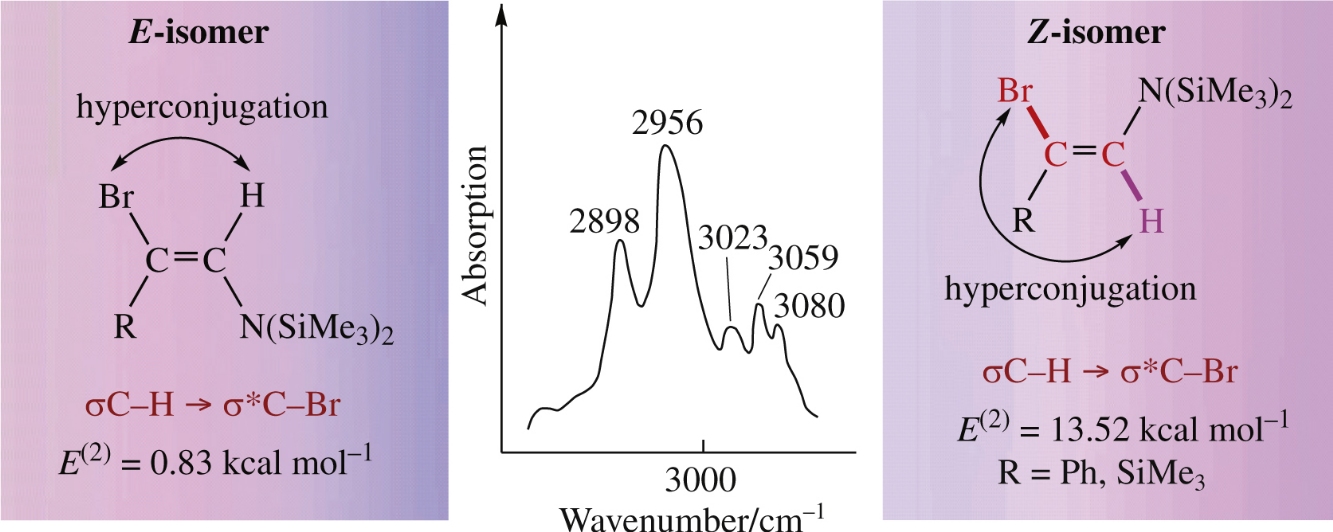
The conformational isomerism and orbital interactions of N-(2-bromo-2-phenylethenyl)-N,N-bis(trimethylsilyl)amine and N-(2-bromo-2-trimethylsilylethenyl)-N,N-bis(trimethylsilyl) amine were examined using NMR technique and quantum-chemical calculations. The IR criterion characterizing σ→σ* hyperconjugation is considered, and the linear dependence of σC–H→σ*C–X (X = F, Cl, Br) interaction energy on the polarizability of X is discussed.

References

1.
10.1016/j.mencom.2020.11.018_bib0005
Alabugin
Wiley Interdiscip. Rev.: Comput. Mol. Sci., 2011
3.
The Magnitude of Hyperconjugation in Ethane: A Perspective from Ab Initio Valence Bond Theory
Mo Y., Wu W., Song L., Lin M., Zhang Q., Gao J.
Angewandte Chemie - International Edition, 2004
7.
Importance of σ-type hyperconjugation to the eclipsed structure of propylene
Lin B., Xie Z., Liu R., Liu L., Guo Q.
Journal of Molecular Structure THEOCHEM, 2003
8.

N-halohexamethyldisilazanes
Rakhlin V.I., Mirskov R.G., Podgorbunskaya T.A., Voronkov M.G.
Russian Journal of General Chemistry, 2007
9.
Physical and chemical properties of N-halohexamethyl-disilazanes
Bailey R.E., West R.
Journal of Organometallic Chemistry, 1965
10.

E.s.r. studies of the bis(triethylsilyl)aminyl radical and trialkylsilyl(t-butyl)aminyl radicals: a reinvestigation
Brand J.C., Cook M.D., Price A.J., Roberts B.P.
Journal of the Chemical Society Chemical Communications, 1982
11.
Silylaminyl radicals. Part 2. Free radical chain halogenation of hydrocarbons using N-halogenobis(trialkylsilyl)amines
Cook M.D., Roberts B.P., Singh K.
Journal of the Chemical Society Perkin Transactions 2, 1983
12.
Radical chain bromination of hydrocarbons using bis(trimethylsilyl)bromamine
Roberts B.P., Wilson C.
Journal of the Chemical Society Chemical Communications, 1978
14.
Computational liquid-phase and solid-state 29Si NMR
Krivdin L.B.
Russian Chemical Reviews, 2020
15.
10.1016/j.mencom.2020.11.018_bib0075
Frisch
Gaussian 09, Revision C.01, 2010
17.
Complexes of dichlorosilylene with allyl chloride and allyl bromide: matrix IR spectroscopy and quantum chemical studies
Boganov S.E., Promyslov V.M., Rynin S.S., Krylova I.V., Zaitseva G.S., Egorov M.P.
Russian Chemical Bulletin, 2018
18.
Stereoelectronic Effects and General Trends in Hyperconjugative Acceptor Ability of σ Bonds
Alabugin I.V., Zeidan T.A.
Journal of the American Chemical Society, 2002
19.
Atomic polarizability and electronegativity
Nagle J.K.
Journal of the American Chemical Society, 1990
20.
Preparative Synthesis of N-Bromohexamethyldisilazane
Rakhlin V.I., Grigor'ev S.V., Mirskov R.G., Podgorbunskaya T.A., Voronkov M.G., Gendin D.V.
Russian Journal of General Chemistry, 2003