Abstract
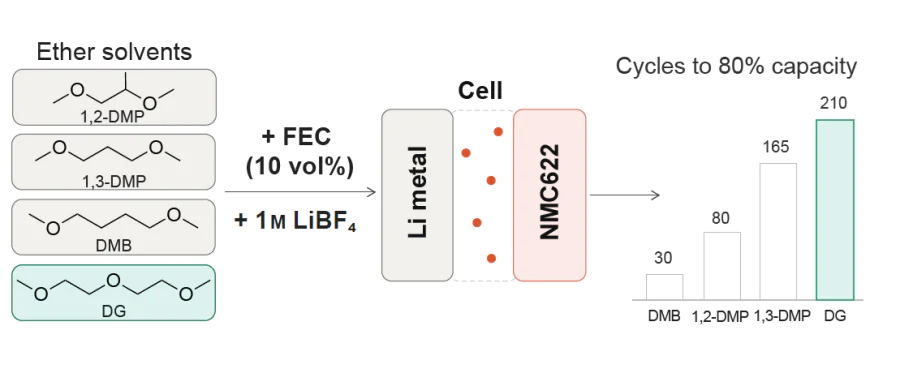
A systematic examination of ether-based electrolytes, stabilized with 10 vol% fluoroethylene carbonate (FEC), as alternatives to conventional carbonate-based electrolytes in Li||NMC622 and Li||NMC811 cells has revealed that, among all the ethers tested, diglyme provides the best balance of ionic conductivity and cycling stability. These findings suggest that diglyme is a promising ether solvent for lithium-metal batteries and point toward molecular design strategies aimed at further enhancing the performance of ether-based electrolytes when used with high-voltage, nickel-rich cathodes.
Keywords
Communication
Lithium‑ion batteries have gained widespread commercial adoption due to their high efficiency and reliability; however, further increases in energy density are constrained by the chemistry of current electrodes and electrolytes.[1, 2] Replacing the graphite anode with a lithium metal anode[3-5] offers a viable path toward substantially higher energy density, potentially exceeding 500 Wh kg−1. Nevertheless, the practical implementation of lithium‑metal batteries is hindered by unresolved challenges, including the growth of lithium dendrites,[6, 7] low Coulombic efficiency and safety concerns associated with the use of conventional carbonate-based electrolytes.[8, 9] Ether solvents, which exhibit good compatibility with lithium metal, are being explored as a promising alternative.[10-13]
This work examines ether-based electrolytes as alternatives to conventional carbonate electrolytes, as the former generally exhibit better chemical compatibility with lithium and facilitate more efficient ion transport. A systematic evaluation of 1,2-dimethoxypropane (1,2-DMP), 1,3-dimethoxypropane (1,3-DMP), 1,4-dimethoxybutane (DMB) and diethylene glycol dimethyl ether, also known as diglyme (DG), as electrolyte solvents, conducted in comparison with a reference LiPF6–carbonate electrolyte, combines electrochemical testing in Li||NMC (622 and 811) cells with physicochemical characterization.
First, the solubility of common electrolyte salts in the selected ethers was investigated. The LiPF6 salt exhibited the highest solubility, approximately 1.5 M, in all the ethers tested (with the exception of DG, with which it forms an insoluble complex); however, it rapidly decomposed in these media. Consequently, LiBF4 was chosen as an alternative; its maximum solubility ranged from 1 M in 1,3-DMP, DMB and DG to 1.5 M in 1,2-DMP. A 1 M LiBF4 solution in the respective ether was adopted as the baseline formulation; however, electrolytes based on pure ethers failed to sustain stable cycling of Li||NMC cells beyond approximately 23 cycles, likely due to the insufficient stability of the solid–electrolyte interface. The addition of 10 vol% fluoroethylene carbonate (FEC) substantially extended the cell service life, resulting in the final composition: 1 M LiBF4 in an ether–FEC mixture (9 : 1 v/v).
All prepared electrolytes were compared with a reference electrolyte (1 M LiPF6 in an EC–DMC mixture, 1 : 1 v/v), which exhibited the highest ionic conductivity (~11.6 mS cm−1). This is consistent with the well-known trend that LiPF6-based electrolytes generally possess higher ionic conductivity.[14, 15] Among the ether-based formulations, conductivity decreased in the following order: DG > 1,3-DMP > 1,2-DMP > DMB (Table 1). The DMP-based electrolytes showed a conductivity (0.9 mS cm−1) below the commonly accepted threshold of 1 mS cm−1, which could lead to an increase in the cell resistance. At the same time, the other formulations maintained high conductivity values (3.9–6.6 mS cm−1) for the operation of an electrochemical cell, even though these values were lower than those of the reference electrolyte (see Table 1).
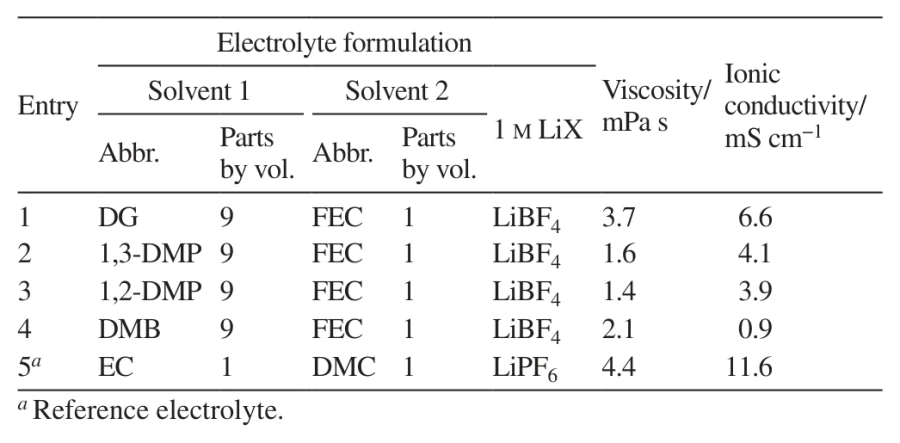
The reference electrolyte also exhibited the highest viscosity (4.40 mPa s), which may hinder ion transport. The viscosity of DG was only slightly lower (3.7 mPa s), whereas DMB, 1,3-DMP and 1,2-DMP had markedly lower viscosities, approximately half that of the reference electrolyte (2.1, 1.6 and 1.4 mPa s, respectively), which facilitates greater ion mobility, despite their lower conductivity in some cases (see Table 1).
All electrolytes were further investigated in symmetric Li||Li cells to evaluate overpotential and cycle life. Among them, the composition containing 1 M LiBF4 in a DG–FEC mixture (9 : 1 v/v) exhibited the longest operational lifespan (520 h) and the lowest overpotential (0.1 V) [Figure S3(a), see Online Supplementary Materials]. Electrochemical testing in full-cell systems was conducted using Li||NMC622 electrodes at a commercially relevant areal loading (2.5 mAh cm−2). The cycling protocol included three initial formation cycles at a current of 0.1 C, followed by repetitive cycles consisting of a charge at 0.2 C (to ensure more uniform lithium plating) and a discharge at 0.5 C.
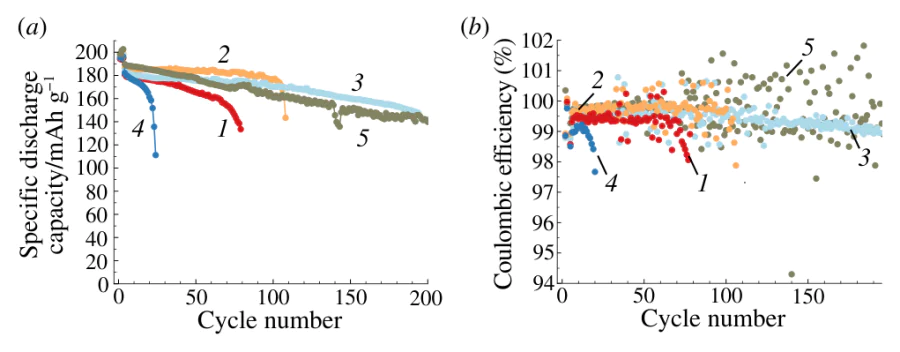
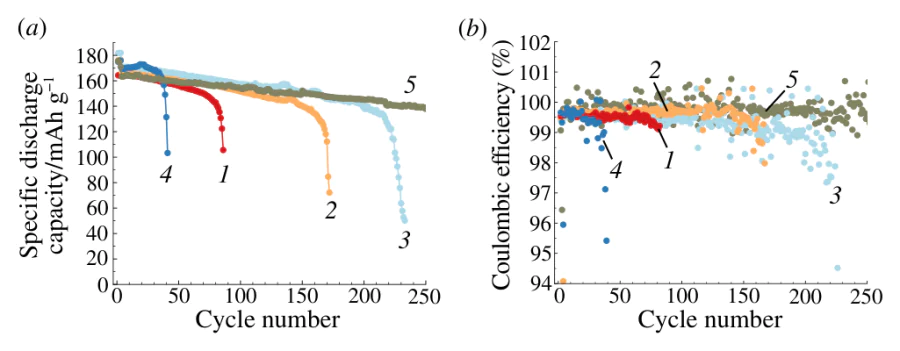
Electrochemical cells containing the electrolytes under investigation (1 M LiBF4 in an ether–FEC mixture, 9 : 1 v/v), using 1,2-DMP, 1,3-DMP, DMB or DG as the ether solvent, exhibited performance comparable to that of a reference electrolyte (1 M LiPF6 in an EC–DMC mixture, 1 : 1 v/v). Among the ether-based electrolytes, the one containing DG performed the best, retaining 80% of its initial capacity after 210 cycles. For the electrolytes based on 1,3-DMP, 1,2-DMP and DMB, this same 80% threshold was reached after 165, 80 and 30 cycles, respectively (Figure 1(a)). The carbonate-based electrolyte proved to be notably more consistent, retaining 85% of its capacity over more than 250 cycles. The average Coulombic efficiency for the electrolytes based on DG, 1,2-DMP, 1,3-DMP, DMB and carbonates was 99.4, 99.5, 99.6, 99.5 and 99.7%, respectively (Figure 1(b)). These performance differences are likely due to the lower oxidative stability of ethers compared to carbonates, particularly at potentials above 4 V.
Galvanostatic tests were also conducted using NMC811. The overall performance of Li||NMC811 cells was found to be similar to that of Li||NMC622 cells (Figure 2): the DG-based electrolyte retained 85% of its capacity after 200 cycles, whereas the DMB-and 1,2-DMP-based electrolytes lasted for fewer than 80 cycles; the 1,3-DMP-based electrolyte initially showed good results, but experienced a sharp drop in capacity after 100 cycles.
In summary, we have demonstrated that ether-based electrolytes, stabilized by the addition of 10 vol% FEC, can serve as an effective alternative to conventional carbonate-based electrolytes in lithium-metal batteries. Among the ethers investigated, DG consistently outperformed 1,2-DMP, 1,3-DMP and DMB, by offering a combination of the highest ionic conductivity and superior stability during cycling tests in both Li||NMC622 and Li||NMC811 cells. In these systems, 80 and 85% of the initial capacity were retained after 210 and 200 cycles, respectively. Although the reference carbonate-based electrolyte still demonstrates greater stability during long-term operation, its suitability for high-voltage, nickel-rich cathodes remains limited. Meanwhile, ether-based electrolytes hold significant potential for further optimization. These findings identify DG as the most promising ether-based platform for lithium‑metal batteries and support the use of molecular design strategies, such as targeted fluorination, to enhance oxidative stability. This paves the way for fully unlocking the potential of ether-based electrolytes in systems utilizing nickel-rich cathodes, which are characterized by high energy density.
The authors are grateful to the company Rustor LLC for providing NMC622 and NMC811 cathode materials and to Mr. Kamil Yusupov for analyzing the NMR spectra.
References