Abstract
This work demonstrates that targeted additives significantly improve the high-voltage cycling performance of the fluorinated ester electrolyte in graphite||NMC811 Li‑ion cells: dimethoxydiphenylsilane and vinylene carbonate after 300 charge/discharge cycles achieved capacity retentions of 88.1 and 86.4%, respectively, compared to 85.5% for the additive-free methyl 3,3,3-trifluoropropionate–fluoroethylene carbonate electrolyte. Both additives also delivered exceptional average Сoulombic efficiencies (99.96 and 99.98%), representing a critical step toward preserving energy density and lifetime in high-voltage lithium‑ion batteries.
Keywords
Communication
High-voltage lithium-ion batteries based on graphite||LiNi0.8Mn0.1Co0.1O2 (NMC811) are an effective route to increased energy density for electric vehicles and grid storage,[1, 2] yet their performance and lifetime are often limited by electrolyte instability at elevated potentials.[3-5] Oxidative decomposition of conventional solvents,[6] parasitic interfacial reactions,[7] transition metal dissolution,[8] and aluminum current collector corrosion[9] lead to unstable solid electrolyte interphases (SEIs) and cathode electrolyte interphases (CEIs), increasing impedance, causing gas evolution, and accelerating capacity fade.[10-13] Functional molecules in small concentrations as electrolyte additives play a decisive role by preferentially reducing or oxidizing to form protective SEI/CEI layers and by modifying interfacial chemistry to suppress side reactions,[14-18] reduce impedance growth,[19, 20] and improve Coulombic efficiency.[21-23]Fluorinated electrolyte components are designed to promote the formation of a LiF-rich, robust SEI,[16, 18, 24] while boron-based compounds, on the other hand, aid in modifying and reforming less conductive inorganic SEI layers, improving its ionic conductivity.[25, 26] Unsaturated sulfur-containing and anhydride-derived additives polymerize at the electrode surfaces, forming protective films that shield the electrodes from side reactions.[17] Silicon-containing additives serve dual roles: they can contribute to film formation and simultaneously scavenge harmful hydrogen fluoride, thereby protecting the electrode materials and electrolyte.[17]
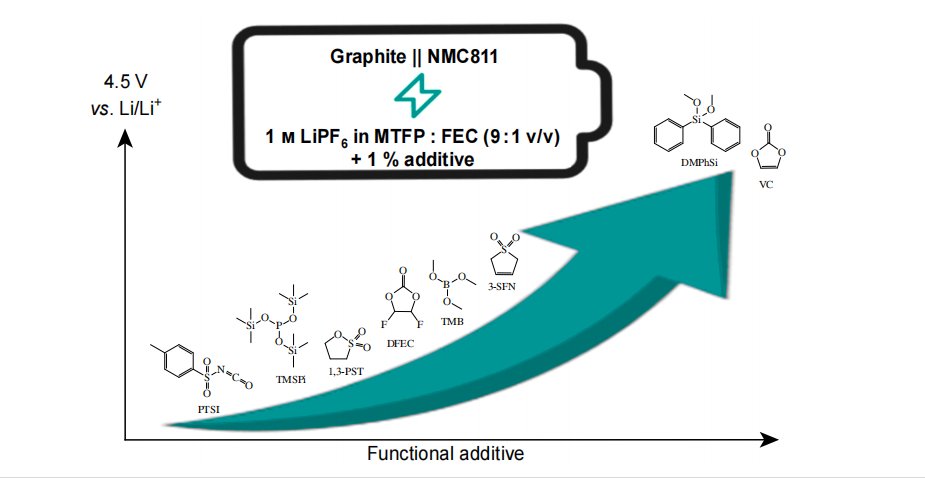
Recently we have developed a high-voltage ester-based electrolyte (1 M LiPF6 in methyl 3,3,3-trifluoropropionate (MTFP)/fluoroethylene carbonate (FEC), 9 : 1 v/v) for commercial-loaded graphite||NMC811 coin and pouch cells.[27] This electrolyte has demonstrated effectiveness at a cutoff voltage of 4.5 V, superior to conventional carbonate-based formulations, owing to the improved high-voltage stability of fluorinated ester. Here, we set out to further improve the performance of the MTFP–FEC high-voltage electrolyte by systematically evaluating a range of additives with different functional groups in the fluorinated ester electrolyte for graphite||NMC811 cells, with the goal of preserving capacity during prolonged high-voltage cycling and maintaining high Coulombic efficiency (CE).
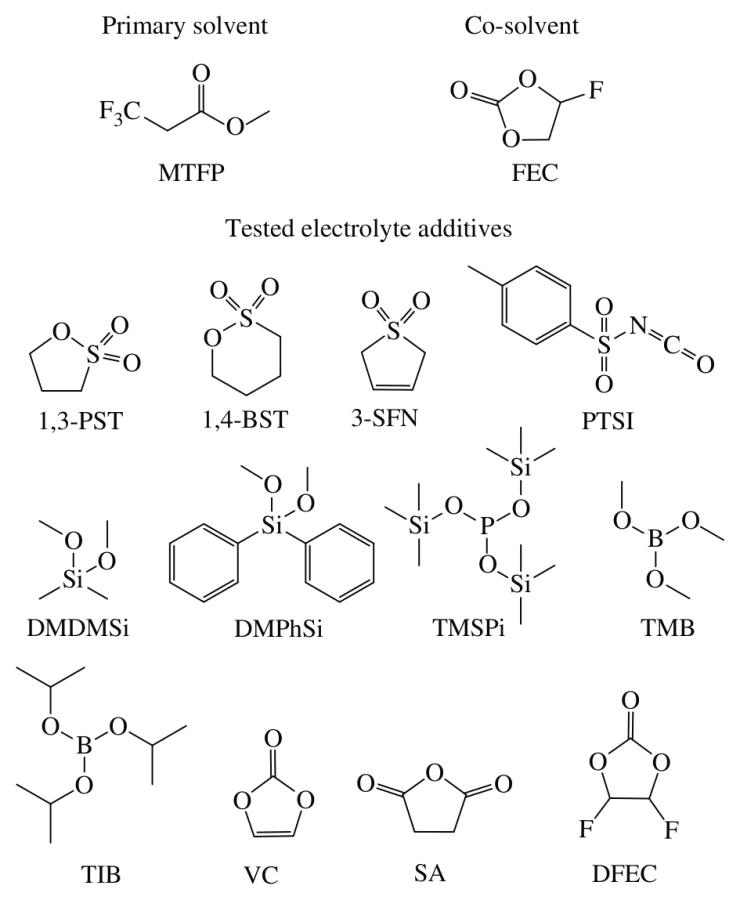
To improve the long-term stability of the MTFP-based electrolyte, we performed broad screening of electrolyte additives. The investigated compounds included sulfur-containing additives (1,3-propanesultone, 1,3-PST; 1,4-butanesultone, 1,4-BST; 3-sulfolene, 3-SFN; and p-toluenesulfonyl isocyanate, PTSI), silicon-containing additives (dimethoxydimethylsilane, DMDMSi; dimethoxydiphenylsilane, DMPhSi; and tris(trimethylsilyl)phosphite, TMSPi), boron-containing additives (trimethyl borate, TMB, and triisopropyl borate, TIB), carbonate- and anhydride-derived additives (vinylene carbonate, VC, and succinic anhydride, SA), and the replacement of FEC with difluoroethylene carbonate (DFEC) (Figure 1). Coin cells (graphite||NMC811, ~1.8 mAh cm−2) employing 1 M LiPF6 in MTFP/FEC (9 : 1 v/v) with 1 wt% additive were cycled between 2.7 and 4.5 V using three formation cycles at 0.1 C followed by 300 cycles at 0.5 C. The electrochemical performance of the investigated electrolyte formulations is presented in Figure 2(a).
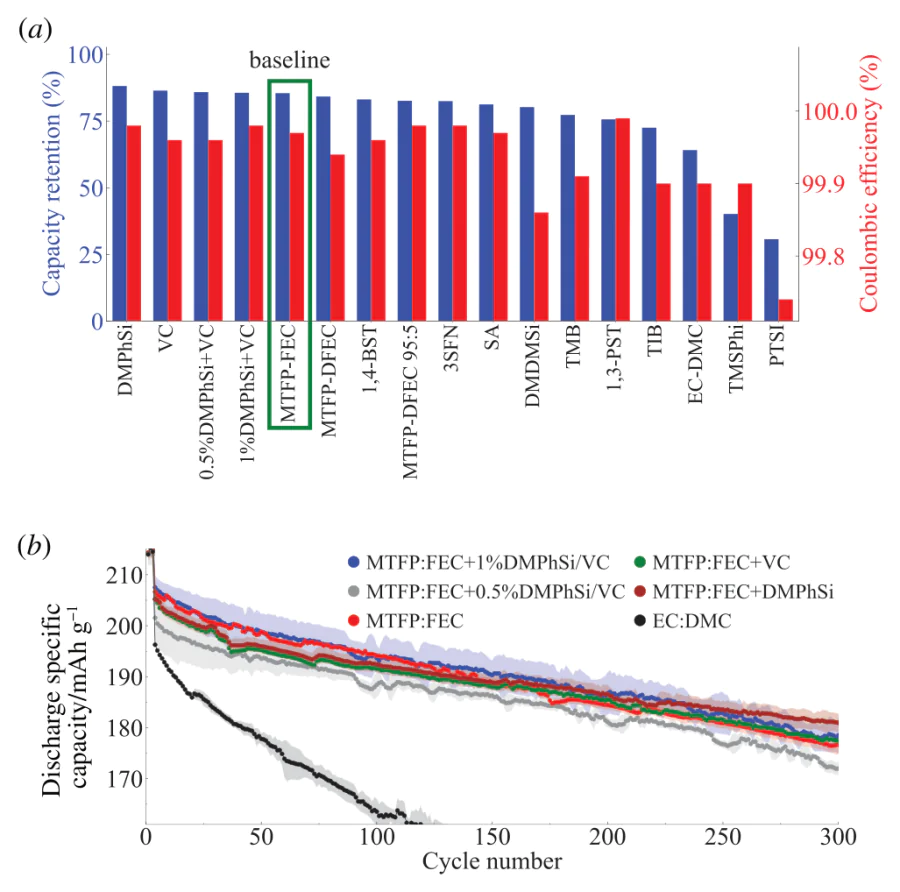
Only a few of the tested classes of additives (Figure 2(a)), produced measurable benefits. DMPhSi delivered the best result, reaching 88.1% capacity retention (CR) and an average CE of 99.98% after 300 cycles, likely by forming a more stable, mechanically robust interphase that suppresses electrolyte decomposition. The addition of VC also improved performance (86.4% CR, ~99.96% CE), while the additive-free MTFP–FEC baseline gave 85.48% CR and 99.97% CE (Figure S1, Online Supplementary Materials). Boron-containing additives (TMB and TIB) accelerated capacity fade and did not improve CE, indicating deleterious side reactions or unstable interphase formation (Figure S2, Online Supplementary Materials). Other silicon additives (DMDMSi, TMSPi) underperformed compared with DMPhSi (Figure S3, Online Supplementary Materials), and sulfur additives showed mixed, generally inferior outcomes; the best sulfur cases represented by 1,4-BST 83.1% CR and 3-SFN 82.6% CR, while PTSI and 1,3-PST worsened cycling stability (Figure S4, Online Supplementary Materials). Replacing FEC with DFEC (9 : 1 v/v) yielded 84.2% CR (99.94% CE), and lowering the DFEC content to 5 vol% reduced CR to 82.46% (Figure S5, Online Supplementary Materials). Overall, DMPhSi and VC are the only additives that meaningfully enhanced long-term stability under these high-voltage conditions (Figure 2(b)).
The mixed additive tests confirm a synergistic interaction between DMPhSi and VC. The electrolyte with 0.5 wt% DMPhSi + 0.5 wt% VC reached 85.8% CR after 300 cycles with an average CE of 99.96% (Figure 2(b),S6), while the formulation with 1 wt% DMPhSi + 1 wt% VC gave 85.6% CR and 99.98% average CE. Although these mixed systems did not outperform pure DMPhSi, they showed stable long-term cycling comparable to or slightly better than the additive-free MTFP/FEC electrolyte.
In summary, the additive screening demonstrates that fluorinated ester electrolytes remain compatible with conventional electrolyte optimization approaches; however, only selected additives provided measurable benefits. DMPhSi and VC delivered the best electrochemical performance: relative to the additive-free MTFP–FEC baseline (85.5% CR, 99.97% CE), DMPhSi produced the largest gain in capacity retention (+2.7 percentage points) and a slight CE improvement (to 99.98%), while VC increased retention to 86.4% with CE ≈ 99.96%. Although these differences after 300 cycles are small, they may amplify over longer cycling. In contrast, boron-based and most sulfur-containing additives failed to improve or slightly worsened the long-term performance.
The authors are grateful to Rustor LLC for providing NMC811 cathode materials and to Mr. Kamil Yusupov for NMR spectra analysis.
References