Abstract
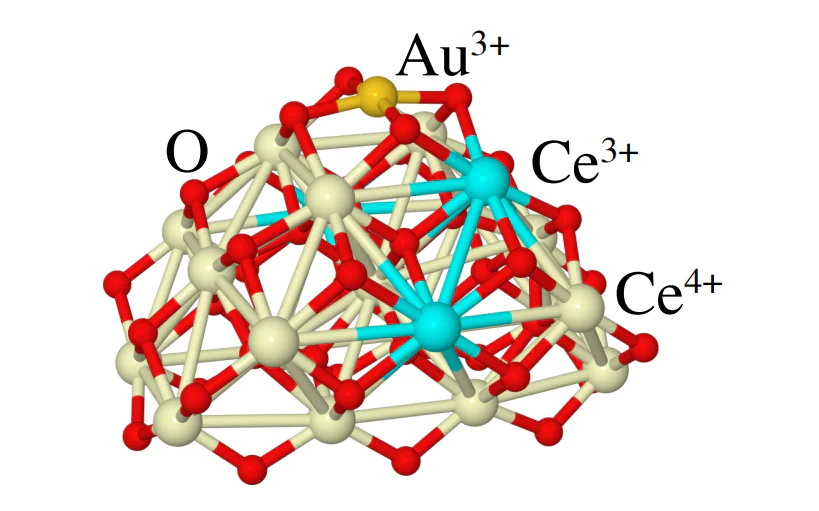
The active site of Ce21O42 ceria nanoparticles comprising four two-coordinated oxygen centers, an O4 site, is adopted for the selective trapping of single gold atoms. Opposite to active sites of extended ceria surfaces, the O4 site allows the formation of four Au–O bonds and the presence of gold not only in +1 but also in +3 oxidation states. Bonding of Aun species with n > 2 at the O4 site shows similar features with those anchored at extended CeO2 surfaces.
Keywords
Communication
Ceria surfaces modified with single-atom and few-atom gold species are of interest due to their high applicability in catalysis for CO oxidation, CO2 hydrogenation, and water–gas shift reaction.[1] The coordination modes, oxidation states, and binding energies of single and polyatomic gold species at stable nonpolar CeO2(111) surfaces were investigated theoretically.[2-4] The adsorbed gold atoms preferred the bridging O–Au–O adsorption mode with a moderate binding energy of about 1 eV. The adsorption of Aun at polar CeO2(110) or CeO2(100) surfaces[5-8] was modeled less frequently despite the fact that they provided almost two times stronger metal–support binding and, therefore, reduced unwanted sintering of gold species. Moreover, nanostructured ceria surfaces (e.g., stepped surfaces that provided intersection of different ceria nanofacets) can be even more active and catalyze processes up to an order of magnitude faster compared to traditional 2D extended ceria surfaces.[9] This effect can be rationalized in view of the presence of low-coordinated and, hence, more mobile oxygen atoms, which can participate in oxidation processes.
Here, we report the density functional modeling of structural, electronic, and energetic features of gold species (single atom, dimer, trimer, and tetramer) adsorbed at active sites of ceria nanoparticles. As a ceria model, the stoichiometric Ce21O42 nanoparticle with an active center composed of four oxygen atoms of the CeO2(100) nanofacet, so-called O4 pocket, has been used.[10] This model was elaborated as the smallest one in the series of ceria nanoparticles of enlarging sizes containing 21, 30, 40, and 80 cerium atoms.[11] The O4 site of Ce21O42 and Ce40O80 was very effective in trapping single transition-metal atoms.[12, 13] However, a systematic investigation of the anchoring of gold Aun (n = 1, 2, 3,…) species of growing size at the O4 pocket has not been performed as, for example, it was the case for CeO2(111), MgO(100), and graphite (0001) surfaces.[4] The present study is aimed at fulfilling this gap.
The calculations were carried out using the Vienna ab initio simulation package (VASP) code.[14] The computation parameters were taken as in our previous works.[13, 15] The spin unrestricted eigenfunctions of the projector augmented wave method[16] were built for explicitly treated 11 valence electrons of each Au atom (5s14d10), 6 electrons of each O atom (2s22p4), and 12 electrons of each Ce atom (5s25p66s25d14f1). For this purpose, the plane waves were included up to an energy cut-off of 415 eV.[17] The GGA+U scheme with the Perdew–Wang PW91 parametrization of the exchange-correlation functional and inclusion of the Hubbard-type on-site correction U-term of 4 eV for Ce 4f states was utilized. The Gaussian smearing of 0.05 eV was applied to the Kohn–Sham levels close to the Fermi energy, but the final energy values were extrapolated to zero smearing. The calculations of finite nanoclusters were performed at the Γ-point of the reciprocal space. To avoid interaction between repeated images of the nanoparticles, the vacuum gaps of ~1 nm in three Cartesian directions were utilized. The binding energies (Eb) of the Aun species on the CeO2 substrate were calculated as averaged values over n gold atoms: Eb(Aun/CeO2) = [E(Aun) + E(CeO2) – E(Aun/CeO2)]/n.
Figure 1 shows the lowest-energy structures of anchored Aun (n = 1–4) moieties at ceria models. The geometries of all studied systems are collected in Table S2 of the Online Supplementary Materials. Given the preferred location of single gold atoms in the center of O4 pockets previously modeled at Ce40O80 nanoparticles,[12] we used this geometry as a starting point. Three Au1/Ce21O42 structures with similar gold binding energies within 0.2 eV were optimized (Table 1). The most stable model 1a was characterized by four short Au–O contacts of 2.04–2.07 Å and gold atom lying 0.20–0.25 Å above the O4-square plane (Figure 1). The Au center in structure 1a had a charge of +0.91 e; the metal to support charge transfer was accompanied by the appearance of three reduced Ce3+ ions; that is, the gold center had the formal oxidation state +3. In two alternative structures 1b and 1c (Figure S2), Au atoms formed two short bonds of 2.06–2.07 Å and two long bonds of 2.74–2.79 Å with oxygen centers lying at the opposite sides of O4 pockets and rose 0.35–0.85 Å above the O4-square plane. Here, the charge of an Au center was +0.33 e, which is equivalent to the formal oxidation state +1 since the reduction of only one Ce3+ ion was observed. The adsorption energies of Au atoms in models 1a, 1b, and 1c were 2.3, 2.2, and 2.1 eV, respectively. These values are smaller than Eb of 2.73 and 3.46 eV calculated for Au+ and Au3+ ions at O4 pockets of a larger Ce40O80 nanoparticle, respectively.[12] Note that the strengthening of metal–ceria bonding at O4 sites by 0.3 eV with the growth of ceria nanoparticles from Ce40O80 to Ce80O160 has been previously reported for the Pd2+ ion.[12] The larger discrepancy in Eb for Au3+ can be explained by the larger electrostatic metal–support interaction. The PBE-calculated Eb values of 2.6–3.0 eV for Au+ anchored at O–O bridge sites of the extended CeO2(100) surface were reported.[8] On the other hand, the values of 2.07, 2.11, and 2.19 eV[5] were obtained[5-7] for two-coordinated Au+ adsorbed in a bridging mode at the CeO2(110) surface with Au–O bonds of 1.98 Å. Note that Eb of ~1.1–1.2 eV was calculated for the bridging adsorption of single Au atoms for nondefect CeO2(110)[18] and CeO2(111)[4, 19, 20] surfaces. Interestingly, the Au+ ion coordinated at one O atom of the O4 site had similarly small Eb of 1.03 eV (Table S2).
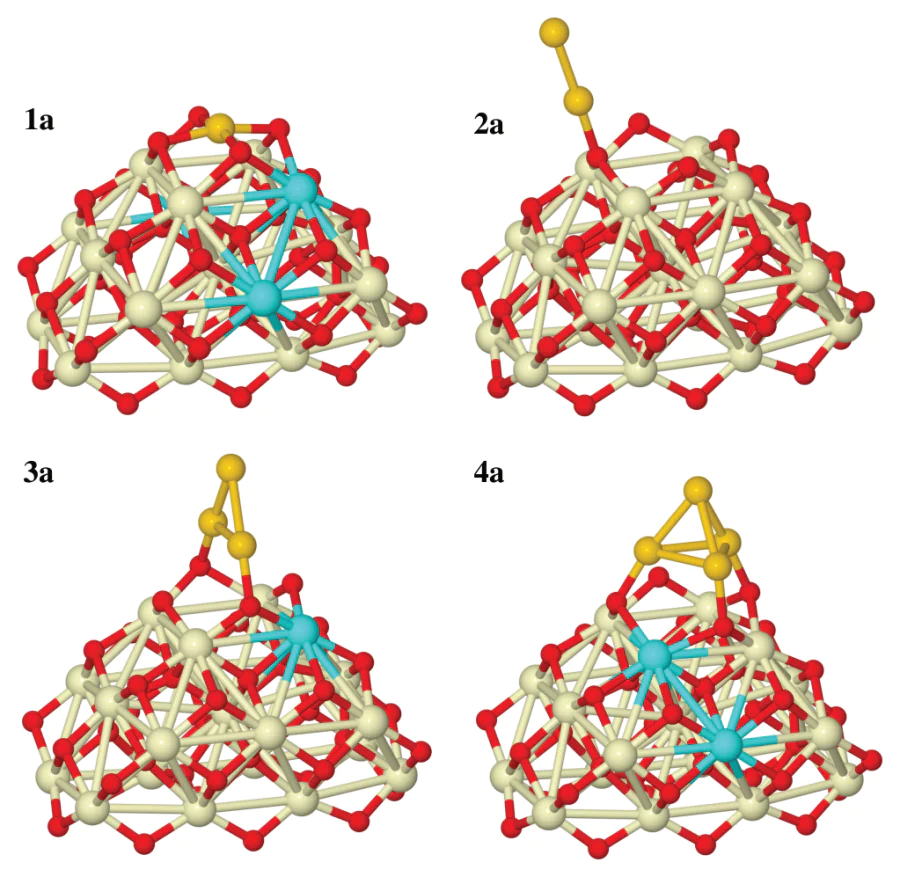
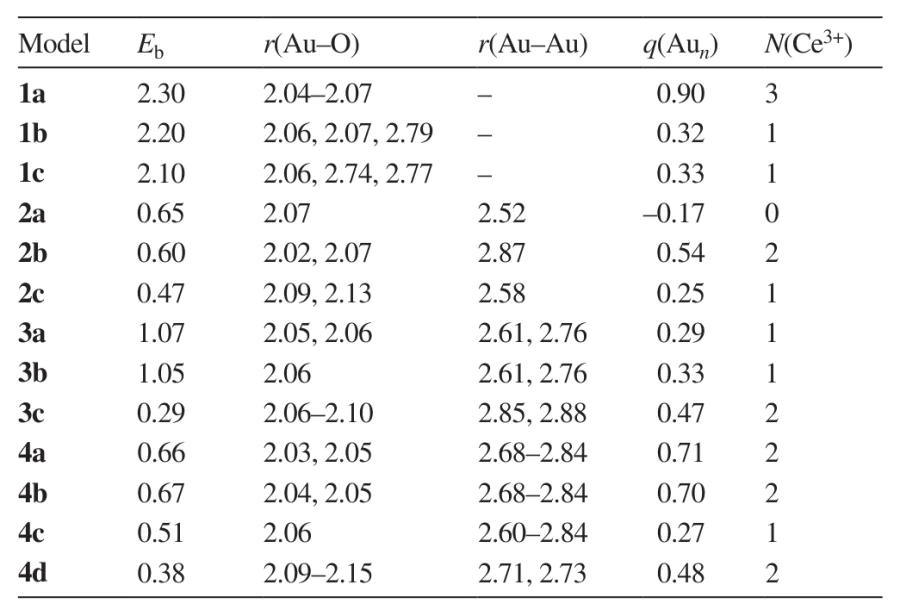
The most stable gold dimer in structure 2a was preferably coordinated in slightly tilted vertical mode forming one Au–O bond of 2.07 Å in length. The Au–Au bond length of 2.52 Å was not changed upon adsorption with respect to a gas-phase digold molecule. The binding energy of Au2 species in 2a was 0.65 eV, which is slightly smaller than 1.03 eV for the adsorption of a single Au atom at the same O atom of the O4 site.
Similar values of 1.0–1.2 eV were calculated for Au2 adsorption at CeO2(110)[18] and CeO2(111)[4] while larger values of 1.75 and 2.0 eV were reported for the Au2/CeO2(111) system.[3, 20] Teng et al.[3] and Ghosh et al.[20] obtained two times larger Eb values due to the use of the different formula Eb(Aun/CeO2) = [nE(Au) + E(CeO2) – E(Aun/CeO2)]/n, where the sum of the energies of single Au atoms nE(Au) was applied instead of the cluster energy E(Aun). In line with a study of Engel et al.,[4] the vertical model 2a featured no charge transfer and oxidation of Au2 moieties and, consequently, no appearance of reduced Ce3+ ions. The total charge of an Au2 moiety was –0.17e with a positively charged Au atom (0.1e) in contact with the ceria oxygen center. Less stable model 2b (Eb = 0.60 eV) with one Au atom of Au2 located in the center of an O4 pocket and the other one interacting with an O atom of the O4 site featured a significantly elongated Au–Au distance of 2.87 Å, accompanied by reduction of two Ce4+ ions and oxidation of the Au2 moiety (+0.54e). Structure 2c with a nearly parallel orientation of the Au2 moiety forming two nearly equal Au–O contacts of 2.09 and 2.13 Å and an Au–Au bond stretched to 2.58 Å was the least stable (Eb = 0.47 eV). Structure 2c had one reduced Ce3+ ion and an Au2 moiety with a total charge of +0.25e, which indicated the charge transfer and oxidation of the Au2 moiety. All gold atoms of structures 2b and 2c were positively charged with a larger charge at the Au atom closer to the ceria surface.
Gold trimers were preferably adsorbed as triangles in a vertical position, forming two Au–O bonds of 2.06 Å. Two possible vertical adsorption modes 3a and 3b had binding energies of 1.07 and 1.05 eV, respectively. Preference of a vertical orientation of the Au3 moiety at extended CeO2(111), (110), and (100) surfaces with Eb of 1.02, 1.09, and 1.24 eV, respectively, has been reported.[21] Larger Eb values of 2.2 eV were calculated for the Au3/CeO2(111) system[3, 20] when nE(Au) was used as a reference. An adsorbed Au3 moiety represented an isosceles triangle with two Au–Au edges at 2.61 Å and an Au–Au side interacting with the ceria support elongated to 2.76 Å. Indeed, vertical moieties 3a and 3b were positively charged: +0.289e and +0.325e, respectively. Similar to Au2 model 2a, the Au atoms of Au3 with no Au–O contact had a negative charge of about –0.1e. Structure 3c (Table S2) with a linear Au3 moiety was significantly, by 2.33 eV, less stable (Eb = 0.35 eV). It had three slightly longer Au–O bonds of 2.06–2.10 Å. The Au–Au bonds (2.85–2.88 Å) were sizably longer than those in gas-phase Au3 species (2.56 Å). Linear model 3c featured a more positive charge of +0.469e, which reflected stronger oxidation of gold clusters and appearance of two Ce3+ ions vs. one reduced cerium ion in vertical models 3a and 3b. Several attempts to locate a structure with Au3 moieties lying parallel to the ceria surface were unsuccessful, in line with published data.[4, 21]
Tetrameric Au4 species anchored at O4 pockets of ceria models with 3D tetrahedral and 2D rhombus shapes, respectively, have been located. The Au4 tetrahedron was connected with ceria via three Au–O bonds of 2.03–2.05 Å (models 4a and 4b). The binding energy of Au4 (0.66 eV) was close to the value for an even-numbered Au2 moiety. The identical energy was calculated for an Au4/CeO2(111) model with a high concentration of Au4 tetrahedrons per unit cell.[22] Two times larger energy of 1.4 eV was obtained for adsorption of Au4 at the CeO2(111) surface with lower density.[4] The values of 2.2 eV were calculated for Au4/CeO2(111) models with the use of nE(Au) as a reference.[3, 20] The charge of the Au4 moiety was +0.714e, which supposed deep oxidation reflected in the presence of two Ce3+ ions. Moreover, transformation of a 2D Au4 moiety more stable in a gas phase to a 3D tetrahedron upon adsorption at a ceria support also reflected sizable charge transfer from Au4 to ceria. Two structures with 2D Au4 moieties oriented vertically and horizontally were located. The Au4 species with a vertical orientation (4c) had two Au–O contacts of 2.06 Å and Au–Au distances similar to those in 4a and 4b models (Table 1). In line with trimeric 3a and 3b structures, the Au4 moiety charge in model 4c was small (+0.27e) and consistent with appearance of only one Ce3+ center. The 2D Au4 moiety parallel to the oxide surface (4d in Table 1) was coordinated to the ceria surface via four slightly elongated Au–O contacts of 2.09–2.15 Å. It featured Au–Au distances of 2.71–2.73 Å, similar to those in a gas-phase Au4 rhombus.[22] Similar to a 3D structure, this model was characterized by two reduced Ce3+ ions despite a smaller cluster charge of +0.48e. Binding energies of flat Au4 moieties were 0.38 and 0.51 eV, respectively, that is, smaller than that for tetrahedral species. Thus, the shapes and relative energies of ceria-supported Au4/Ce21O42 models were the same as those located on extended CeO2(111) surfaces.[3]
Summarizing, our calculations revealed that a gold atom, dimer, trimer, and tetramer were bound with O4 sites of the CeO2(100) nanofacet with binding energies ranging from 0.66 eV for even-numbered Au2 and Au4 species to 1.1 eV for odd-numbered Au3 moieties with a maximum value of 2.3 eV for a single Au atom. Thus, the binding energy had a nonmonotonous, zigzag-like trend observed earlier[4] for the Aun/CeO2(111) systems with small Aun species at n = 1–4. All clusters, except digold species, featured oxidation with the appearance of reduced Ce3+ ions in the vicinity of adsorbed gold species. In line with previous calculations,[3, 4, 20] the oxidation of Au3 and Au4 moieties to +1 and +2 states, respectively, was observed. The two oxidation states +1 and +3 were found to be nearly equally possible for single Au atoms. The latter state was not previously calculated for two-coordinated extraframework Au atoms supported at extended ceria surfaces but the presence of Au3+ ions was modeled for four-coordinated intraframework Au ions substituting for Ce ions in a ceria lattice.[23] Deeper oxidation of single Au species observed in this study can be explained by the specific structure of the (100) nanofacet supplying four oxygen atoms located in a plane (the O4 site). Such isolated Au3+ species have been experimentally detected on TiO2 and CeO2 surfaces by IR, XAFS, and electron microscopy techniques.[24, 25] These sites coexisted with Au+ and Au0 sites at temperatures below 0 °C and participated in CO oxidation, but disappeared with increasing temperature and during CO oxidation. Earlier,[12] it has been shown that this O4 site was adopted for the selective trapping of other 11 single metal atoms as part of the larger ceria nanoparticles Ce40O80 and Ce80O160.
In general, comparing the bonding of Aun (n = 1–4) at O4 site of the (100) nanofacet with that at other ceria surfaces, we can conclude that the bonding of Aun species with n > 2 had similar features (binding energies, numbers of Au–O bonds, cluster charges, and numbers of reduced Ce3+ ions) with those for extended CeO2 surfaces. The binding energy of single Au atoms at the (100) nanofacet was close to that for more reactive extended CeO2(110) and CeO2(100) surfaces, but the coordination mode and oxidation state were different. This finding can be crucial for understanding the catalytic properties of single gold atoms highly dispersed at a ceria support.
This research was supported by the Russian Science Foundation (grant no. 25-23-20124, https://rscf.ru/project/25-23-20124/) and a grant of the Krasnoyarsk Regional Science Foundation. The authors thank the Supercomputing Center of the Institute of Computational Modeling, SB RAS (Krasnoyarsk) and Irkutsk Supercomputer Center of SB RAS (HPC-cluster ‘Akademik V. M. Matrosov’, ISDCT SB RAS; http://hpc.icc.ru) for provided computational resources.
Funders
References