
Abstract
Carbon dioxide hydrate was prepared from a 1 wt% aqueous LiOH solution and CO2 at a pressure of 3 MPa and a temperature of 273 K. The enthalpy of hydrate decomposition wasdetermined using solution calorimetry. The phase equilibriumof the carbon dioxide clathrate hydrate was calculated theoretically, and the effect of adding lithium hydroxide (LiOH) ata concentration of approximately 1 wt% on the ‘ice (or water)–hydrate–gas’ equilibrium conditions was demonstrated.
Keywords
Communication
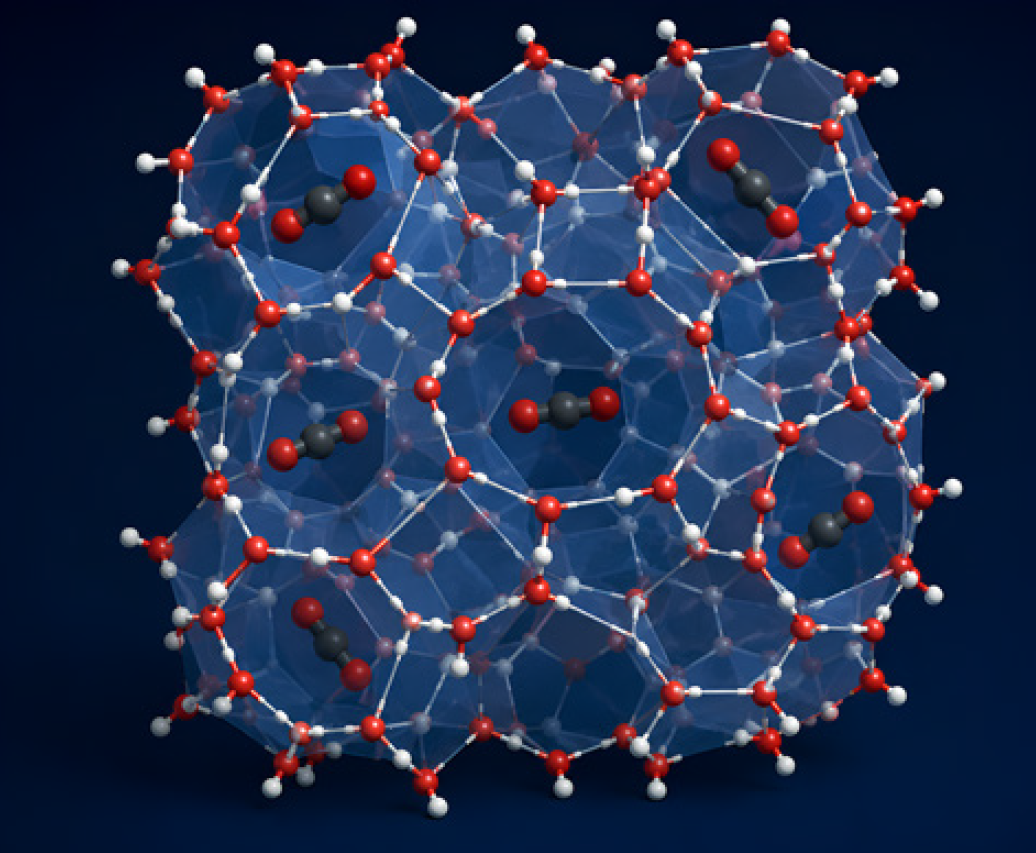
Amidst the steady rise in global energy consumption and the gradual depletion of oil and natural gas reserves, the development of alternative energy sources and the implementation of resource-saving technologies are becoming increasingly important.[1-10]In this context, gas hydrate technologies are of significant interest, as they are viewed as a promising component of environmentally oriented energy and resource management. Research into gas hydrate technologies is being conducted in areas such as gas transportation and storage, CO2 capture and sequestration, water desalination and the extraction of critical elements (including lithium) from various natural environments.[1-10]
Natural gas hydrate deposits are widely distributed across both the World Ocean and onshore permafrost zones.[11-14] A promising approach to their commercial development is the method of replacing methane with carbon dioxide, wherein the gas hydrate’s clathrate structure largely retains its stability during the partial or complete displacement of CH4 molecules by CO2 molecules.[11-14] This approach enables the simultaneous extraction of methane and the long-term storage of carbon dioxide in the form of a hydrate phase. Additionally, gas hydrate processes are considered a potentially effective tool for extracting lithium from seawater as well as from formation fluids in oil and gas fields.
To develop and optimize gas hydrate technologies, it is crucial to study the physicochemical, and above all, thermodynamic, properties of gas hydrates in detail. Carbon dioxide hydrate (CO2·nH2O) is a key model system of interest for applications such as CO2 capture, gas storage and the fundamental analysis of clathrate structure stability.[11-15] Thermodynamic analysis makes it possible to assess phase stability, determine optimal conditions for hydrate formation and decomposition, ascertain the direction of processes and provide a thermodynamic basis for technological schemes.
Carbon dioxide hydrates in water–CO2 binary systems have been obtained using various methods in a number of studies.[11-15] Both calorimetric methods and techniques based on measuring the equilibrium vapor or gas pressure over the hydrate phase[16-20] are widely used to investigate the thermodynamic properties of gas hydrates. According to the literature,[21] CO2 hydrate has been studied in LiCl solutions; however, there is no information regarding the ‘CO2 hydrate–1% aqueous LiOH solution’ system or the determination of its thermodynamic characteristics. Investigating this system is of interest for understanding the influence of alkali cations and hydroxide anions on the stability of the clathrate structure and the thermal effect of hydrate decomposition.
In this work, carbon dioxide hydrate was synthesized in the CO2–1% aqueous LiOH solution system, and its enthalpy of decomposition was determined using solution calorimetry. The obtained data are comparable to literature values for CO2 hydrates formed from pure water.
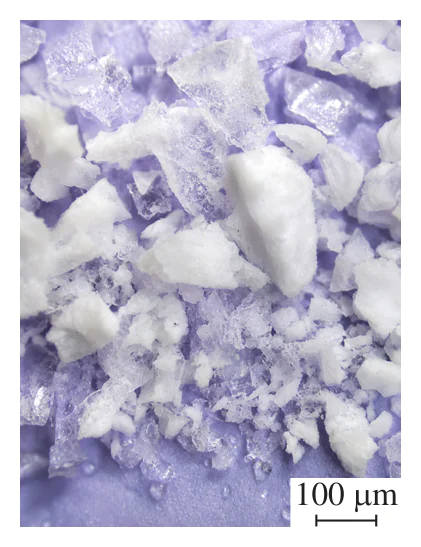
Carbon dioxide hydrate was synthesized from 1% solution of lithium hydroxide and CO2 under pressure.† The synthesis procedure was described in detail in published papers.[21-23] The appearance of carbon dioxide hydrate is shown in Figure 1.
† Synthesis of carbon dioxide hydrate. The setup included a 140 cm3 reactor constructed as a stainless steel cylinder and equipped with valves for gas inlet and outlet. Carbon dioxide was supplied from a 40-liter gas cylinder. An aqueous 1% lithium hydroxide (LiOH) solution was prepared using distilled water and high-purity lithium hydroxide monohydrate (LiOH·H2O). Twenty milliliters of the 1% LiOH solution were placed into the reactor’s working chamber. The chamber was sealed and purged with carbon dioxide. The reactor was then cooled to the target temperature, after which carbon dioxide was introduced until a pressure of 3 MPa was reached. The synthesis was conducted at 273 K for 168 h. Completion of the reaction was determined by the establishment of an equilibrium pressure. Upon completion of the synthesis, the water remaining after gas hydrate formation was removed, and the resulting hydrate was held under pressure for 24 h for stabilization. The chamber was then opened, and the resulting hydrate was placed in a Dewar flask containing liquid nitrogen for storage and subsequent analysis. The lithium content of the initial solution was determined by atomic emission spectrometry with flame atomization. The resulting hydrate was characterized using gravimetry (to analyze carbon dioxide content) and flame photometry (to determine lithium ion content).
Solution calorimetry was used to determine the enthalpy of decomposition of carbon dioxide hydrate. During the experiment, the hydrate sample, which had been stored in a liquid-nitrogen Dewar flask following synthesis, was rapidly removed from the liquid nitrogen, placed in an open Teflon cuvette, weighed and promptly transferred directly into the solution calorimeter. The calorimeter recorded the temperature change, and the enthalpy of decomposition was calculated using calibration data. The mass of the carbon dioxide hydrate samples used in the calorimetric experiments ranged from 2 to 4 g. The hydrate sample was stored in liquid nitrogen until the calorimetric measurements were performed.
A detailed description of the calorimeter and the experimental procedure were presented in published works.[18, 19] The calorimeter consisted of a Dewar flask placed inside a brass cup, which was sealed with a brass lid. Housed within the calorimeter were a thermometer, a heater and a device for breaking and rinsing ampoules. The thermometer was connected to a computer via an interface. A program written in the MATLAB environment automatically processed the experimental results.
To verify the correct operation of the calorimeter, the dissolution of a standard substance, potassium chloride (KCl), was carried out. The obtained value for the heat of dissolution of KCl (17.529 ± 0.009 kJ mol–1) was in good agreement with the value recommended in the literature.[20]
The carbon dioxide content of the hydrate was analyzed using the described method.[21] It was determined that CO2 content of the hydrate obtained from CO2 and a 1% lithium hydroxide solution was 23 wt%. The lithium ion content in the water† remaining after hydrate formation was 5.61 mg ml–1. The lithium ion content in the hydrate itself was 1.31 mg ml–1. Thus, using the hydrate technology, the lithium ion concentration in the residual water increased approximately fourfold compared to the lithium ion concentration in the hydrate. The initial solution contained approximately 2.8 mg ml–1 of lithium ions; this means that the lithium ion concentration in the residual water approximately doubled compared to the initial concentration.
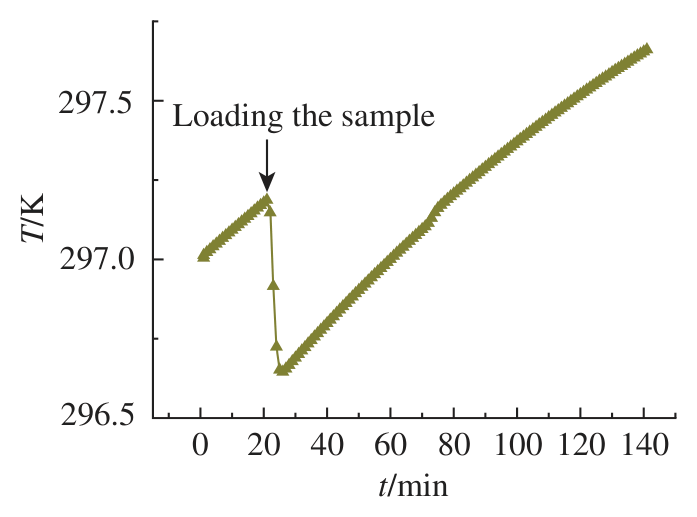
As shown in the graph illustrating the change in calorimeter temperature over time during the decomposition of carbon dioxide hydrate (Figure 2), the hydrate decomposed very rapidly, within 2–3 min. The enthalpy of decomposition for the carbon dioxide hydrate synthesized from CO2 and a 1% LiOH solution (calculated from the results of five replicate calorimetric experiments) was ΔdecHo = +342.7 J g–1,‡ with an uncertainty of 5%. According to the thermodynamic data reference source,[24] carbon dioxide hydrate synthesized from CO2 and water contains 28 wt% carbon dioxide and has a decomposition enthalpy of +425.3 J g–1. The carbon dioxide hydrate we obtained using a 1% LiOH solution contains 23 wt% CO2. The lower CO2 content in the hydrate synthesized with LiOH instead of pure water can be attributed to the fact that the presence of LiOH shifts the equilibrium, resulting in a reduced CO2 content in the hydrate.
‡ To calculate the enthalpy of gas hydrate decomposition, it was necessary to calibrate the calorimeter to determine its thermal equivalent, a value representing the ratio of the quantity of heat to the temperature change. Calorimeter calibration was performed after each carbon dioxide hydrate decomposition experiment. The calorimeter’s thermal equivalent was determined using the formula H = Qcal/ΔTcal, where Qcal is the quantity of heat released during calibration and ΔTcal is the temperature change during the calibration experiment. To supply the calibration heat, the calorimeter was equipped with a heater that generated Joule heat. The value of ΔTcal was calculated using the well-known Regnault–Pfaundler method for accounting for heat exchange, while the Joule heat Qcal was calculated using the formula Qcal = UIt, where U is voltage, I is current, and t is time. The enthalpy of carbon dioxide hydrate decomposition was calculated using the formula ΔdecH = (HΔThyd)/m, where ΔThyd is the temperature change during hydrate decomposition and m is the mass of the hydrate.
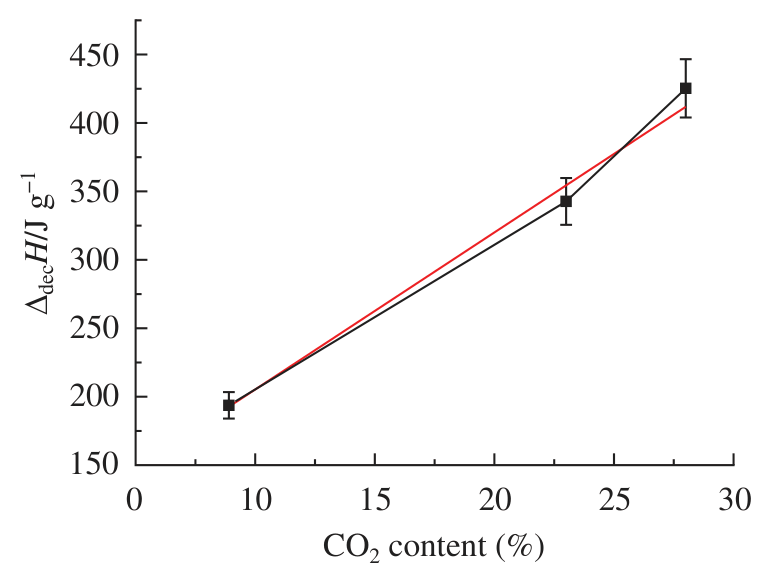
We previously measured the decomposition enthalpy of a carbon dioxide hydrate containing 8.9 wt% CO2 and prepared from CO2 and a 1% LiCl solution.[21] In that instance, the decomposition enthalpy was ΔdecHo = +193.7 J g–1, with a measurement uncertainty of 5%. Based on the results of the present study, reference[24] and findings from the previous publication,[21] a relationship between decomposition enthalpy and carbon dioxide content was identified (Figure 3). The correlation coefficient R2 for this relationship was 0.986. It was found that the decomposition enthalpy increases with the carbon dioxide content in the hydrate.
The phase equilibrium of the carbon dioxide clathrate hydrate was calculated theoretically,§[25, 26] and the effect of adding lithium hydroxide (LiOH) at a concentration of approximately 1 wt% on the ice (or water)–hydrate–gas equilibrium conditions was illustrated in Figure 4. The curve corresponding to pure water (blue circles, solid line) characterizes the equilibrium pressure of the CO2 hydrate phase at various temperatures. The addition of LiOH shifts the phase equilibrium line (red squares, dashed line) toward lower temperatures at the same pressure, reflecting the effect of hydrate temperature depression in the presence of an electrolyte.
§ Interactions between water molecules were described using the SPC/E potential with Lennard–Jones parameters σ = 3.166 Å and ε = 0.6507 kJ mol–1; the charges were qH = +0.4238|e| for hydrogen atoms and qO = –0.8476|e| for oxygen atoms.[27] In calculations involving lithium hydroxide, LiOH was represented explicitly as dissociated Li+ and OH– ions. Ion parameters were taken from the model employed by Carvajal–Ortiz and Svishchev.[27] For the Li+ ion, the values used were σ = 1.506 Å, ε = 0.690 kJ mol–1 and q = +1|e|. The hydroxide ion was represented by two interaction centers: for the O center within OH–, the parameters were σ = 3.233 Å, ε = 0.6320 kJ mol–1 and q = –1.3|e|; for the H center within OH–, they were σ = 2.083 Å, ε = = 0.2310 kJ mol–1 and q = +0.3|e|, yielding a total charge of –1|e| for the OH– ion. Lorentz–Berthelot mixing rules were applied to describe cross-species Lennard–Jones interactions, while long-range electrostatic interactions were accounted for using the Ewald method. The numbers of Li+ and OH– ions were selected to match the experimental LiOH concentration of approximately 1 wt%. Preliminary calculations, in which the effect of the electrolyte was accounted for solely via a correction for water activity, showed poorer agreement with the experimentally observed shift of the phase equilibrium curve compared to calculations that explicitly included the ions; therefore, explicit interaction potentials for Li+ and OH– ions were used in the final calculations. The interaction of CO2 molecules (guest molecules) with water was modeled using a Lennard–Jones potential with parameters σ = 4.000 Å and ε = 1.5798 kJ mol–1.[28]
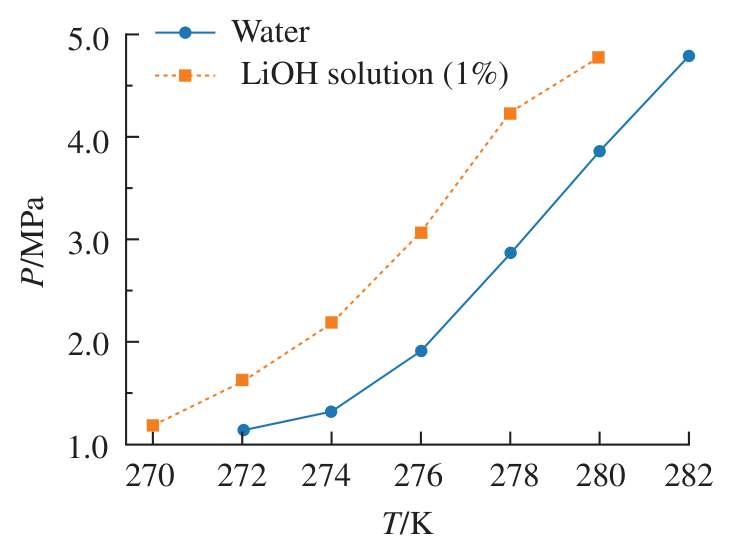
The obtained data show that at a LiOH concentration of approximately 1 wt%, the CO2 hydrate formation temperature decreases by about 1.5–2 K compared to pure water, and the magnitude of this shift varying as pressure decreases. In the present calculations, this electrolyte effect was reproduced by explicitly incorporating the interaction potentials of Li+ and OH– ions into the aqueous phase model. This approach accounts for changes in the local hydration environment and intermolecular interactions resulting from the presence of the dissolved electrolyte. A trial calculation based solely on a water activity correction showed poorer agreement with the experimentally observed phase equilibrium shift and was therefore not used to construct the final equilibrium curve.
Thus, carbon dioxide hydrate was obtained from CO2 and a 1% aqueous lithium hydroxide solution under high pressure. The decomposition enthalpy of the hydrate was determined using solution calorimetry. A relationship was established between the decomposition enthalpy and the carbon dioxide content of the hydrate: the decomposition enthalpy increased as the carbon dioxide content rose. Theoretical modeling of the phase equilibrium of carbon dioxide clathrate hydrate was performed, demonstrating the effect of adding lithium hydroxide (LiOH) at a concentration of approximately 1 wt% on the equilibrium conditions in the ‘ice (or water)–hydrate–gas’ system.
This work was supported by the Russian Science Foundation (grant no. 25-19-00816).
Funders
References