
Abstract
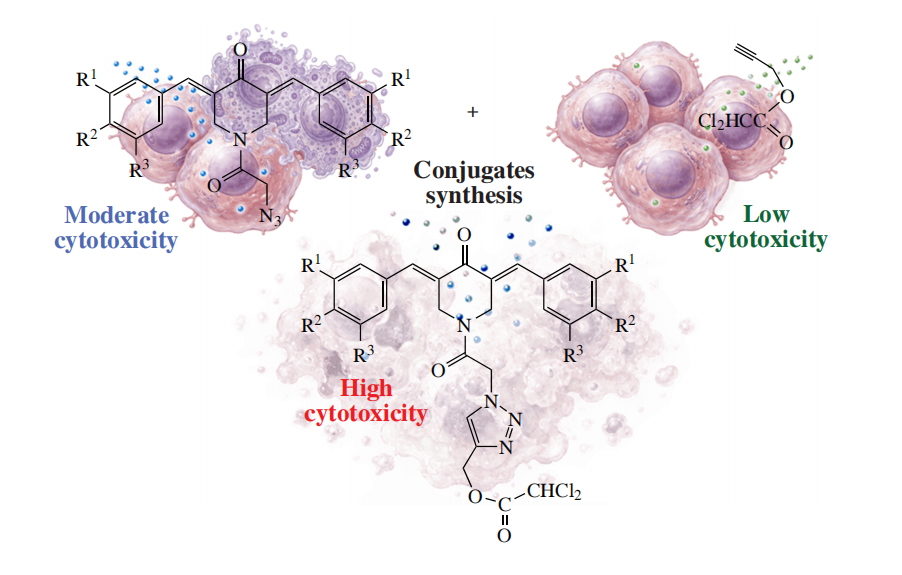
Based on 3,5-bis(arylidene)piperidin-4-ones in scaffold-oriented synthesis, new (1-{2-[(3,5-bis((E)-benzylidene)-4-oxopiperidin-1-yl]-2-oxoethyl}-1H-1,2,3-triazol-4-yl)methyl 2,2-dichloroacetates were prepared using ‘click’ chemistry as the key step. The compounds obtained possessed pronounced cytotoxic activity.
Keywords
Communication
3,5-Bis(arylidene)piperidin-4-ones belong to a large and well-studied group of monocarbonyl analogs of curcumin (MACs)[1] and have proven to be versatile biologically active scaffolds with diverse pharmacological profiles, including antitumor, anti-inflammatory, and antioxidant activities.[2, 3] The ability to vary the substituents on the piperidone cycle and the easy chemical modification of 3,5-bis(arylidene)piperidin-4-ones at the nitrogen atom provide opportunities for introducing additional functional groups, making these compounds convenient precursors for the creation of bifunctional molecules. The formation of bipharmacophoric hybrids allows for the combination of two independent fragments with different mechanisms of action in a single molecule, which can lead to synergistic effects and increased target biological activity.
Several studies have shown that chemical modifications of the nitrogen atom in the piperidone cycle led to the production of bipharmacophoric conjugates based on 3,5-bis(arylidene)piperidin-4-ones with pronounced antitumor and antioxidant activity.[4, 5] Such hybrids combine the antimitotic and antiproliferative activity of the MAC skeleton with additional mechanisms provided by the attached fragments (e.g., modulators of mitochondrial functions or inducers of oxidative stress), which increases the likelihood of cell-specific cytotoxicity and reduces side effects.
One of the promising pharmacophores may be dichloroacetic acid (DCA), an available low-molecular-weight compound active against various tumor cell lines.[6] Being an effective inhibitor of pyruvate dehydrogenase, DCA and its derivatives by suppressing glycolysis, can inhibit tumor growth without toxic effects on normal cells.[7] Platinum complexes with DCA act as DNA alkylating agents[8] and lead to mitochondrial degradation, which causes apoptosis in cancer cells that are resistant to classical selective antitumor drugs.[9] The most significant DCA effects were observed on changes in mitochondrial membrane potential and the production of reactive oxygen species (ROS).[10] It has been shown that DCA with doxorubicin, when combined with a small amount of DSPE-PEG2000, forms nanoparticles that are significantly more effective than free doxorubicin.[11]
This work is a continuation of our research[12] in the field of ‘click’ chemistry and is devoted to the synthesis of new hybrid conjugates of 3,5-bis(arylidene)piperidin-4-one and propargyl dichloroacetate, with the aim of obtaining highly cytotoxic agents for the further development of effective antitumor drugs based on them.
Starting from (3E,5E)-3,5-bis(arylidene)piperidin-4-ones 1a–g, the N-(2-azidoacetyl) derivatives 2a–g were synthesized as described previously (Scheme 1).[13] The conjugation of propargyl dichloroacetate with azides 2a–g toward target 1,2,3-triazoles 3a–g was carried out under [2 + 3]-cycloaddition conditions using CuBr as a catalyst to provide 41–95% yields.
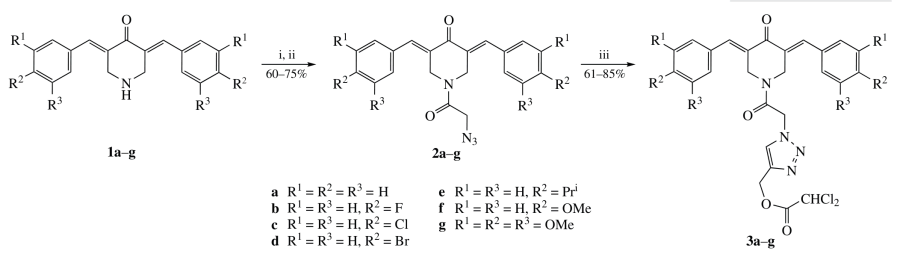
The structure of compounds 3a–g was confirmed by 1H and 13C NMR spectroscopy and high-resolution mass spectrometry. Analysis of the 1H and 13C NMR spectral data shows that compounds 2a–g and 3a–g exist as two rotamers, which is in agreement with reported data.[14] In the spectra, the signals for the NCH2 groups of the piperidin-4-one ring as well as for methine exocyclic groups are doubled. Moreover, the 19F NMR spectra of compounds 2b and 3b contain two signals each.
In the context of biological studies aimed at assessing the cytotoxic potential of new piperidin-4-one conjugates with dichloroacetic acid, experiments were conducted to evaluate the effect of the parent azides 2a–g and their triazole conjugates with dichloroacetic acid 3a–g. The assessment was performed upon 72-hour incubation on the survival of tumor cells of various origins: T24 (human bladder carcinoma cell line), A431 (human epidermal skin carcinoma), and T98G (human glioblastoma). The IC50 values are presented in Table 1.
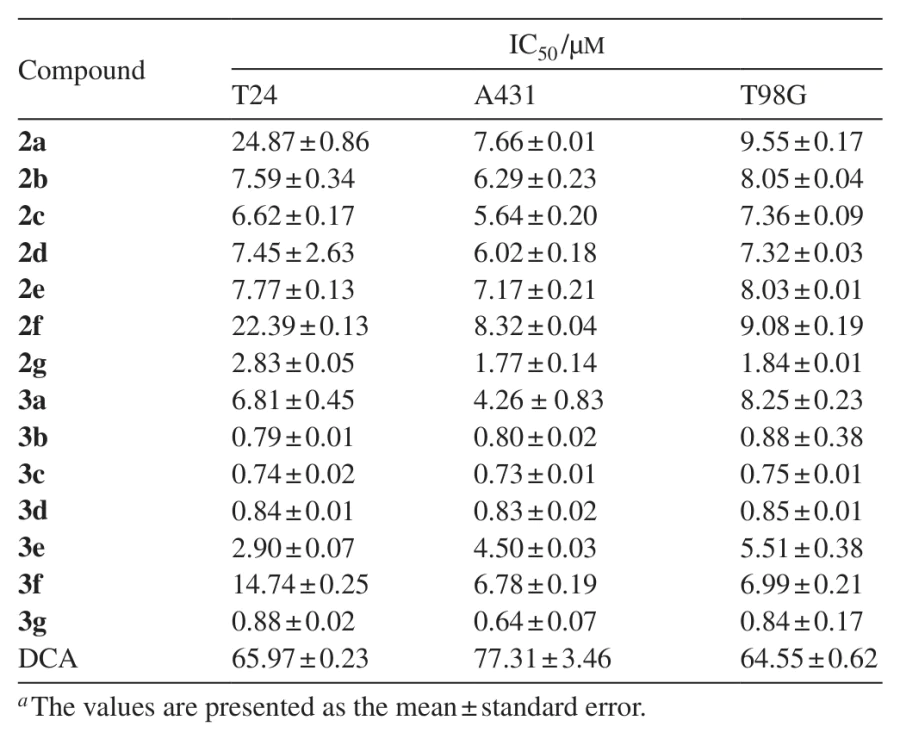
In total, the conjugation significantly enhanced the cytotoxic activity compared to the corresponding parent compounds: the most pronounced increase was observed for compounds containing halogen substituents (3b–d) and three methoxy groups (3g) in the benzene ring (IC50 in all three lines were in the submicromolar range of 0.64–0.90 µM). The corresponding parent azides 2b–d,g demonstrated IC50 predominantly in the range of ~1.77–8.32 µM. This fact indicates a significant increase in cytotoxicity after the attachment of the dichloroacetyl moiety. Compounds 3a,e showed a moderate improvement in potency compared to the parent compounds: 3a decreased the IC50 on all lines (T24: 6.81 vs. 24.87 µM for 2a; A431: 4.26 vs. 7.66 µM; T98G: 8.25 vs. 9.55 µM), while 3e had intermediate values (IC50 2.90–5.51 µM), improved relative to 2e, but inferior to the most active conjugates. Conjugate 3f retained relatively low activity, especially on the T24 line (14.74 µM), and only slightly improved the values on A431 and T98G (6.78–6.99 µM vs. 8.32–9.08 µM for 2f), indicating less sensitivity to modification with this type of substituent.
We also examined the effect of the individual piperidone fragment lacking dichloroacetyl moiety on cell survival to understand its contribution to cytotoxicity. Since no significant toxic effect was observed (IC50 > 60 µM), we can conclude that the complete bipharmacophoric structure, including both the piperidone fragment and the attached dichloroacetic acid group, plays a significant role in the conjugates’ demonstrated efficacy.
To summarize, the most promising cytotoxic candidates for further research are conjugates 3b–d and 3g with the greatest effect compared to the parent 3,5-bis(arylidene)piperidin-4-ones.
This work was financially supported by The Russian Science Foundation (grant no. 25-23-00810). The authors would like to aknowledge the Center for Molecular Composition Studies of INEOS RAS.
Funders
References