Abstract
Six new water-soluble hexacationic pyridinium receptors for binding pertechnetate anion TcO4– were obtained in high yield. Their high susceptibility to the separation of pertechnetate ions in spent nuclear fuel was demonstrated. The extraction feasibility was also mimicked by the use of homologous non-radioactive perrhenate anion ReO4–.
Keywords
Communication
Nuclear power’s share of the global energy balance is steadily growing year after year. At the same time, the amount of spent nuclear fuel (SNF), whose reprocessing generates highly radioactive waste, is increasing.[1] In accordance with the strategy of closed nuclear fuel cycle in spent nuclear fuel reprocessing,[2] long-lived radionuclides are separated from higly radioactive waste for return to the nuclear fuel cycle, transmutation in fast neutron reactors into short-lived or stable nuclides, or long-term disposal in special matrices. One of the main decay products of 235U in nuclear reactors, the long-lived β-emitter 99Tc (t1/2 = 2.13 × 10⁵ years), is stabilized during reprocessing (PUREX) as the pertechnetate anion TcO4 –. It can be co-extracted with uranium and plutonium during the subsequent reprocessing stages and partially converted into an organic phase.[3, 4]In this case, it is present in the entire chain of subsequent technological processes, which essentially complicates the technology and greatly increases its cost.[4-6] Thus, the full extraction of TcO4 from nitric acid-containing spent nuclear fuel wastes is a task of primary importance, for which an optimal solution has not yet been found, despite a large amount of research and development in this area.[2, 6-14]
Studying the possibility of effective binding of the pertechnetate anion, we have synthesized and investigated a series of water-soluble dicationic receptors of symmetrical structure, in which the pyridinium centers were linked by methylene bridges of varying lengths.[15] It was found that the use of bis-pyridinium salts reduced extraction of pertechnetate into the organic phase by a factor of 3–5. However, those ligands were found to be not efficient enough to completely retain it in the aqueous phase.
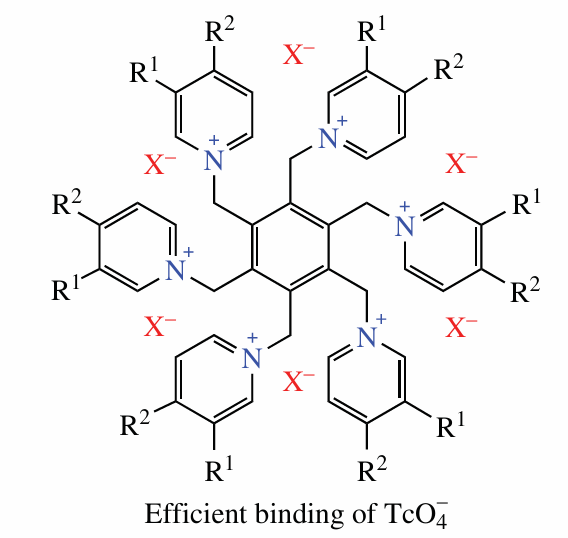
Hoping to improve the pertechnetate extraction suppression coefficient, we decided to examine salts of similar type containing six pyridinium cationic centers attached to the benzene ring via methylene groups. Previously, similar receptors containing three, four, and six methylimidazolium fragments[16, 17] were found to have a high affinity for TcO4 –, but due to the insufficient stability of imidazole in a nitric acid medium they were not sufficiently stable for SNF reprocessing. Pyridine derivatives are significantly more stable under these conditions.
Herein, the synthesis of the target compounds was carried out in accordance with Scheme 1. We prepared hexakis(bromomethyl)benzene in 88% yield by bromination of hexamethylbenzene.[18] Next, we found that reactions of 1 with various pyridines occurred under heating in DMF at 80 °C. This allowed us to efficiently obtain pyridinium receptors 2–4 in 95–99% yields. High solubility is very important for such receptors. The compounds contained bromide as a counter-anion and were white powders readily soluble in water, methanol, and ethanol, but insoluble in isopropanol, acetonitrile, acetone, ethyl acetate, dichloromethane, chloroform, tetrachloromethane, hexane, benzene, and toluene.
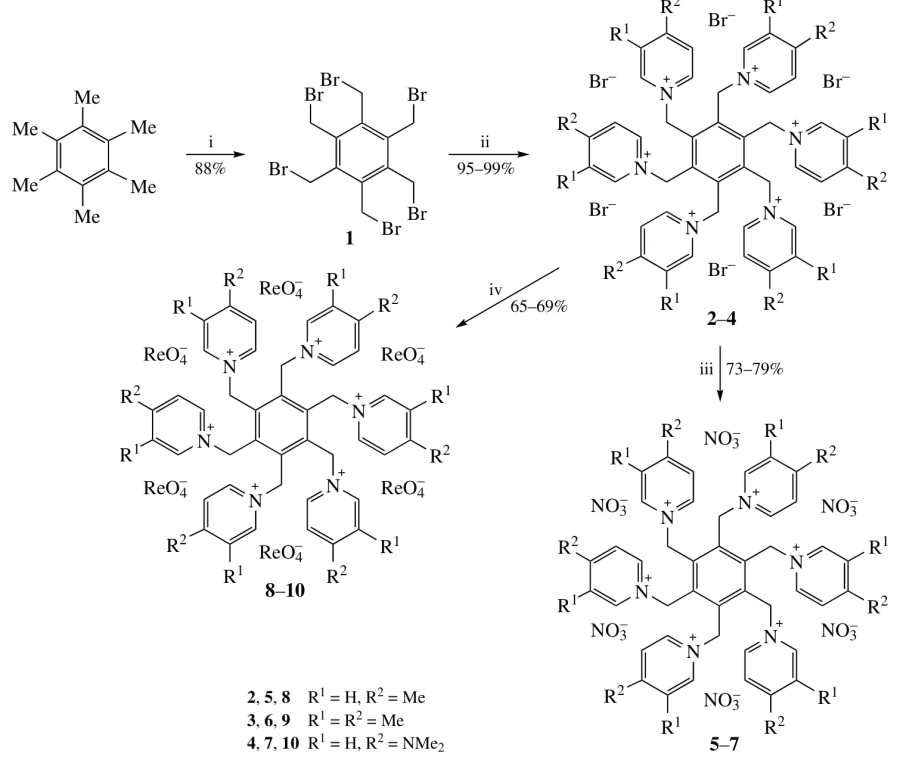
From a technological standpoint, bromides cannot be used in SNF reprocessing since oxidation of the Br– anion into molecular bromine is possible under such conditions. Therefore, their conversion to nitrates was performed. Ion exchange with silver nitrate leads to complexones 5–7 in yields of 73–79%. Their structures were established using 1H, 13C NMR, and high-resolution mass spectrometry. We also exchanged bromide anions for a non-radioactive analog of pertechnetate, the perrhenate anion ReO4 –. The interaction of receptors 2–4 with sodium perrhenate in water at room temperature (see Scheme 1) produced precipitates of complexones 8–10. Unfortunately, our attempts to obtain crystals suitable for X-ray study were not successful.
The properties of water-soluble ligands 5–7 as masking agents were studied in a tributyl phosphate–kerosene system. For all experiments, the concentrations of uranium(VI) and nitric acid in an aqueous phase were 1 and 3 M, respectively. Suppression experiments for pertechnetate anion extraction for ligand 5 were performed at a concentration of 0.4 M, since the complex composition of the solutions within the PUREX process required the most effective suppression of technetium extraction. The extraction suppression coefficient under these conditions was 4.7, and the pertechnetate distribution coefficient was 0.06. These data demonstrated high potential of cationic receptors based on pyridinium fragments for the technology of separating pertechnetate ions in spent nuclear fuel.
The research was supported by The Russian Science Foundation (grant no. 25-23-00050).
Funders
References