
Abstract
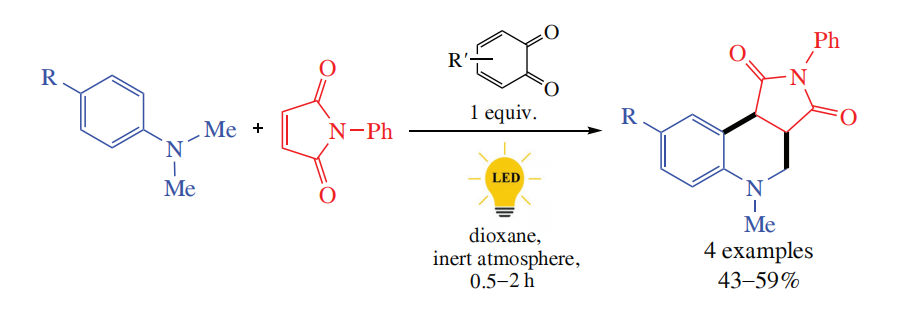
The photoinduced Povarov-type reaction of N,N-dimethylanilines and N-phenylmaleimide utilizing stoichiometric amounts of o-quinones under irradiation with low-energy yellow light afforded tetrahydroquinoline derivatives comprising pyrrolo[3,4-c]quinoline core. 4,6-Di-tert-butyl-3-(3,5-dimethylpyrazol-1-ylmethyl)-o-benzoquinone was found to be an optimal oxidant in deaerated dioxane for obtaining the desired products in 43--59% yields.
Keywords
Communication
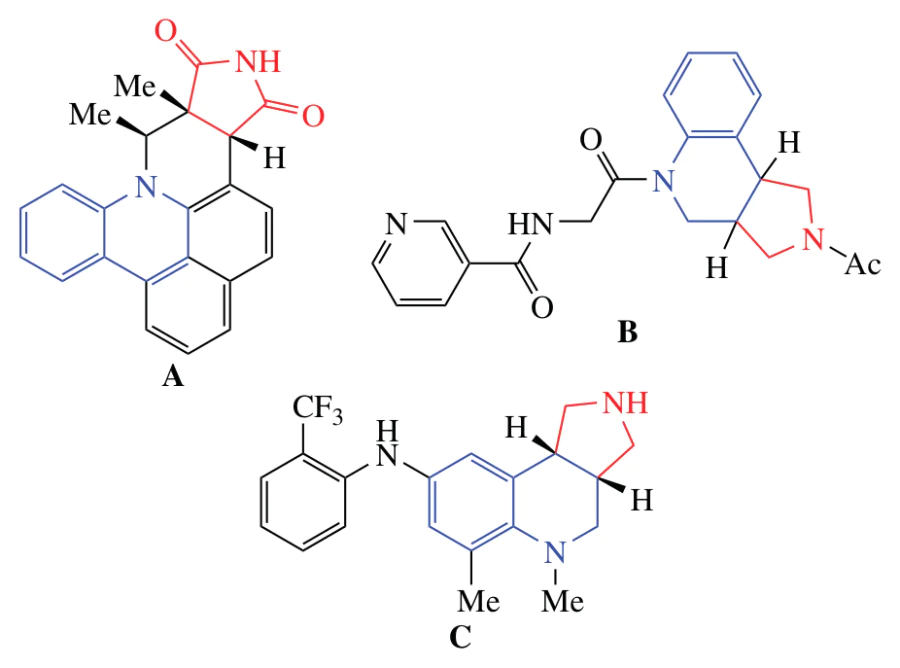
Medicinal and natural compounds possessing important pharmacological and biological properties frequently have high molecular complexity and require a comprehensive synthetic approaches for their preparation. Radical cyclization is one of the methods for constructing polycyclic frameworks.[1] In particular, this approach is applied for synthesis of (tetrahydro)-quinoline and maleimide/pyrrolidine derivatives A–C which exhibit a wide range of biological activity.[2-6]
Recently, numerous methods for their preparation and modification have been developed.[7, 8] Photooxidation of tertiary amines[9] in the presence of maleimides for obtaining annulated pyrrole tetrahydroquinoline derivatives which can formally be considered as the Povarov reaction products takes a special place. Noble metal complexes,[10] covalent organic frameworks,[11, 12] and various organic dyes[13, 14] have been previously used as photooxidants in such reactions, LED lamps with a wavelength range of incident radiation from 460 to 480 nm having been employed as a light source.
A current trend in photochemistry is the shift from high-energy blue light to yellow and red light.[15-17] In this way, the range of substrates (including those absorbing in the visible region) involved in photochemical processes can be expanded, and the selectivity of photoinduced processes can be improved.
Quinones are among the compounds that are photosensitive in almost the entire visible range and are wildly used as photoactive species.[18, 19] In the presence of tertiary amines, they undergo photoreduction with the generation of aminomethyl radicals capable of initiating radical polymerization of oligo-ether (meth)acrylates.[20] The postulated intermediates of the photoreduction of o-quinones are unstable amine-containing phenol ethers and the resulting products are catechols.[21] The initiating efficiency of these systems substantially depends on the structure of the reaction substrates. It has been shown that trisubstituted o-quinones possessed the most effective initiating properties, allowing for efficient polymerization of ultra-thick layers of the composition even in the presence of additives strongly absorbing in the visible range.[22, 23]
Despite the fact that the photoreduction of o-quinones in the presence of tertiary amines has been known for more than 40 years,[24] this process has not been employed for the synthesis of complex organic substrates based on trisubstituted amines. In this work, we present the possibility of using o-quinones as photooxidants of N,N-disubstituted anilines, not for initiating radical polymerization but for the photochemical version of the Povarov reaction with N-phenylmaleimide under irradiation with low-energy yellow light to afford tetrahydroquinoline derivatives.
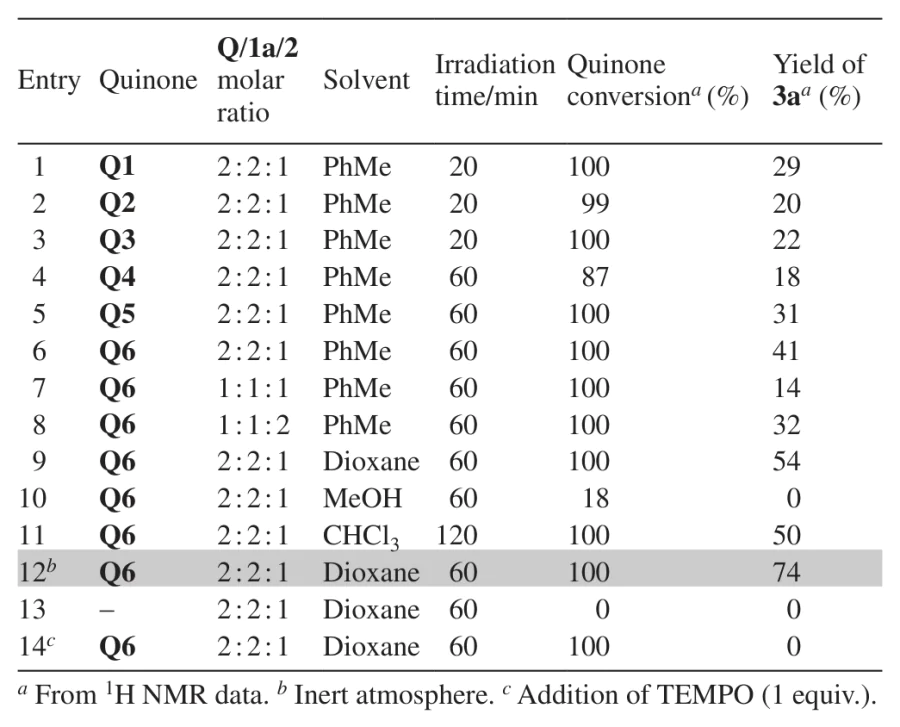
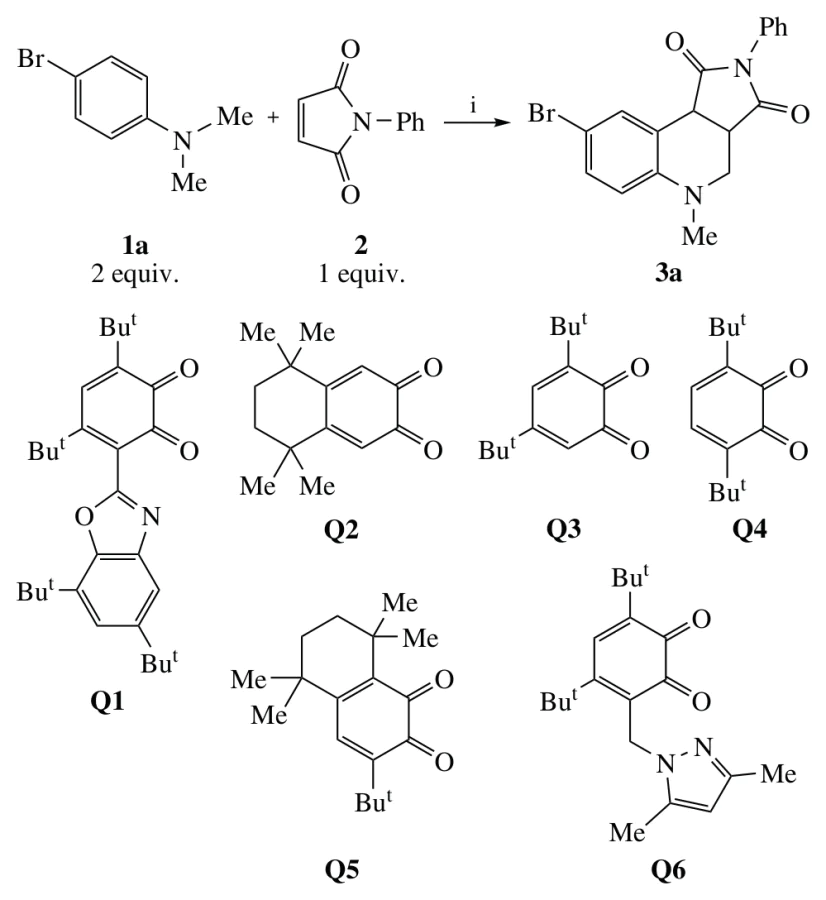
At the first stage, optimization of the reaction conditions was carried out using various o-quinones Q1,[25], Q2,[26] Q3,[27] Q4,[28] Q5,[29] and Q6.[30] The reaction was conducted in toluene, using 4-bromo-N,N-dimethylaniline 1a and N-phenylmaleimide 2 as model compounds in a 2 : 1 molar ratio (Scheme 1) and equimolar (to the amine) amounts of o-quinone. A yellow LED with an emission maximum at 600 nm was applied as the radiation source. The results of the optimization are presented in Table 1.
It was shown that in the dark, o-quinones did not react with the amine in solution for 12 h. It is known that under irradiation with yellow light, the o-benzoquinone/amine system undergoes photoreduction with the formation of phenol ethers and catechols as final products. The formation of tetrahydroquinoline was observed upon irradiation of the reaction mixture containing N-phenylmaleimide, which is capable of trapping the generated aminomethyl radical. As the reaction proceeded (1H NMR monitoring), a decrease in the intensity of the characteristic signals for the o-quinone (e.g., for Q6 at 6.85 ppm in C6D6) and maleimide (at 5.73 ppm in C6D6) was observed, while the new signals at 12 ppm characteristic for catechol and double doublets in the regions 3.06–3.14 and 3.14–3.28 ppm corresponding to the methylene group of tetrahydroquinoline appeared in the spectrum. The product yield was estimated based on maleimide conversion.
Among the various photooxidants (see Table 1, entries 1–6), compound Q6 exhibited the highest efficiency, while disubstituted o-quinones Q2–Q4 provided lower yields of the desired product 3a compared to trisubstituted Q1, Q5, Q6. Variation of the initial reagent ratio (entries 7, 8) showed that the system with a twofold excess of amine and photooxidant was the most efficient one. Further optimization of the solvent raised the yield of 3a from 41 to 54% upon replacing toluene (entry 6) with dioxane (entry 9). To evaluate the effect of atmospheric oxygen on the product yield, the reaction was performed under an inert atmosphere (entry 12). In this case, a significant growth in product yield up to 74% was observed.
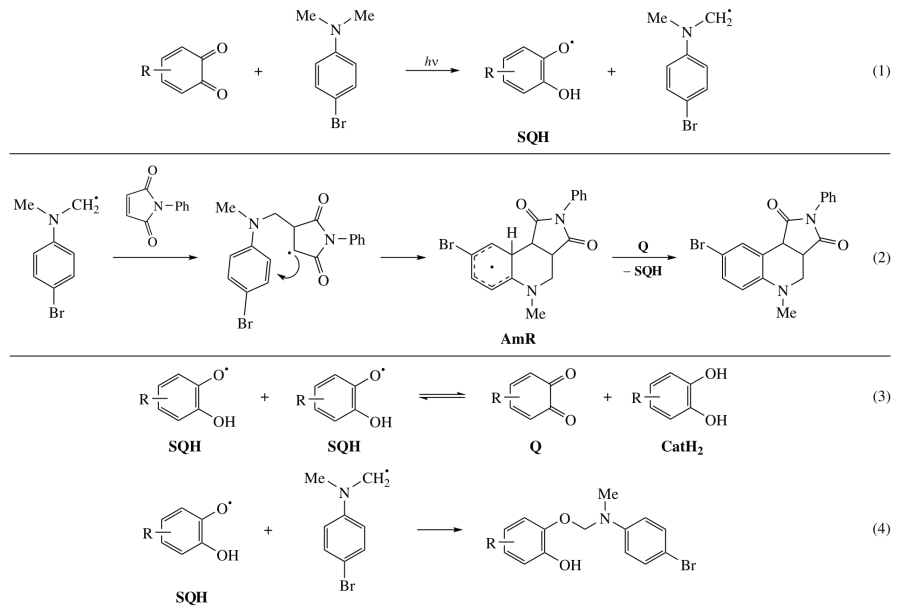
To clarify the mechanism, control experiments were carried out (see Table 1, entries 13, 14). In the absence of either o-quinone or irradiation, and in the presence of a radical scavenger, 2,2,6,6-tetramethylpiperidin-1-yl 1-oxyl (TEMPO, 1 equiv.), no reaction products were detected. The observed suppression of the reaction by TEMPO is consistent with a radical pathway. Based on the results of the control experiments, the mechanism for the transformation was proposed (Scheme 2), which may be divided into four steps. First, photoreduction of o-quinone occurs [reaction (1)], involving hydrogen atom transfer and formation of semiquinone (SQH) and aminomethyl radicals. Next, the aminomethyl radical is trapped by N-phenyl-maleimide 2 with the formation of two new C–C bonds. The resulting radical AmR is oxidized by another molecule of o-quinone to give the product and another equivalent of SQH [reaction (2)]. The SQH radicals accumulating in the system undergo disproportionation[31] to afford catechol (CatH2) as the final product of photoreduction and partially regenerate o-quinone (Q) [reaction (3)]. Additionally, SQH can be trapped by aminomethyl radicals, leading to phenol ether [reaction (4)] and resulting in deactivation of the radical species, which is allegedly responsible for the decrease in yields.
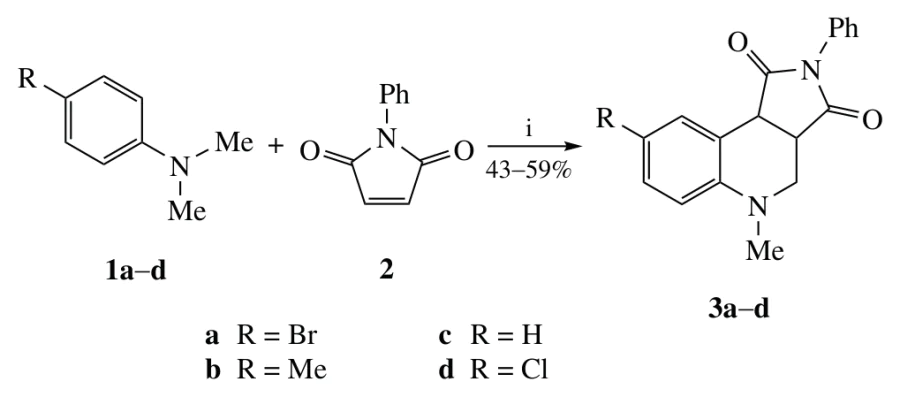
The reactions with several 4-substituted N,N-dimethyl-anilines 1a–d were carried out under the optimized conditions (Scheme 3). All obtained compounds 3a–d were characterized by a set of physicochemical methods.
In conclusion, we have demonstrated the use of o-quinones for the photochemical version of the Povarov reaction between N,N-dimethylaniline and N-phenylmaleimide under low-energy yellow light irradiation. The obtained tetrahydroquinoline derivatives, which contain a fused succinimide moiety, can be further fully reduced to the corresponding pyrrolidine derivatives, compounds known to exhibit a wide range of biological activity.[32] It is worth noting that the catechols formed in the photoreduction process can be oxidized back to o-quinones, which opens up a pathway to the regeneration of the photooxidant and, consequently, to the potential use of o-quinones as photoredox catalysts sensitive to visible-light irradiation.
The work was carried out within the framework of a state assignment using the equipment of the Center for collective use ‘Analytical Center of the IOMC RAS’.
References