
Abstract
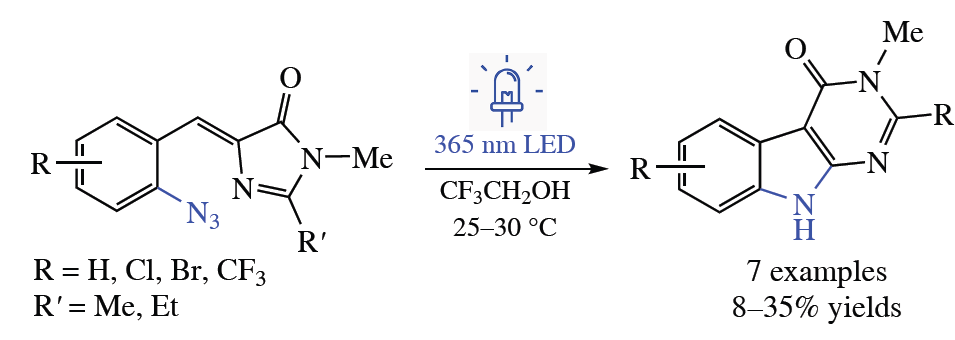
The photochemical transformation of 5-(2-azidobenzylidene)-imidazol-4-ones results in the formation of pyrimido[4,5-b]indol-4-ones via an intramolecular 1,2-carbonyl shift.
Keywords
Communication
The unique reactivity of aryl azides has found widespread application in organic chemistry.[1] The formation of nitrenes from aryl azides under light or heat is a powerful tool for the synthesis of anilines and N-heterocycles.[2-4] A key reaction pathway for in situ generated aryl nitrenes is the intramolecular insertion of a nitrogen atom into the aromatic ring.[5-7] Recently, this approach has been rapidly developed in the field of late-stage skeletal editing.[8-10]
Another promising reaction pathway of aryl azides involves the reaction of the generated nitrene with ortho-substituents. For ortho-vinyl azides, a cascade cyclization/1,2-shift leading to 2,3-disubstituted indoles is described (Scheme 1).[11] The process is characterized by high sensitivity to the nature of the migrating group X.[12] The order of migratory aptitude of X has been studied for a wide range of functional groups (see Scheme 1).[11, 13] However, to the best of our knowledge, studies on the 1,2-shift selectivity for nitrogen-containing functionalities (X or Y = NR2) have not been reported.
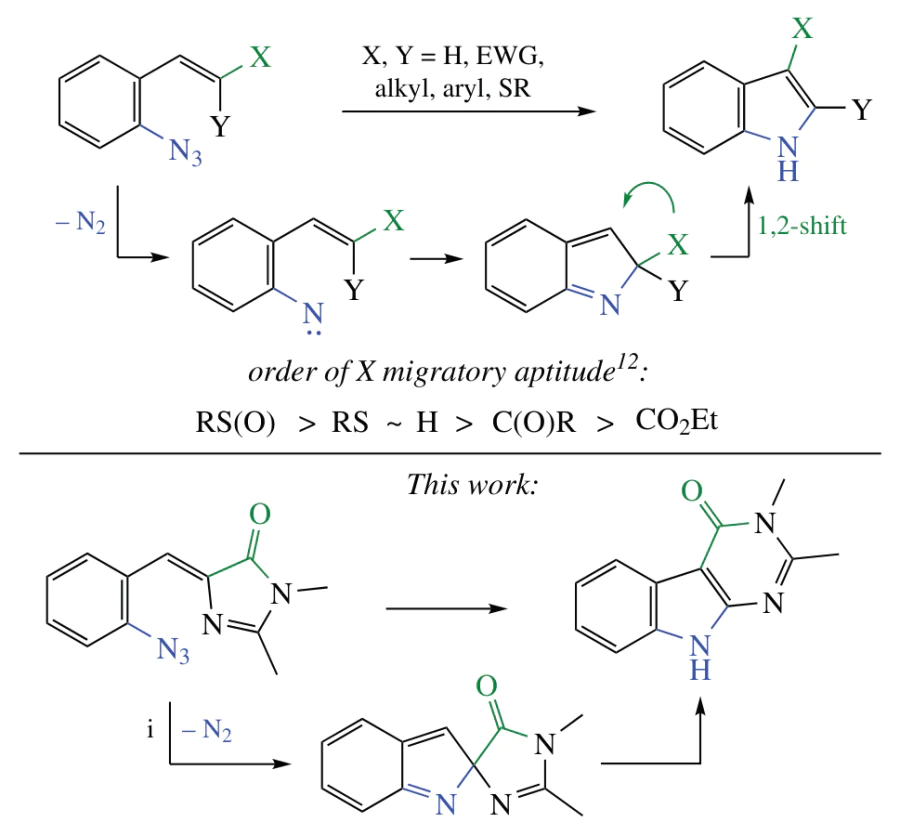
In this work, we investigated this phototransformation using (Z)-5-(2-azidobenzylidene)imidazol-4-ones (see Scheme 1), analogs of the green fluorescent protein chromophore.[14] These compounds are of fundamental interest due to the non-equivalent functional groups on the benzylidene moiety and the hypothetical possibility of forming different 1,2-carbonyl or 1,2-nitrogen shift products. Our study revealed that the reaction proceeds exclusively via the 1,2-carbonyl migration to afford pyrimido-[4,5-b]indol-4-ones.
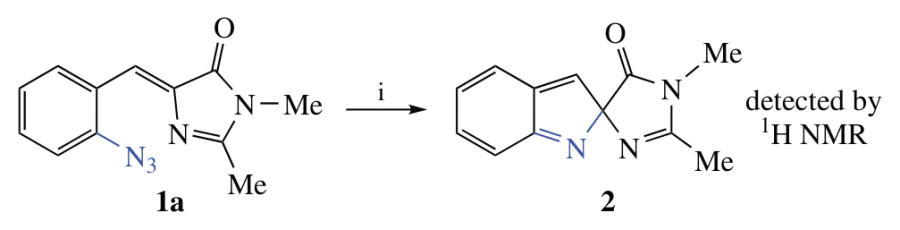
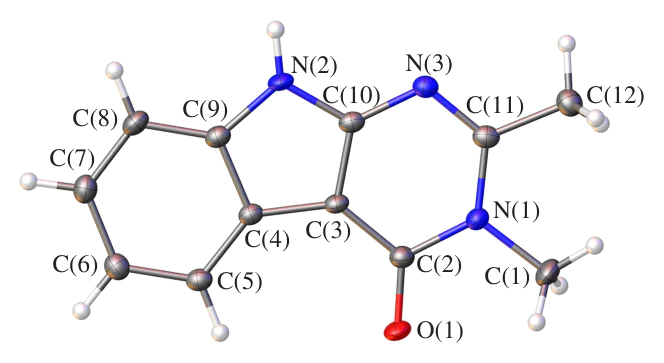
During photochemical study of ortho-substituted benzaldehydes and their derivatives,[14, 15] we observed the phototransformation of 5-(2-azidobenzylidene)imidazol-4-one 1a into a new compound 2 in DMSO-d6 (Scheme 2, see Online Supplementary Materials, part S2). Upon isolation, compound 2 was converted to product 3a along with a complex mixture. We hypothesized that compound 2 was an intermediate and that product 3a was formed via a 1,2-shift and restoration of aromaticity according to Scheme 1. Two-dimensional NMR spectroscopy alone could not unambiguously confirm the structure of product 3a; therefore, it was supported as 2,3-dimethyl-3,9-dihydro-4H-pyrimido[4,5-b]indol-4-one using X-ray diffraction analysis (Figure 1).†
Solvent optimization failed to significantly improve the product yield (see Online Supplementary Materials, part S3). Nevertheless, 2,2,2-trifluoroethanol proved to be the best reaction medium for the direct formation of product 3a from substrate 1a and was chosen for synthetic studies. Optimization of the irradiation time showed that complete consumption of substrate 1a and maximum accumulation of product 3a occurred within 2 h. Prolonged irradiation resulted in slow photodegradation of the product 3a.
The reaction scope was investigated using a series of derivatives 1a–g, which afforded products 3a–g in 8–35% yields (Scheme 3). The relatively low yields may be attributed to the substrate photoisomerization[16]and the high propensity of the reactive nitrene intermediates to undergo side reactions. The best yield (35%) was obtained for product 3f bearing a chlorine atom at the 6-position. This correlates with our previous results[17] and can presumably be rationalized by the ‘buttressing effect’ of the substituent.[18] Three additional substrates 1h–j underwent complete photodegradation without forming the target products. In particular, for substrate 1j, which bears a strongly electron-donating substituent, the reason may be a significant change in the nature of the excited state[19] and the accompanying off-target processes.
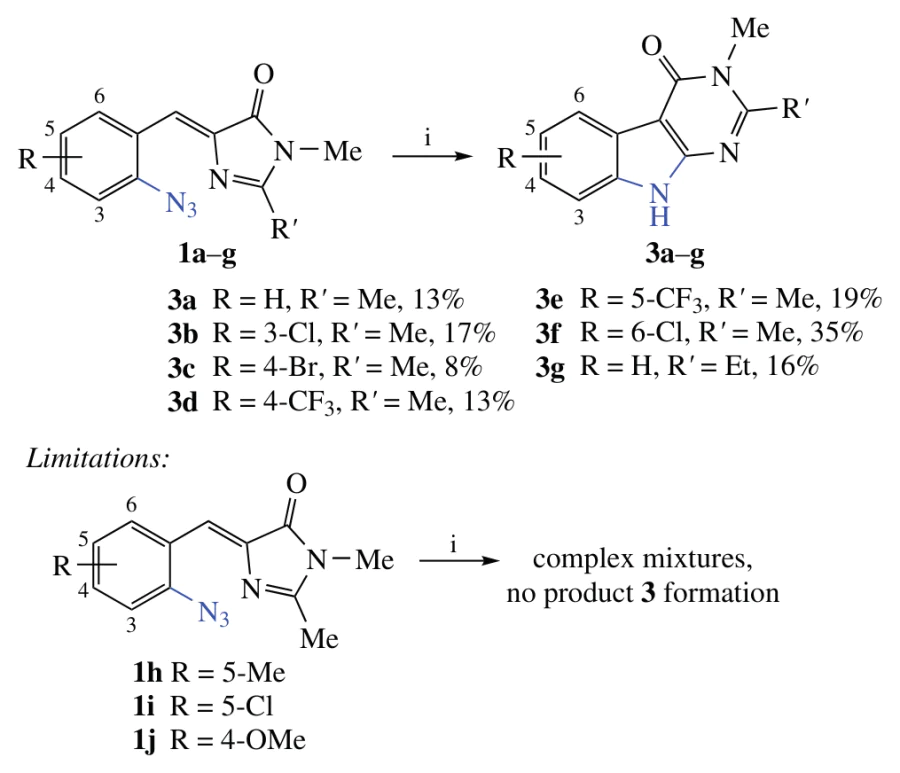
Thus, the phototransformation of 2-azidobenzylidene-imidazol-4-ones into the corresponding pyrimido[4,5-b]indol-4-ones has been accomplished. The reaction proceeds only via carbonyl 1,2-shift. The products represent a unique combination of biologically significant indole[20] and pyrimidine[21] moieties and, therefore, may be of interest for medicinal chemistry.[22] In particular, related structures are actively being studied as potential anticancer agents.[]
The authors gratefully acknowledge support from the Russian Science Foundation (grant no. 25-13-00043). A. A. Korlyukov and A. R. Romanenko are grateful to the Ministry of Science and Higher Education of the Russian Federation (contract no. 075-03-2026-024) for supporting of X-ray studies that were carried out at the Center for Collective Use of INEOS RAS.
Crystal data
† Crystal data for 3a. Crystals are monoclinic (space group C2/c), chemical composition C12H11N3O, a = 10.5212(13), b = 10.2505(13) and c = 18.844(2) Å, α = γ = 90°, β = 101.116(4)°, V = 1994.1(4) Å3, Z = 8, dcalc = 1.421 g cm–3, F(000) = 896, M = 213.24. Single crystal (clear yellow prism, dimensions 0.02 × 0.04 × 0.05 mm) was selected, and intensities of 13804 reflections were measured with Bruker SMART APEX II diffractometer at 120 K (ω and φ scans, sealed tube, λ[MoKα] = 0.71073 Å, μ = 0.095 mm–1, 2θmax = 61.116°). After merging of equivalents and absorption correction 3060 independent reflections (Rint = 0.0436) were used for the structure solution and refinement. The structure was solved by dual space method and refined against F2 in anisotropic approximation. The positions of hydrogen atoms were calculated geometrically and refined with constraints. Final R factors: R1 = 0.0453, [2179 reflections with I > σ(I )], wR2 = 0.1186 (all reflections), GOF = 1.100. The structure was solved with the ShelXT[23] program and refined with the ShelXL[24] program. Molecular graphics was drawn using OLEX2[25] program. Dataset for 3a was measured at the Center for Collective Use of INEOS RAS. CCDC 2563534 contains the supplementary crystallographic data for this paper. These data can be obtained free of charge from The Cambridge Crystallographic Data Centre via https://www.ccdc.cam.ac.uk.
Funders
References