
Abstract
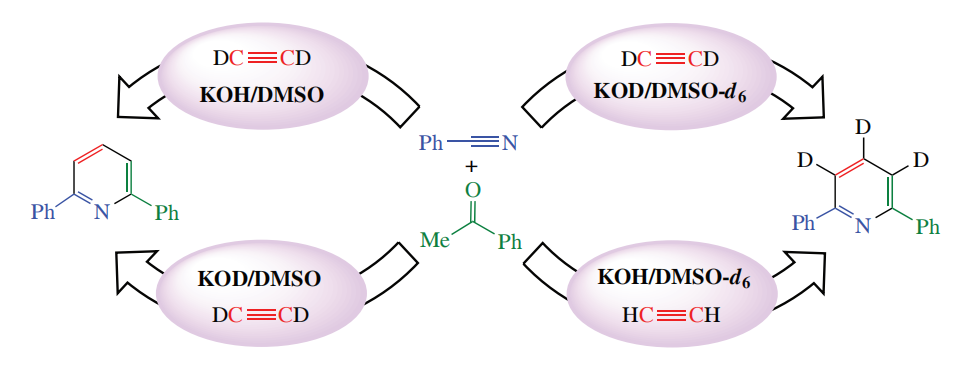
The distribution of deuterium during the self-organization of 2,6-diphenylpyridine from benzonitrile and acetophenone in the C2D2/KOD/DOBut/DMSO-d6 system evidences that the process is governed by dimsyl anions as actual superbases, representing the electron pair transfer between acetylenic carbanion, benzonitrile and acetophenone.
Keywords
Communication
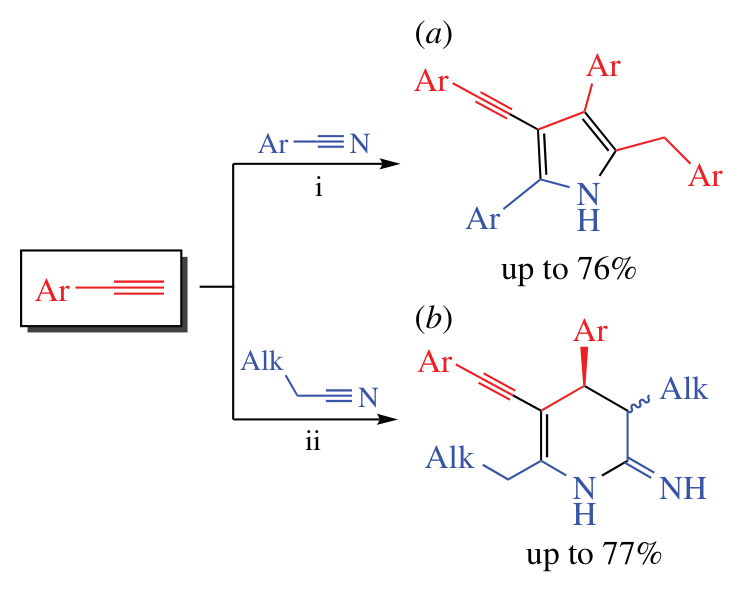
Over the last two decades, the self-organization of complex molecules triggered by acetylene in the superbasic media gained considerable attention.[1, 2] Acetylenes were found to unpredictably participate in multicomponent reactions involving simple and available starting compounds (ketones,[1] amines,[3] nitriles[4]) thereby affording the structures of higher complexity and diversity. Recent advances in this field include self-organization of tetrasubstituted pyrroles[5] and tetrasubstituted dihydropyridinimines[6] from nitriles and acetylenes in the KOBut/DMSO system, which demonstrated a strong response of the reaction to changes in the structure of a nitrile (Scheme 1). In the former case, an aromatic nitrile reacts with three molecules of arylacetylene to build up a substituted pyrrole ring (Scheme 1(a)).[5] In the latter case, two molecules of an aliphatic nitrile react with two molecules of arylacetylene to produce substituted dihydropyridinimines (Scheme 1(b)).[6]
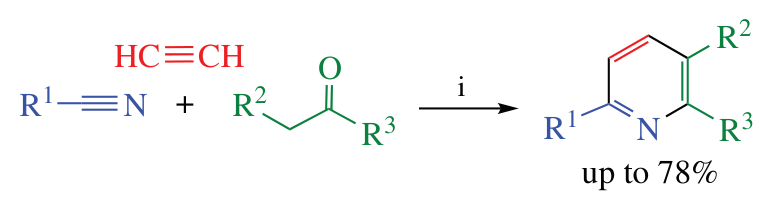
Recently we found that acetylene gas, various organic nitriles, and ketones produced a wide scope of di- and trisubstituted pyridines in good yields in the KOH/DMSO system (Scheme 2).[7]
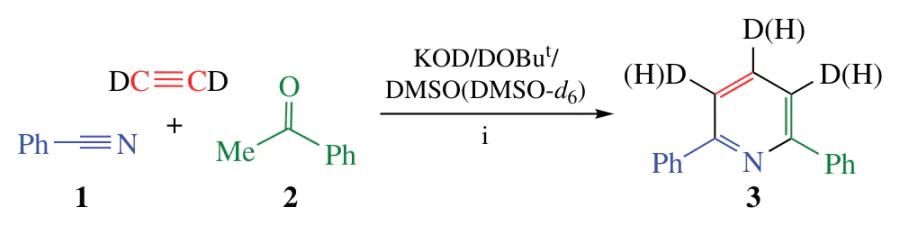
In this work, to gain a deeper insight into the mechanism of this condensation, we have studied the reaction of deuterioacetylene gas (C2D2) with benzonitrile 1 and acetophenone 2 in the KOD/DOBut/DMSO and KOD/DOBut/DMSO-d6 systems, giving 2,6-diphenylpyridine 3 and/or its deuterated analog, in order to track the deuterium distribution in the reaction components and thereby to retrieve additional information on their interactions during this process (Scheme 3).
These experiments aimed to shed light not only on the mechanistic details of the process but also on the specific role of DMSO as an indispensable component of the superbasic composition, in which the self-organization phenomenon is the most pronounced. A priori, a number of different reactions should occur in the multicomponent system acetylene/benzonitrile/acetophenone/KOH/DMSO. These include the addition of acetylenic carbanions to the carbonyl group (synthesis of propargyl alcohols and diols),[8] the addition of acetophenone as CH-acid to acetylene (synthesis of bicyclooctanes),[1] the addition of acetylenic anions to the nitrile function (synthesis of acetylenic imines),[9] the self-condensation of acetophenone, alkaline hydrolysis of benzonitrile to benzamide and benzoic acid, etc., as well as follow-up reactions of primary products. Surprisingly, among these expected parallel and crossover transformations, there is a dominant one, namely, the self-organization of 2,6-diphenylpyridine 3. Generally, this is typical for all other known cases of acetylene-induced condensations. Therefore, it was reasonable to use labeled acetylene (C2D2) to better understand its triggering and driving role in this and similar processes.
The first experiment was conducted with unlabeled reactants, except for the addition of D2O (1 equiv. relative to benzonitrile 1) to the reaction mixture under the previously established conditions (75 °C, 15 min, acetylene pressure ~3 atm).[7] Astonishingly, the isolated pyridine 3 (60% yield) contained no deuterium at all (1H NMR, MS). This may be explained by a limited exchange of the reactant protons with the external medium during the concerted cyclization or by a larger amount of protons (compared to deuterons from D2O) supplied by C2H2, CH3 group of acetophenone 2 and CH3 groups of DMSO. Another explanation of this fact is that D2O is bound by solid KOH, which is poorly soluble in DMSO.
DMSO is known to generate dimsyl anions under treatment with strong bases (NaH, NaHMDS, KOBut, CsOH).[10-14] To our knowledge, this transformation was not commonly accepted for the KOH/DMSO system, although it was assumed by default. Dimsyl anions generated in the KOH/DMSO system were reported to react with ketones, affording allyl alcohols with an extra methylene group.[15]
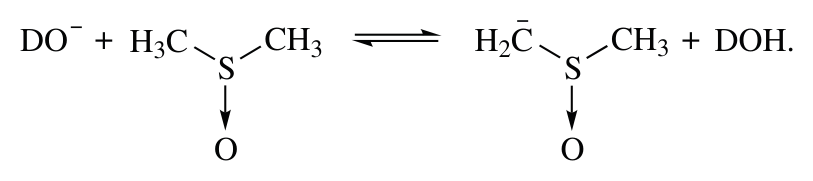
Even more astonishing was the result of the experiment with C2D2 in the KOH/DMSO system, in which the isolated pyridine 3 (48% yield) turned out to be also free of deuterium. This can only occur if the H/D exchange rate is very high and the number of protons considerably exceeds that of deuterons, i.e. if the protons of DMSO are also involved in the process. Any remaining doubt about this conclusion was dispelled when the reaction was performed in the C2D2/KOD/DOBut/DMSO system, wherein DMSO was the only proton supplier, and the isolated pyridine 3 (40% yield) again contained no deuterium. Thus, the rapid formation of dimsyl anions in the composition studied should be considered experimentally proven, and, consequently, the following equilibrium should be quickly reached in the system:
Eventually, when the reaction with C2D2 was carried out in the fully deuterated composition KOD/DOBut/DMSO-d6, the expected pyridine 3-d3 (3,4,5-d3 isotopomer) was obtained in 44% yield with 100% selectivity (no protons were detected in product 3 by both NMR and MS spectra) (see Scheme 3). Thus, the self-organization of pyridine 3-d3 consumes the deuterium atoms delivered by DMSO-d6 via the formation of dimsyl anions, which play a leading role in the whole process.
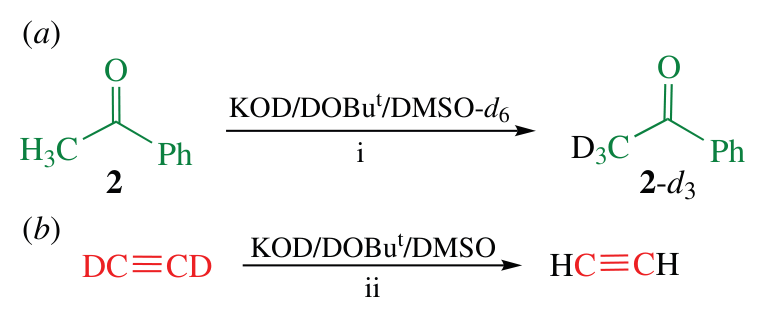
Next, it was necessary to check whether proton–deuterium exchange could occur in target product 3. Non-deuterated pyridine 3 was treated with fully deuterated superbasic composition KOD/DOBut/DMSO-d6 under the reaction conditions. As a result, no deuterium was detected (1H NMR) in the pyridine ring. On the contrary, the starting acetophenone 2 in the same composition predictably exchanged its methyl protons for deuterium (Scheme 4(a)). This confirms the facile formation of acetophenone carbanions and their active participation in the pyridine self-organization, i.e., acetophenone reacted as CD3 isotopomer. In the KOD/DOBut/DMSO composition, the rapid H/D exchange was experimentally observed for gaseous deuterioacetylene (Scheme 4(b)).
In line with the above observations was the selective formation of pyridine 3-d3 (45% yield) from C2H2, benzonitrile 1, and acetophenone 2 in the composition KOH/HOBut/DMSO-d6, wherein the only source of deuterium was deuterated DMSO. This result is consistent with the known application of the KOH(KOBut)/DMSO-d6 system for deuteration of organic compounds.[16-19] Also, it is possible that observed deuterium incorporation could also occur from rapid equilibration among the anionic intermediates (cf. Scheme 5) generated in the reaction course.
Evidently, the previous consideration of the KOH/DMSO system needs to be revised, as it has been proven here that DMSO is not just a solvent but also a reagent and a source of true superbase species (dimsyl anions). We assumed that despite the higher acidity of water compared to DMSO (pKa 31.4[20] and 35.1,[21] respectively), the equilibrium may be shifted to the right, likely due to the deactivation of water molecules by the complexation with an excess DMSO or due to the water uptake by the solid KOH, which is poorly soluble in DMSO.
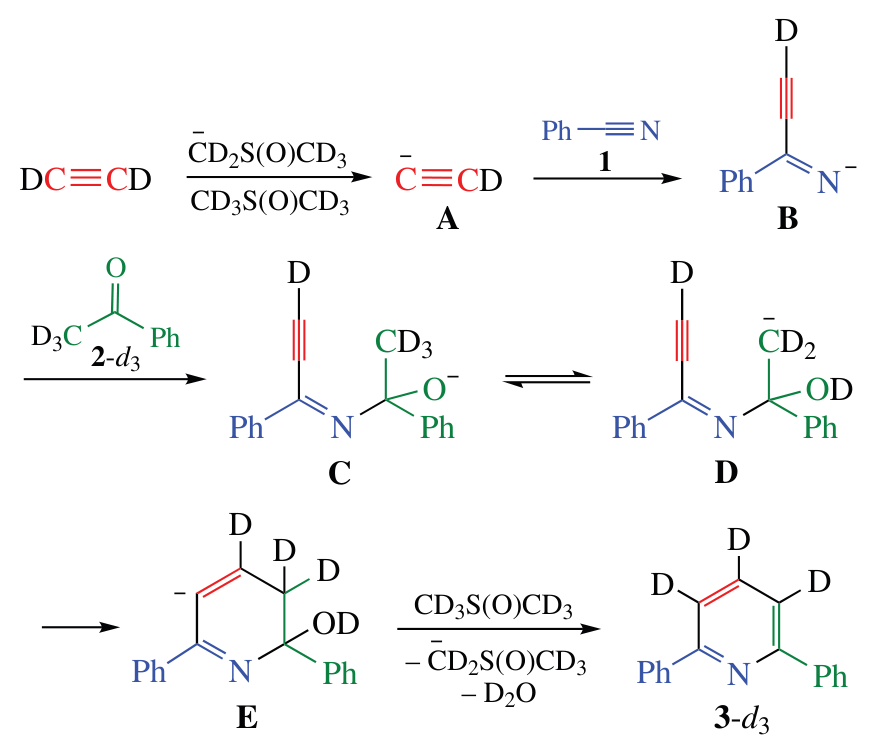
All the above supports the previous assumption[7] that the self-organization of pyridine 3 is triggered by the acetylenic carbanion A (see Scheme 5), which attacks the C≡N bond of benzonitrile 1. Formed acetylenic imine anion B further adds to the carbonyl group of acetophenone 2. The anion C undergoes proton transfer (form D) and 6-endo-dig cyclization. Protonation (deuteration) and elimination of D2O molecule of dihydropyridine anion E affords pyridine 3-d3. The absence of the 5-exo-dig product from cyclization of carbanion D is most likely a consequence of selective hyperconjugative stabilization of the 6-endo-dig pathway through donation from the carbanion into the σ*C–N orbital, similar to the previously documented regioselectivity.[22]
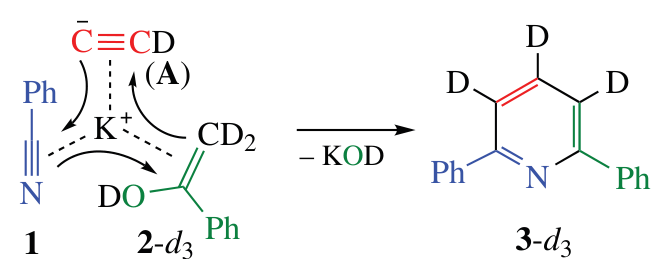
Since no intermediate was detected (1H NMR) in the reaction mixture, an alternative hypothesis of the pyridine self-organization as a concerted process may be considered (Scheme 6).[7] This mechanism should involve transfer of the electron pair of the acetylenic carbanion A to the back of the same species A via electrophilic cyano and carbonyl groups (without formation of the kinetically independent intermediates) like a snake biting its tail. The acetylenic carbanion is necessarily escorted by potassium cation, which further accompanies the anion transfer up to the carbonyl group. These three reacting molecules should be centripetal thereby facilitating the ring closure.
In summary, the character and dynamics of deuterium distribution during the self-organization of 2,6-diphenyl-pyridine-3,4,5-d3 from deuterioacetylene, benzonitrile, and acetophenone in the KOH/DMSO system and its deuterated analogs evidence that the proton transfers and anion evolutions in this process are governed by dimsyl anions, which are generated via the deprotonation of DMSO. This conclusion is most likely extendable to other reactions that proceed in the KOH/DMSO systems.
This work was supported by the Russian Science Foundation (grant no. 24-13-00031). The spectral data were obtained with the equipment of the Baikal Analytical Center for collective use, Siberian Branch of the Russian Academy of Sciences.
Funders
References