
Abstract
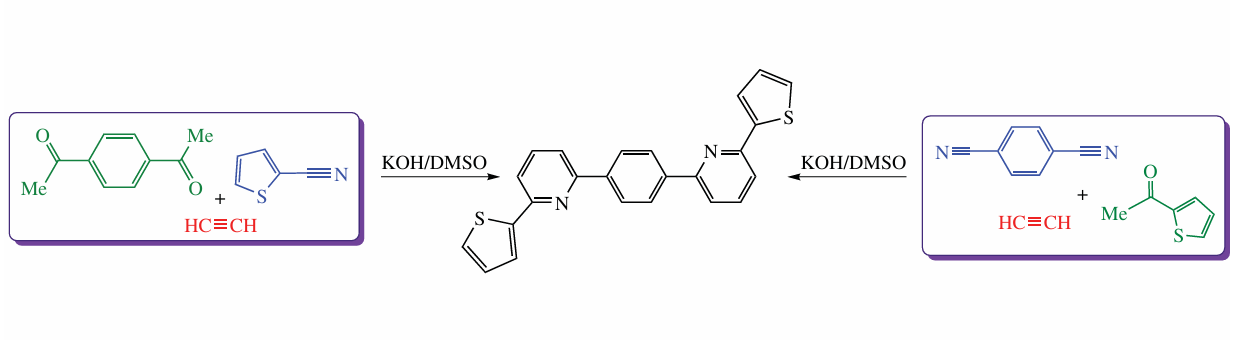
Alternating benzene/pyridine oligoaryl scaffolds were produced from 1,4-dicyanobenzene and aromatic (heteroaromatic) ketones or from 1,4-diacetylbenzene and aromatic (heteroaromatic) nitriles under slightly elevated acetylene pressure (~3 atm) in the KOH/DMSO system (75 °C, 20 min) in 27--55% yields.
Keywords
Communication
In the current alkyne chemistry, there is a growing interest in acetylene-driven assembly of complex molecules starting from simple available compounds in strongly basic (superbasic) systems of the types KOH/DMSO and KOBut/DMSO.[1] The driving force of this phenomenon is the dual reactivity of acetylenes, i.e., their ability to react as both nucleophiles and electrophiles. Typically, the process is triggered by the addition of acetylenic carbanions to electrophilic substrates (ketones,[1] nitriles[2-4]) to generate the intermediate anions, which render further self-organization. Likewise, the nucleophilic substrates (amines,[5] oximes,[1] and amides[6]) react with acetylenes to produce vinyl carbanions, involving other molecules in the process. A distinguishing feature of this phenomenon is the unpredictability of the reaction course. In recent years, various organic nitriles have been intensively studied as efficient electrophilic platforms for the self-organization of practically valuable compounds of higher complexity. Against this background, there was developed a one-pot synthesis of tetra(het)aryl substituted NH-pyrroles from one molecule of (hetero)aromatic nitrile and three molecules of (het)arylacetylenes in the KOBut/DMSO system, as exemplified in Scheme 1(a).[2, 3] Recently, one-pot assembly of 2,6-disubstituted pyridines from acetylene gas, nitriles, and various ketones in the KOH/DMSO system was elaborated (Scheme 1(b)).[7]
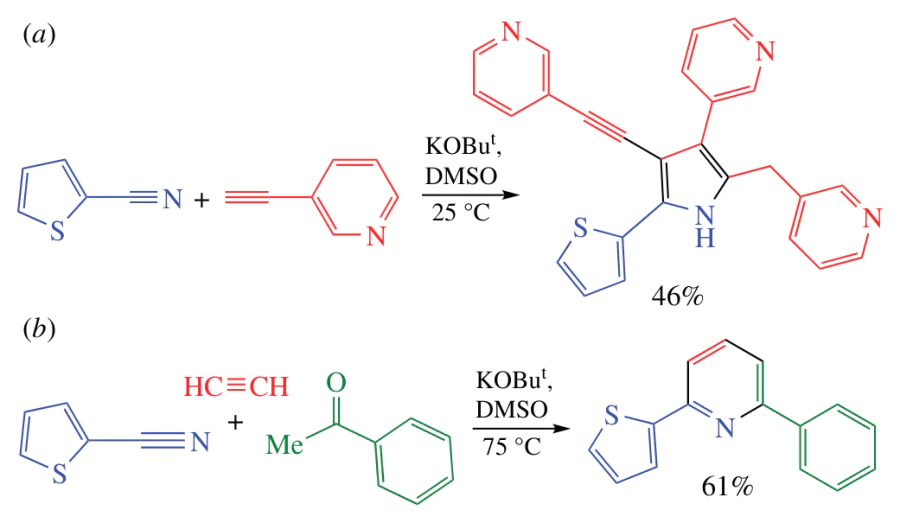
Examples shown in Scheme 1 suppose the possible extension of this reaction over dinitriles and diketones to create a general approach to design regularly alternating linked conjugated arene (hetarene)/pyridine assemblies.
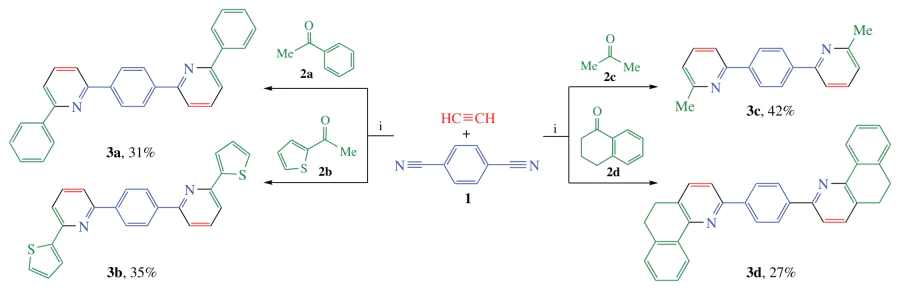
Follow-up experiments, which are described in this work, have confirmed the above supposition. Indeed, when 1,4-dicyanobenzene 1 reacted with ketones 2a or 2b under slightly elevated acetylene pressure, the alternating benzene/pyridine (3a) and thiophene/pyridine/benzene (3b) structures were formed in 31 and 35% yields, respectively (Scheme 2). The use of aliphatic and cycloaliphatic ketones on the platform of aromatic dinitriles was demonstrated by the condensation of acetylene, dinitrile 1, and acetone 2c or tetralone 2d. The yields of the corresponding assemblies 3c and 3d were 42 and 27% (see Scheme 2).
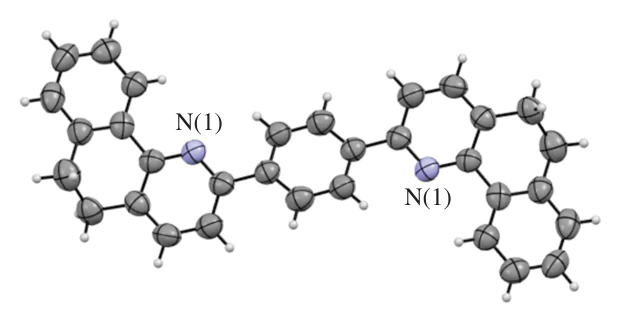
The structure of assembly 3d was proven by X-ray analysis (Figure 1).† According to the X-ray data, molecule of 3d in the solid state is almost planar (the dihedral angles between the benzene and dihydrobenzoquinoline rings are about 19°) and has the trans-disposition of the dihydrobenzoquinoline moieties relative to the benzene spacer. This almost coplanar structure favors the electron transport along an extended conjugated chain, which is prerequisite for the application of product 3d and its congeners as optoelectronic materials. The self-organization of such complex molecular architectures containing up to seven aromatic and heteroaromatic (including pyridine) cycles, virtually in one click, from available starting materials under operationally simple transition metal-free conditions looks as an entry in a new intriguing area of the alternating conjugated aromatic/heteroaromatic molecular hybrids, prospective for electronic and optoelectronic devices.
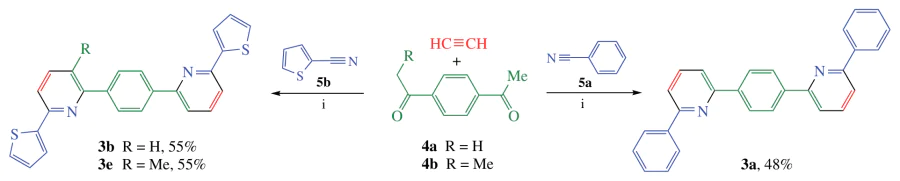
The much higher yields of assemblies 3a (48%) and 3b (55%) were attained by the three-component reaction of acetylene gas, 1,4-diacetylbenzene 4a and benzonitrile 5a or thiophene-2-carbonitrile 5b under the same conditions (Scheme 3). In the case of 1,4-diacylbenzene 4b with different acyl groups (acetyl and propionyl) and thiophene-2-carbonitrile 5b, self-organization with acetylene led to arene/hetarene array 3e containing one methyl-substituted pyridine ring in 55% yield (Scheme 3). Consequently, this approach should work with a variety of diacylarenes, thereby providing a wide possibility for the modification of the pyridine unit in the self-organized structures.
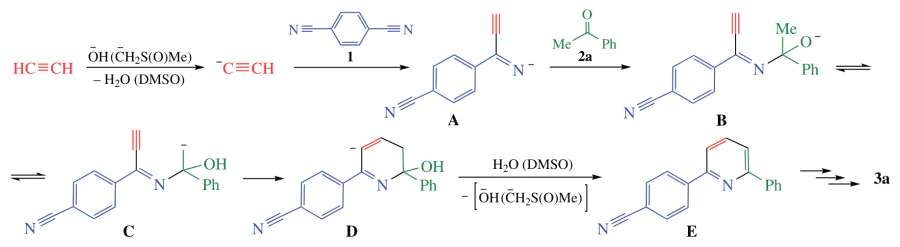
The proposed mechanistic rationale for the cyclocondensation is presented in Scheme 4 for the reaction of the C2H2, dinitrile 1, and ketone 2a. The acetylenic carbanion adds to the nitrile function and thus formed nitrogen-centered anion A attacks ketone 2a to produce intermediate B. It undergoes proton transfer to carbanionic form C that undergoes cyclization on the triple bond. Cyclic anionic structure D aromatizes to pyridine E after protonation and dehydration. The same reaction sequence with the participation of the remaining nitrile function of the starting dinitrile 1 leads to the final product 3a.
The acetylene-driven self-organization of alternating arene(hetarene)/pyridine structures from aromatic (heteroaromatic) nitriles and ketones in the KOH/DMSO system opens new possibilities for the design of the pyridine-installed arene (hetarene) oligoaryl scaffolds. It should be underscored that similar conjugated arene/bispyridine motifs are being studied intensively as N-type electron transport materials (ETMs), which could be used not only in different high-performance OLEDs[8-10] and fluorescent, phosphorescent, white emission devices,[11-13] but also in organic thin-film transistors (OTFTs).[14-16] The above products were prepared in two steps from arylaldehydes and 1,4-diacetylbenzene, followed by the reaction of the intermediate unsaturated diketones with enolizable ketone in the presence of ammonium acetate.[14, 16] Also, for this purpose, the double Kröhnke cyclization[17, 18] of α,α'-bispyridinium methyl ketone salts with chalcones[19, 20] as well as Pd-catalyzed cross-coupling of 2-halopyridines with 1,4-benzenediboronic acid were used.[21]
In conclusion, the fundamental possibility of extending the previously discovered multimolecular assembly of complex molecular structures from acetylene and simple nucleophiles and electrophiles in superbasic media was demonstrated. Particularly, the reaction of aromatic dinitriles and aromatic diketones provided a one-pot access to alternating arene(hetarene)/pyridine oligoaryl scaffolds. The attractive feature of this synthesis is its one-pot implementation using cheap and available feedstock (industrially available acetylene gas, nitriles, and ketones) in the presence of the simplest superbasic system KOH/DMSO.
This work was supported by the Russian Science Foundation (grant no. 24-13-00031). The spectral data were obtained with the equipment of the Baikal Analytical Center for collective use, Siberian Branch of the Russian Academy of Sciences.
Crystal data
† Crystal data for 3d. C32H24N2 (M = 436.56). The determination of the unit cell and the data collection were performed on a Bruker D8 VENTURE PHOTON 100 CMOS diffractometer with MoKα radiation (λ = 0.71073 Å) at 293.2(2) K using the ω–j scan technique. A specimen of C32H24N2, approximate dimensions 0.35 mm × 0.23 mm × 0.08 mm, was used for the X-ray crystallographic analysis. The integration of the data using a triclinic unit cell with P\(\bar{1}\)space group yielded a total of 52481 reflections to a maximum 2ψ angle of 54.8°, of which 9631 were independent (completeness = 100%, Rint = 11.43%, Rsig = 11.19%) and 4120 were greater than 2σ(F2). The final cell constants of a = 7.693(12), b = 7.726(10) and c = 37.96(4) Å, α = 84.64(3)°, β = 84.44(3)°, γ = 89.26(7)°, Z = 4, V = 2236(5) Å3. The calculated minimum and
Funders
References