Abstract
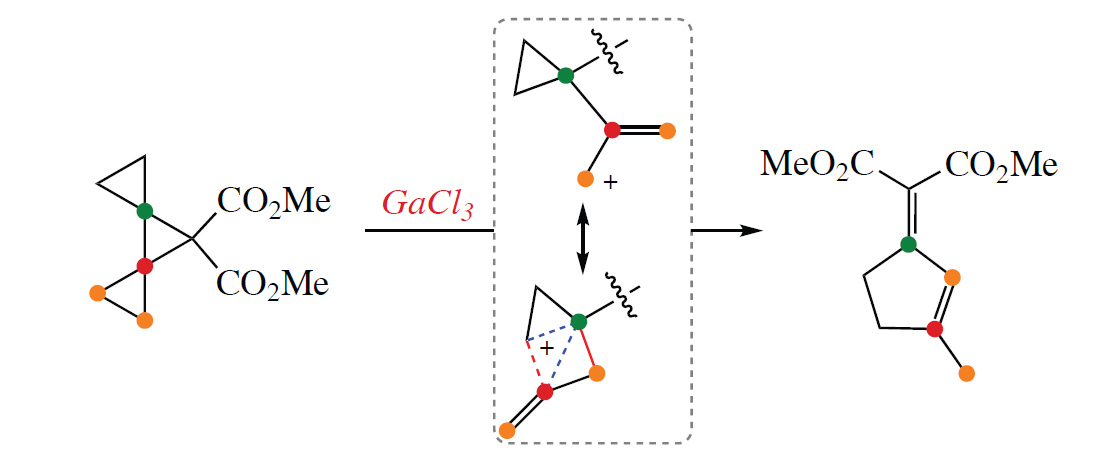
Dimethyl dispiro[2.1.2.0]heptane-4,4-dicarboxylate containing three spiro-linked cyclopropane rings has been proven to be a valuable building block for the Lewis acid catalyzed rearrangements to give a set of products involving the cleavage of two or three cyclopropane rings. Among various Lewis acids tested, GaCl3 was able to selectively generate a non-classical 2-cyclopropylallyl carbocation that further isomerized to produce (3-methylcyclopent-2-enylidene)malonate as almost exclusive product.
Keywords
Communication
Donor–acceptor cyclopropanes (DACs) are widely used in modern synthetic chemistry as valuable building blocks due to their unique reactivity caused by the presence of vicinally-positioned electron-donor and electron-withdrawing substituents on the cyclopropane ring.[1-3] Most common Lewis acid mediated ring-opening transformations of DACs involve reactions of nucleophilic or electrophilic addition, (3 + n)-cycloadditions, annulations and other transformations, where DAC is serving as a formal synthetic equivalent of 1,3-dipole.[4-10]
Donor–acceptor cyclopropanes containing one or more additional small cycles are of particular interest due to their increased ring strain energy that should facilitate ring-opening rearrangements to cause additional more complicated cascade transformations. For instance, the reactions of spiro[2.2]pentanes (‘monospiro-DACs’) are well documented proceeding either with the second cyclopropane ring retained,[11-17] or with the cleavage of both of them.[18, 19] Rearrangements of polyspiroalkanes are also known and include only carbocationic[20-25] and radical transformations;[26] while the reactions of polycyclic DACs via zwitter-ionic intermediates are limited. We have recently demonstrated that DACs containing additional cycloalkane scaffolds either in linearly-arranged substituention or in a spiro-coupled fashion exhibited a wide variety of synthetic pathways. These include transformations via classical 1,3-zwitter-ionic intermediates proceeding with the only one three-membered ring cleavage, as well as more complex cascade rearrangements with the both rings cleaved via the formal generation of 1,n-zwitter-ionic intermediates (n = 2–6).[27-30]
In the current work, we have studied Lewis acid mediated rearrangements of a more complex spirocyclic scaffold consisting of three spiro-coupled cyclopropanes, namely, dimethyl dispiro[2.1.2.0]heptane-4,4-dicarboxylate 1 (Scheme 1). In fact, dispiroheptane 1 readily reacted with 1–2 equiv. of TiCl4 and SnCl4 with the full consumption over 1 h to afford malonate derivatives of 2-cyclopropylallyl chloride 2 and 4-methylenespiro[2.3]hexane 3 indicating that two of the three cyclopropane rings were cleaved (Scheme 1, Table 1, entries 1, 2).
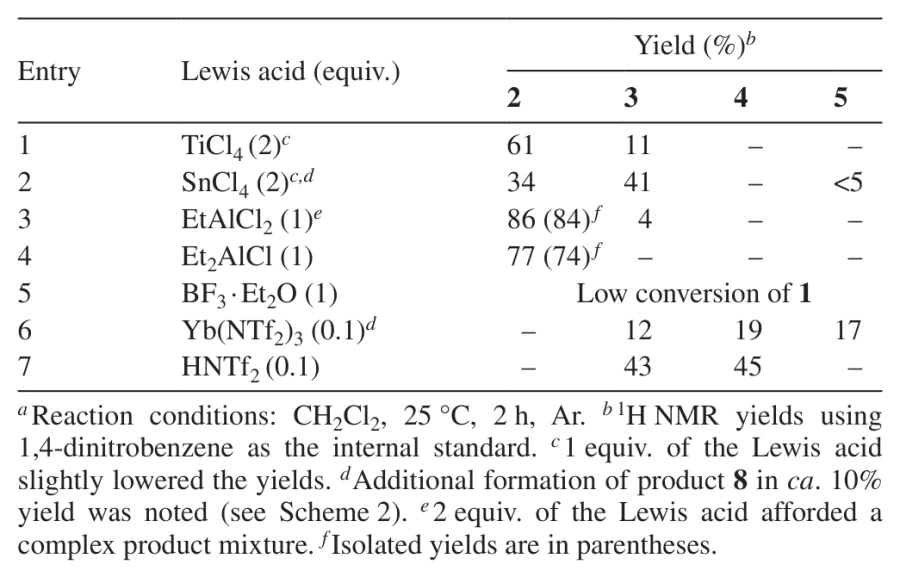
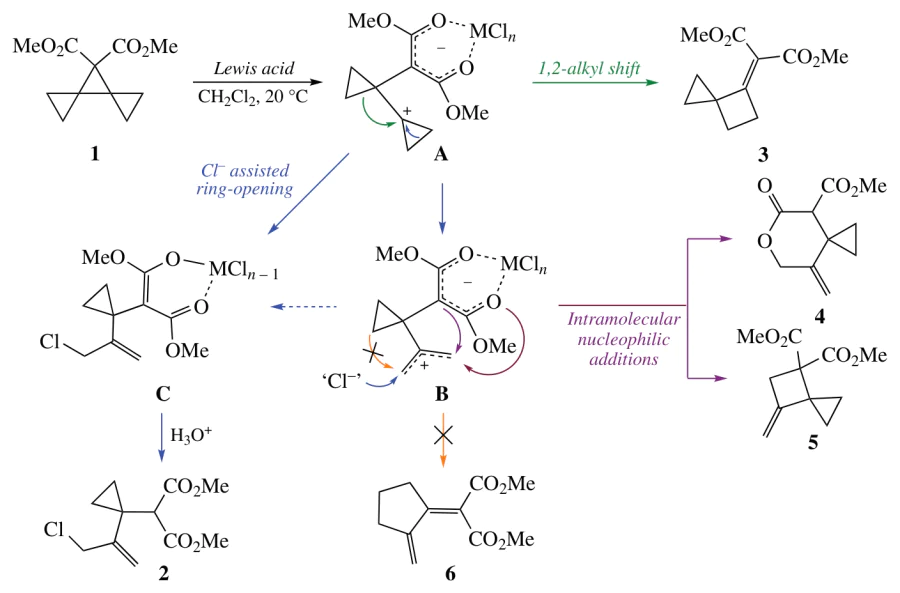
Evidently, the formation of methylenecyclobutane 3 is the result of 1,2-alkyl shift in the intermediate A similarly to the rearrangements of spiro[2.n]alkane-1,1-dicarboxylates that we recently studied.[30] In turn, allyl chloride 2 is the product of formal nucleophilic addition of Lewis acid derived Cl– to the allyl intermediate B that might exist in the reaction mixture as a complex with Lewis acid (see Scheme 1, structure C). Replacing these Lewis acids with EtAlCl2 and Et2AlCl led to significant increase in the reaction selectivity affording allyl chloride 2 as the predominant product (see Table 1, entries 3, 4). The use of 0.1 equiv. of Yb(NTf2)3 or HNTf2 (which do not contain nucleophilic anions) as the catalysts prevents the formation of allyl chloride 2 in favor of lactone 4 as the product of the O-cyclization of intermediate B (entries 6, 7). Furthermore, in the case of Yb(NTf2)3 the yield of the C-cyclization product, 6-methylenespiro[2.3]hexane-4,4-dicarboxylate 5 that is an isomer of 3, is notable (entry 6).
Using significantly stronger Lewis acids such as GaCl3 and AlCl3 revealed an unusual reaction pathway. For instance, when 1 equiv. of GaCl3 or AlCl3 was used, products 2 and 3 were formed similarly to TiCl4 and SnCl4 mediated reactions (Table 2, entries 1, 3). However, when the amount of GaCl3 or AlCl3 was raised from 1 to 2 equiv. the reaction proceeded differently: the fractions of compounds 2 and 3 dropped significantly, and (3-methylcyclopent-2-en-1-ylidene)malonate 7 became the major product (Scheme 2, Table 2, entries 2, 4). Furthermore, in the case of GaCl3, very high selectivity could be achieved. Thus, a further increase in the amount of GaCl3 to 3 equiv. allows achieving a product ratio of 7 to 3 greater than 10 to 1 with only trace amounts of allyl chloride 2 (entry 5).
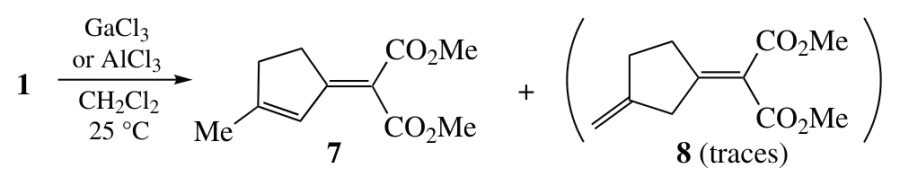
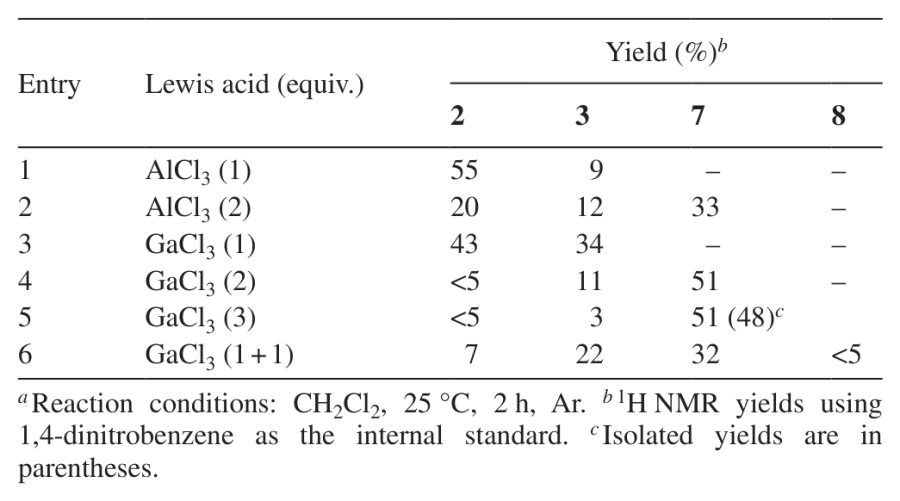
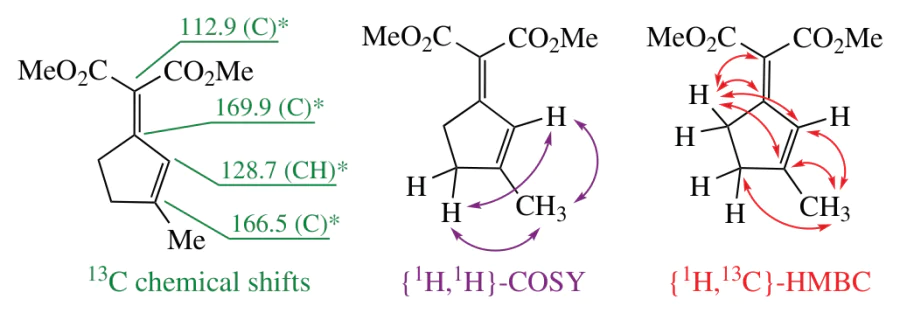
The methyl group position in the diene 7 has been unequivocally confirmed by 13C, COSY and HMBC NMR spectra (Figure 1). It is difficult to explain the formation of such a product in terms of classical carbocations. To clarify the formation mechanism, we conducted a control experiment by adding GaCl3 to DAC 1 in two portions of 1 equiv. each 1 h apart (see Table 2, entry 6). In this case, the first equivalent of GaCl3 generated a mixture of allyl chloride 2 and methylenecyclobutane 3 in the form of gallium complexes. Treatment with the second equivalent of GaCl3 led to the nearly complete disappearance of allyl chloride 2 and the formation of an equivalent amount of diene 7. This observation clearly indicates that the formation of diene 7 proceeds sequentially via an allyl intermediate (either allyl chloride 2 or allyl carbocation B). Note that the amount of methylenecyclobutane 3 also decreased by ~10%, which correlates with the overall decrease in yield, likely due to oligomerization.
The observed virtually exclusive formation of diene 7 when 2–3 equiv. of GaCl3 are used immediately at the initial stage of the reaction, with products 2 and 3 being virtually absent, is likely due to the facilitated formation of complex C compared to the 1,2-alkyl shift in intermediate A. In turn, an excess of GaCl3 causes the conversion of complex C into the ionic intermediate D, which is essentially a nonclassical carbocation (Scheme 3).
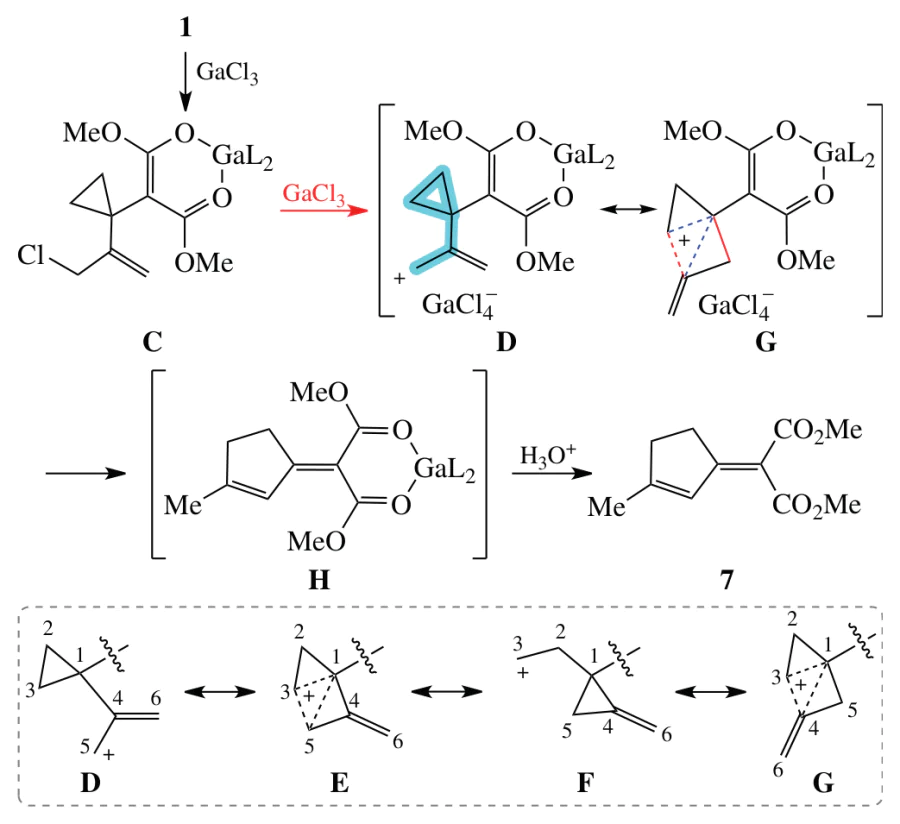
Thus, intermediate D has a structure that combines a malonate fragment, whose negative charge is compensated by the positive charge of the Ga3+ cation, and a (2-cyclopropyl)allyl carbocation fragment that is stabilized by a weakly coordinating polychlorogallate anion GaxCl– 3x + 1. The (2-cyclopropyl)allyl carbocation in D is also a β-cyclopropylcarbinyl carbocation, which is well known for its nonclassical nature from the works of Olah and Masamune.[31-33] The representation of this cation as resonance structures D–G reveals structure G, which is a precursor to the stable 1,2-zwitterionic gallium complex of the final diene 7 (see Scheme 3, structure H). Notably, the transition between resonance structures D–G occurs exclusively via the formation and cleavage of two-electron three-centered bonds, without any hydride shifts.[31-34] The formation of complex H is the driving force that determines the preferred resonance form of the nonclassical (2-cyclopropyl)allyl cation.
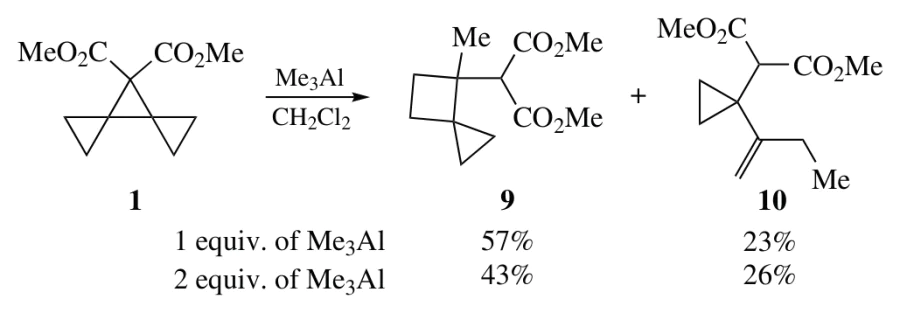
Additional experiments were conducted to investigate whether the intermediates A and B participate in the reaction and can be captured by a non-halogen nucleophile. In this way, we used 1 and 2 equiv. of Me3Al, which can serve as both a Lewis acid and a source of a formal methyl anion able to irreversibly quench the carbocation centers of the corresponding zwitter-ionic intermediates. Under these conditions, both expected products, 9 and 10, were obtained, while their ratio was practically independent on the amount of Me3Al used (Scheme 4).
In summary, we have demonstrated that the ring-opening Lewis acid mediated rearrangements of dimethyl dispiro[2.1.2.0]heptane-4,4-dicarboxylate 1 occurs through the cleavage of two of its three cyclopropane rings via intermediates A–H. When 2 equiv. of GaCl3 or AlCl3 are used, the rearrangement proceeds further, involving the cleavage of the third cyclopropane ring, leading to 3-methylcyclopent-2-enylidene malonate 7 via a cascade of nonclassical carbocations.
This work was funded by The Russian Science Foundation (grant no. 25-13-00574). This work was performed using the equipment in the Shared Research Center (Department of Structural Studies) of N. D. Zelinsky Institute of Organic Chemistry RAS, Moscow.
Funders
References