
Abstract
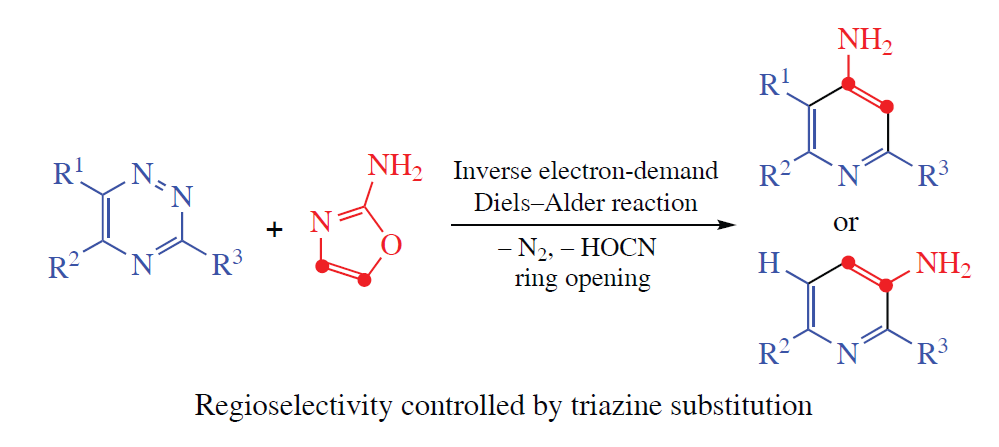
The C4=C5 double bond of 2-aminooxazole serves as dienophile in the course of inverse electron-demand Diels– Alder reactions with 1,2,4-triazines. The primary tricyclic adducts would lose dinitrogen molecule to form fused oxazolopyridine core whose aminooxazoline moiety undergoes extrusion of HOCN species, which finally leads to 3- or 4-aminopyridines. The regioselectivity of the process is governed by the substitution pattern of the triazine core.
Keywords
Communication
The inverse electron-demand Diels–Alder (IEDDA) reaction of 1,2,4-triazines with electron-rich dienophiles represents a powerful approach to substituted pyridines.[1] In addition to enamines and other electron-rich alkenes,[2-7] heterocyclic dienophiles have attracted particular attention, as they enable access to both functionalized pyridines and heteroannulated systems.[8-13]
Previously, we demonstrated that reactions of 2-amino-4-aryloxazoles with 1,2,4-triazines afforded structurally diverse pyridines depending on the substitution pattern of the triazine core.[11-13] However, the reactivity of unsubstituted 2-aminooxazole in such reaction has not been investigated. Herein, we report an alternative oxazole-derived cycloadduct ring-opening pathway observed in the IEDDA reactions between unsubstituted 2-aminooxazole with 1,2,4-triazines, leading to aminopyridines.
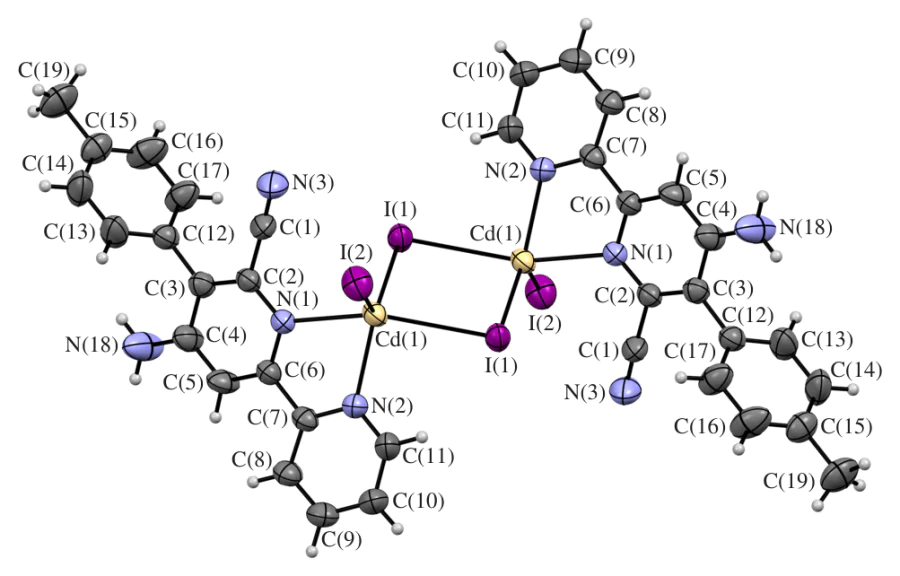
In fact, the reactions of substituted 1,2,4-triazines 1a–h with unsubstituted 2-aminooxazole 2 upon heating in o-xylene at 150 °C afforded 4-aminopyridines 3a–h (Scheme 1). The yields were moderate (36–56%, products 3a–f) or even low but admissible (12–20%, products 3g,h). The 1H NMR spectra of compounds 3 exhibit signals for the amino group at 4.1–4.5 ppm (cf. ref. [14]) as well as a singlets at 7.7–7.9 ppm corresponding to the 3-positioned proton of the newly formed pyridine ring. The crystal structure of 3a as the solvate of a dimeric cadmium complex, (3a · CdI2)2 · 2 MeCN, was confirmed by X-ray diffraction analysis (Figure 1).†
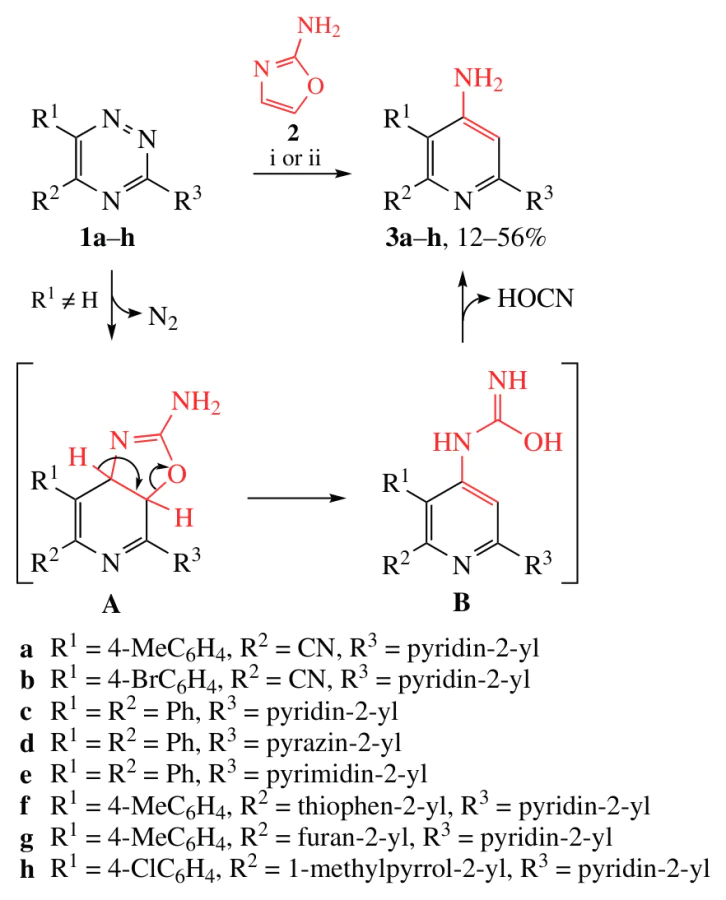
A plausible mechanism for the reaction is outlined in Scheme 1. The process is initiated by an inverse electron-demand Diels–Alder cycloaddition of 2-aminooxazole 2, acting as an electron-rich dienophile, to the 1,2,4-triazine ring at the C3 and C6 positions, followed by extrusion of molecular nitrogen to give intermediate A. Subsequent cleavage of the O–C bond of the oxazole fragment results in ring opening and formation of intermediate B. Formal elimination of cyanic acid from B affords the final aminopyridines 3. Notably, the regioselectivity of the cycloaddition of 2-aminooxazole to the 1,2,4-triazine core is consistent with that observed previously for related systems.[11]
Attempts to extend the reaction to 5-unsubstituted 1,2,4-triazines resulted in complex mixtures and only traces of the desired products.
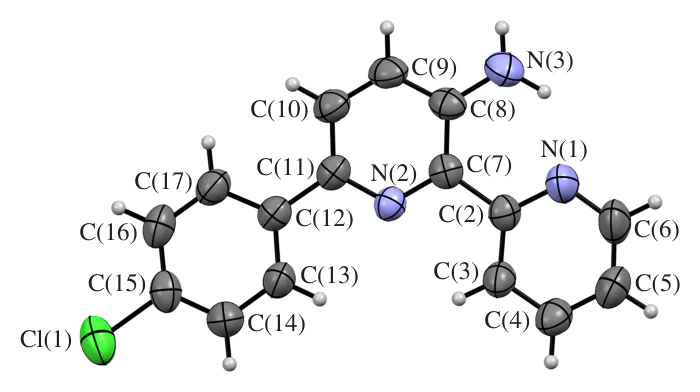
In the case of 6-unsubstituted 1,2,4-triazines 4a,b, the cycloaddition appears to proceed with inverted regioselectivity, involving preferential bonding of the C4 and C5 atoms of the oxazole moiety to the C3 and C6 positions of the 1,2,4-triazine ring, respectively. Earlier, we showed that this type of addition was characteristic of reactions of 6-unsubstituted 1,2,4-triazines with 4-aryl-2-aminooxazoles.[13] In the reaction of 6-unsubstituted 1,2,4-triazines 4a,b with 2-aminooxazole, 6-aryl-2-hetaryl-3-aminopyridines 5a,b were obtained (Scheme 2). The structure of compound 5a was confirmed, along with other methods, by X-ray diffraction analysis (Figure 2).†
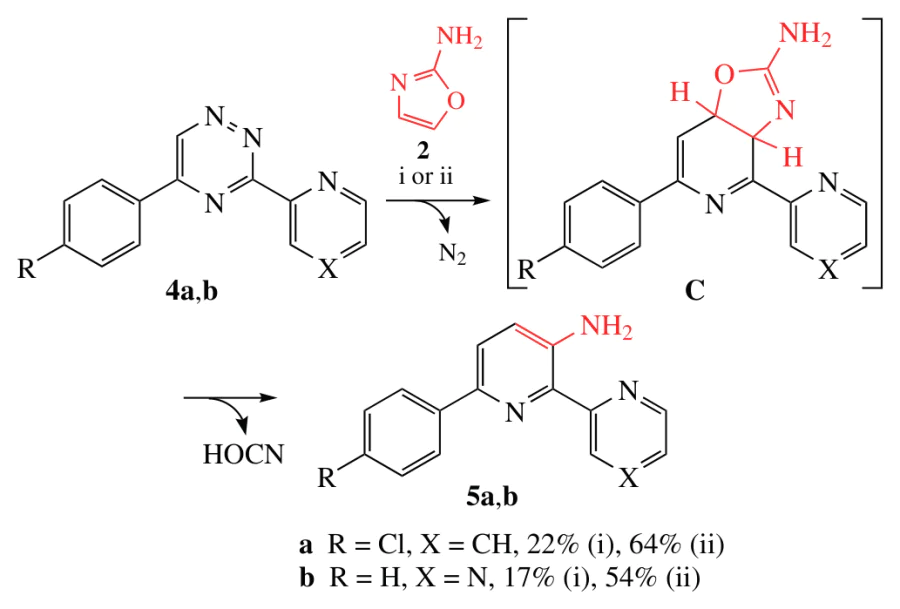
Notably, the reaction efficiency was significantly improved when DMF was used instead of o-xylene in the case of 6-unsubstituted 1,2,4-triazines 4a,b (see Scheme 2). Attempts to perform the reaction of other substituted triazines (1c,h, see Scheme 1) under similar conditions did not lead to improvement in the yields. In contrast to our previous studies on 2-amino-4-aryloxazoles and 1,2,4-triazines, where solvent-free conditions proved effective,[11-13] attempts to carry out the reaction of unsubstituted 2-aminooxazole 2 with 1,2,4-triazines under solvent-free conditions resulted in strong decomposition of the amine accompanied by partial sublimation, while only traces of the desired products were observed.
The photophysical properties of the synthesized 4-aminopyridines 3a–h and 3-aminopyridines 5a,b were investigated by UV–VIS absorption and fluorescence spectroscopy in acetonitrile solutions. The compounds exhibit absorption maxima in the 220–370 nm range and emit in the blue region (392–464 nm). In contrast to the 4-aminopyridines 3, the 3-aminopyridines 5 display an additional long-wavelength absorption band (328–370 nm), which may be associated with an intramolecular N–H···N hydrogen bonding interaction between the amino group and the nitrogen atom of the azine ring. The fluorescence quantum yields vary considerably depending on the substitution pattern (<0.1–57.2%). The absorption and emission spectra (Figures S5–S7) together with the corresponding photophysical parameters (Table S1) are provided in Online Supplementary Materials.
In conclusion, an alternative ring-opening pathway of oxazole-derived cycloadducts was identified in the IEDDA reactions of 1,2,4-triazines with 2-aminooxazoles. Although a related ring-opening process has previously been reported for the reaction of 1,2,4,5-tetrazines with oxazole,[15] the present transformation results in the formation of amino-substituted pyridines rather than the corresponding ring-opened formamide derivatives. The substitution pattern of the triazine core governs the reaction outcome, enabling the selective formation of either 4- or 3-aminopyridines. The photophysical properties of the synthesized aminopyridines were also explored, revealing blue fluorescence with substituent-dependent emission efficiencies.
This work was supported by The Russian Science Foundation (grant no. 25-73-00410). Spectral measurements were carried out at the Laboratory of Complex research and expert evaluation of organic materials at the Center for Collective Use of Unique Equipment, Ural Federal University. X-ray diffraction analysis was performed using the equipment of the Center for Joint Use ‘Spectroscopy and Analysis of Organic Compounds’ at the Postovsky Institute of Organic Synthesis of the Russian Academy of Sciences (Ural Branch).
Crystal data
† Crystal data for (3a · CdI2)2 · 2 MeCN. [Monomeric unit C20H17CdI2N5 (M = 693.59)] triclinic, space group P\(\bar{1}\), a = 8.9742(5), b = 9.1039(5) and c = 15.3620(9) Å, α = 102.899(5)°, β = 105.579(5)°, γ = 94.829(5)°, V = 1164.49(12) Å3, Z = 2, dcalc = 1.978 g cm–3, F(000) = 652.0, T = 295 K, µ(MoKα) = 3.603 mm–1, θmin = 2.32°, θmax = 30.49°, 9220 reflections measured, 6205 independent reflections (Rint = 0.0221), R1 = 0.0382, wR2 = 0.0678 for 4563 reflections with I > 2σ(I ); R1 = 0.0616, wR2 = 0.0776 for all data, GOF = 1.011, ρmax /ρmin = 0.525/-0.992 e Å–3. Crystal data for 5a. C16H12ClN3 (M = 281.74), monoclinic, space group I2y, a = 13.0171(6), b = 5.3893(3) and c = 19.6118(12) Å,
Funders
References