Abstract
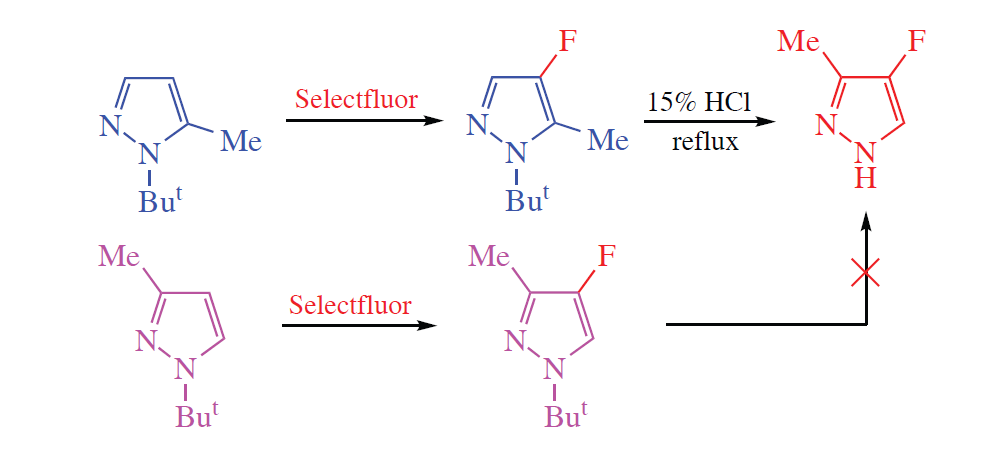
The electrophilic fluorination of 1-tert-butyl-3-methyl- and 1-tert-butyl-5-methylpyrazoles with Selectfluor affords the corresponding 4-fluoropyrazoles, in distinction to N-unsubstituted 3-methylpyrazole. 1-tert-Butyl-4-fluoro-5-methylpyrazole readily undergoes HCl-assitied N-de-tert-butylation yielding 4-fluoro-3-methylpyrazole whereas the isomer with 3-positioned methyl group tolerates the deprotection. The procedure is practical (aqueous medium), scalable, and employs commercial reagents.
Keywords
Communication
Heterocycles are fundamental scaffolds in drug design, they are present in ~85% of bioactive compounds,[1, 2] and the introduction of fluorine into the heterocyclic nuclear has become a key strategy in medicinal chemistry. Today, ~20% of marketed pharmaceuticals and ~50% of agrochemicals are fluorinated, with over 30% of blockbuster drugs containing fluorine.[3, 4] The C–F bond imparts valuable properties such as high bond strength, minimal steric hindrance, enhanced metabolic stability, improved bioavailability, and modulated physicochemical traits[5-7] making fluorinated heterocycles versatile platforms, as demonstrated by numerous FDA-approved drugs.[8, 9]
Despite growing interest, incorporating fluorinated moieties remains challenging.[10-14] Among the most promising strategies are the following: late-stage fluorination,[15-17] difluorocarbene-based approaches,[18-20] catalyzed and photocatalyzed reactions,[21-23] and microwave-assisted synthesis.[24, 25] A special case involves polyfluorinated heterocycles, where the cumulative effect of multiple fluorine atoms facilitates nucleophilic substitution reactions, leading to less fluorinated derivatives.[26-28] While late-stage fluorination and other advanced methods are promising, the use of fluorinated building blocks from the outset is still the prevailing strategy, underscoring the need for efficient routes to basic fluorinated heterocycles.[29]
Fluorinated pyrazoles represent a rapidly expanding research area since over 50% of related publications have appeared in the last five years spanning drug discovery, agrochemistry, and coordination chemistry (>60 000 results in SciFinder/Reaxys).[30-32] Significant efforts have also been focused on synthesizing low molecular weight fluorine-containing pyrazoles,[33-35] e.g., 4-fluoropyrazole[36, 37] and 5-fluoropyrazole.[38-40] However, the literature lacks efficient methods for preparing 3-methyl-4-fluoro- and 3-methyl-5-fluoropyrazole derivatives attractive due to the synthetic versatility of the methyl group. Herein, we present a convenient and scalable procedure for preparing 3-methyl-4-fluoropyrazole 1.
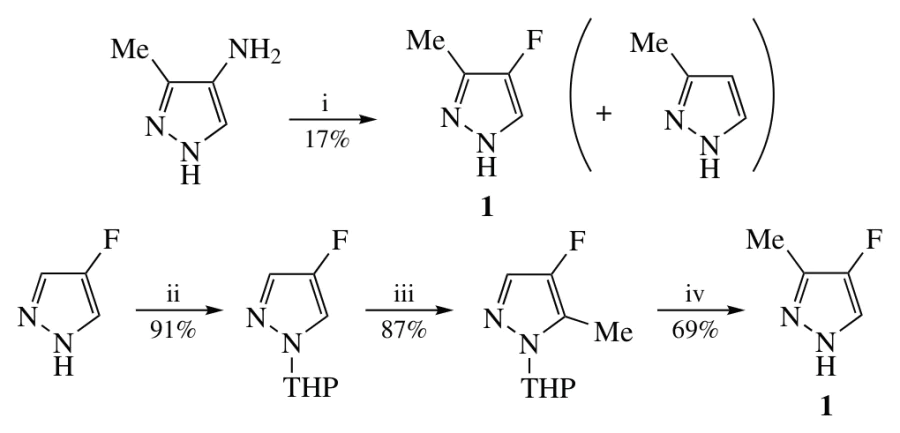
Data on the synthesis and properties of 3‑methyl‑4‑fluoropyrazole 1 remain scarce. In a patent by Arndt et al.,[41] compound 1 was prepared via a diazotization–fluorination sequence: 4‑amino-3‑methylpyrazole was treated with aqueous NaNO2 and HBF4, followed by UV irradiation (Scheme 1, step i). This reaction yielded a 4 : 1 mixture of 3‑methyl‑4‑ fluoropyrazole 1 and 3‑methylpyrazole, from which the target product was isolated in 17% yield. Notably, compound 1 demonstrated efficacy as a prolonged nitrification inhibitor in naturally alkaline soils. An alternative route to fluoropyrazole 1 with improved efficiency (55% overall yield) involved THP protection of the NH moiety in 4‑fluoropyrazole, lithiation, alkylation, and deprotection (see Scheme 1, steps ii–iv). The resulting compound has found application in the synthesis of heterocyclic molecules, particularly in the development of novel pharmaceutical compositions.[42, 43]
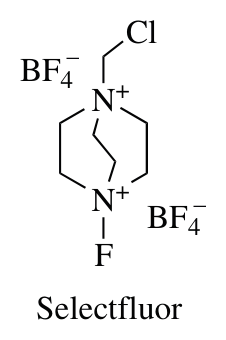
To establish a simpler and more efficient method for the preparation of 3‑methyl‑4‑fluoropyrazole 1, we first explored direct fluorination of 3‑methylpyrazole. However, reactions with common electrophilic fluorinating agents (e.g., Selectfluor) yielded complex mixtures in which the target compound 1 was undetectable. So, we then turned to a protective‑group strategy. A mixture of isomeric 1‑tert‑butyl‑3‑methylpyrazole 2a and 1‑tert‑butyl‑5‑methylpyrazole 2b was prepared by reacting 4,4‑diethoxybutan-2-one with tert‑butyl hydrazine (Scheme 2). The isomers were separated employing high‑efficiency vacuum distillation. Notably, both 2a and 2b underwent electrophilic fluorination with Selectfluor to afford 1‑tert‑butyl‑4‑fluoro‑3‑ methylpyrazole 3a and 1‑tert‑butyl‑4‑fluoro‑5‑methylpyrazole 3b, respectively, with isolated yields of 40–46%.
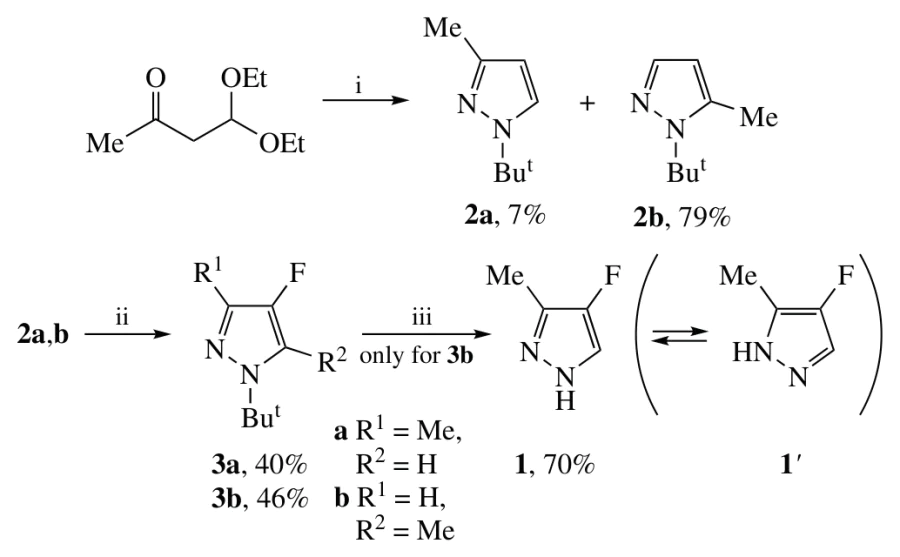
A key finding from the hydrolysis studies was that only isomer 3b underwent acid‑catalyzed cleavage of the But–N bond to yield 4‑fluoro-3‑methylpyrazole 1 (formally, tautomer 1' should initially be formed from 2b, see Scheme 2). This selective transformation prompted us to optimize the conditions for initial condensation of 4,4-diethoxybutan-2-one with tert-butylhydrazine to maximize the ratio of isomer 2b to 2a. Systematic variation of reaction parameters including temperature, HCl concentration, and solvent composition (EtOH or water) enabled us to achieve a reproducible 2b : 2a ratio of 9 : 1, with an overall isolated yield of 95% for the isomeric mixture. The high proportion of the desired isomer 2b makes the entire synthetic sequence from 4,4-diethoxy-2-butanone to product 1 operationally efficient and economically viable. Notably, the optimized protocol offers two additional advantages: all reactions are carried out in aqueous media, and the method relies solely on commercially available reagents, which enhances its suitability for large-scale applications.
The observed selectivity in the N-de-tert-butylation of isomers 3a,b can be rationalized by a mechanism involving protonation of the pyridine-type nitrogen (N2) of the pyrazole ring by a strong acid, which generates a highly polarized pyrazolium ion. The resulting positive charge on the ring induces steric and electronic effects that promote rupture of the N–But bond. Crucially, in isomer 3b (vs. 3a), the methyl group at the 5-position further increases steric hindrance, thereby favoring the N–C bond cleavage.
The structure of compounds 1, 3a, and 3b were unequivocally confirmed by 1H, 13C, and 19F NMR spectroscopy. Notably, for compound 3b, we successfully acquired 15N NMR data, including both chemical shifts and 15N–19F coupling constants. The observed 15N chemical shifts, namely, –85.10 ppm (N1) and –158.62 ppm (N2), reflect the electronic influence of the fluorine substituent on the nitrogen environments within the pyrazole ring. The measured 3JN–F coupling constants further support this interpretation: 8.5 Hz for N2, 2.2 Hz for N1. These values are consistent with anisotropic electronic effects imposed by the fluorine substituent, which differentially perturbs the nitrogen atoms depending on their spatial and electronic relationship to the C–F bond.
In summary, we have demonstrated that N‑tert‑butyl‑ substituted methylpyrazoles 2a,b undergo electrophilic fluorination (in contrast to 3‑methyl substituted NH-pyrazole) to yield the corresponding 1‑tert‑butyl‑4‑fluoro‑3‑methylpyrazole 3a and 1‑tert‑butyl‑4‑fluoro‑5‑methylpyrazole 3b. Only isomer 3b undergoes HCl-assisted removal of the N-tert‑butyl group to afford 4‑fluoro-3-methylpyrazole 1. The newly developed synthetic method for 1 offers several key advantages: practical convenience, scalability, use of readily available reagents, execution entirely in aqueous media. We anticipate that this approach will be of significant interest to the research community. Notably, compound 1 can serve as a pivotal precursor to a diverse family of functionalized 4‑fluoropyrazoles, which are in high demand for applications in medicinal chemistry.
References