Abstract
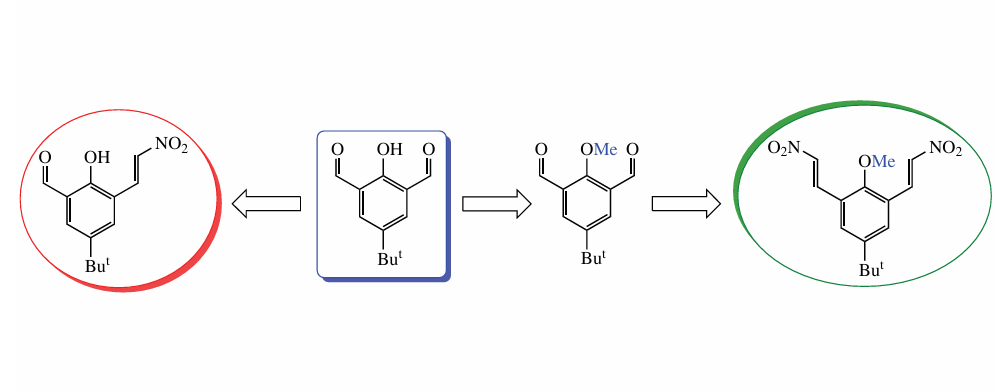
The Knoevenagel condensation of 4-tert-butyl-2,6-diformyl phenol with nitromethane affords only the mono condensation product (61% yield) even under prolonged reflux. This outcome may be attributed to tautomerism which shifts the equilibrium toward the inert keto form once
the first nitrovinylic group is formed. The protection of the phenolic OH group supresses the tautomerism, and the symmetric dinitrovinylic product is obtained in 94% yield.
Keywords
Communication
Ring-opening polymerization (ROP) of esters (lactones, lactides, etc.)[1-9] remains a hot topic due to the desire to obtain materials with new properties but without significant environmental impact. Pincer polydentate ligands (with ONO, NON, SNS, etc. covalently bonded and coordinating atoms)[10-14] represent a key element of modern, highly effective catalysts for the polymerization of cyclic esters. They are necessary, on the one hand, to stabilize the active catalyst particle and, on the other, to ensure that the catalyst is monomeric. Thus, the coordination sphere of the metal makes the polymerization process more controllable and prevents interchain transfer reactions. Consequently, the ligand design and methods for synthesizing their precursors, including non-symmetric ones, are important challenges for modern organic chemistry.
Sufficient conformational mobility of the ligand is known to be necessary[15] for good activity of ROP catalyst while the presence of rigid structural blocks reduces the rate of the process.[16] This caused us to focus our attention on the preparation of ligands with phenol (O-donor) as the main block and containing N-donor fragments separated by a flexible aliphatic spacer of varying length (one or two CH2) from the aromatic ring. Notably, for this structural type a scant number of compounds is known limited to only one CH2 fragment in the spacer.[17] This is not surprising, because the highly efficient condensation reaction of compounds with a strong acceptor at the α-carbon atom (C-nucleophiles) and aldehydes (a simple route to create a spacer with two methylene fragments) has revealed unexpected features that are both a problem for the synthesis of symmetrical ligands and a promising novel approach to the synthesis of non-symmetrical ligands.
In this work, we report the impossibility of the Knoevenagel condensation between nitromethane and 4-tert-butyl-2,6-diformylphenol simultaneously involving two CHO groups, the high stability of the resulting non-symmetric derivative, and its structural features. Furthermore, we explore the fundamental possibility of obtaining bis(nitroalkenyl) derivatives of para-substituted tert-butylphenol by reducing the influence of tautomerism (in our opinion, the principal cause for the condensation process feature) by introducing a protecting group on the phenolic OH.
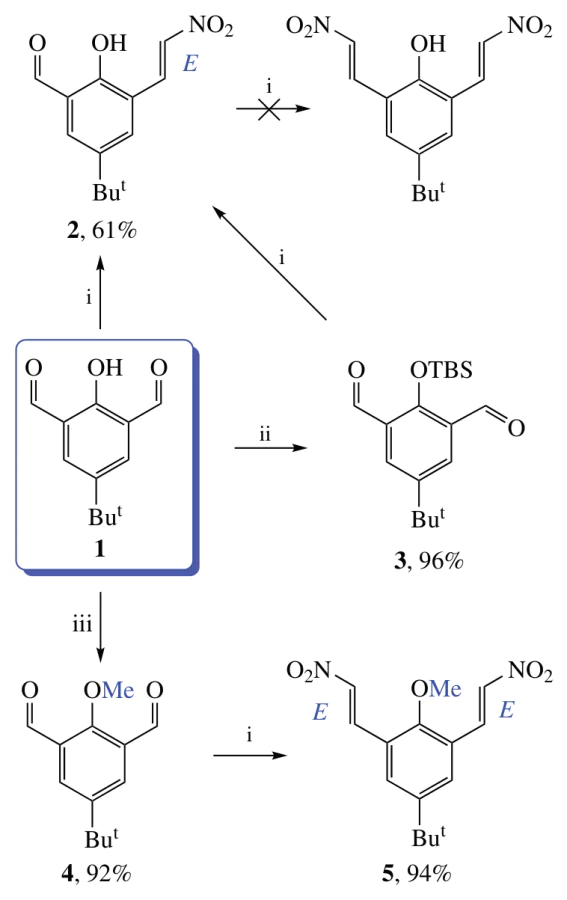
With the initial aim to obtain a precursor for the pincer ligand, 4-tert-butyl-2,6-diformylphenol was prepared according to a published procedure.[18] The synthesized dialdehyde 1 was then subjected to the Knoevenagel condensation (the Henry reaction with subsequent dehydration) under standard conditions[19-28] (nitromethane/acetic acid/ammonium acetate, reflux). As a result, a condensation product 2 of only one formyl group was obtained in good yield (61%, Scheme 1). Prolongation of the refluxing to 5 days did not allow us to detect (1H NMR) the condensation product of two aldehyde groups. Increasing the amount of acetic acid (by a factor of two compared to the general procedure for additional activation of the aldehyde group) and increasing the reflux time to 12 days did not lead to significant changes.
This phenomenon is particularly interesting because no similar problems have been previously reported for substituted salicylic aldehydes being condensed with nitromethane under conditions similar to those used here,[19-27] with a rare exception.[28] In that work[28] the authors attribute similar difficulties to the formation of a stable hydrogen bond in the iminium intermediate. In our case, formation of similar iminium intermediate cannot be the reason explaining why the reaction proceeds at only one formyl group since the reaction mixture contains only 0.2 equiv. of ammonium salt, which is insufficient to block both aldehyde groups.
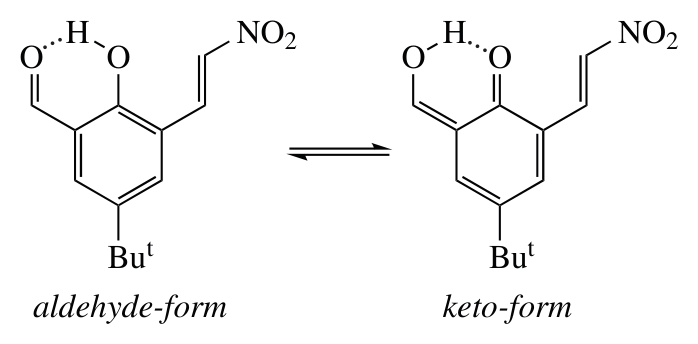
We consider that the key reason for this phenomenon is the tautomeric equilibrium between the aldehyde form (Figure 1) and the less electrophilic keto form. Indirect confirmation of the presence of tautomeric equilibrium is the broadening of the aldehyde signals in the 1H NMR spectra for compounds 1 and 2. However, tautomeric equilibrium typically should exert little effect on the reaction, since the active aldehyde form is always present in the mixture. The introduction of a strong mesomeric acceptor (nitrovinyl group) likely completely shifts the equilibrium toward the inert keto form. The absence of studies in which the corresponding nitrovinyl derivatives were obtained via the Knoevenagel reaction from salicylic aldehyde with a strong mesomeric acceptor as a substituent and nitromethane provides indirect confirmation of our hypothesis. Moreover, addition of F3CCO2H (one, two, three drops) into the solutions of 1 and 2 in NMR tube was performed. The narrowing of the aldehyde signal is observed, indicating the protonation of CHO groups, destroying the hydrogen bonds, and apparently the moving of the tautomeric equilibria (see Figure 1) to the keto form; we explain the last fact by the strong electron withdrawing effect of protonated aldehyde group.
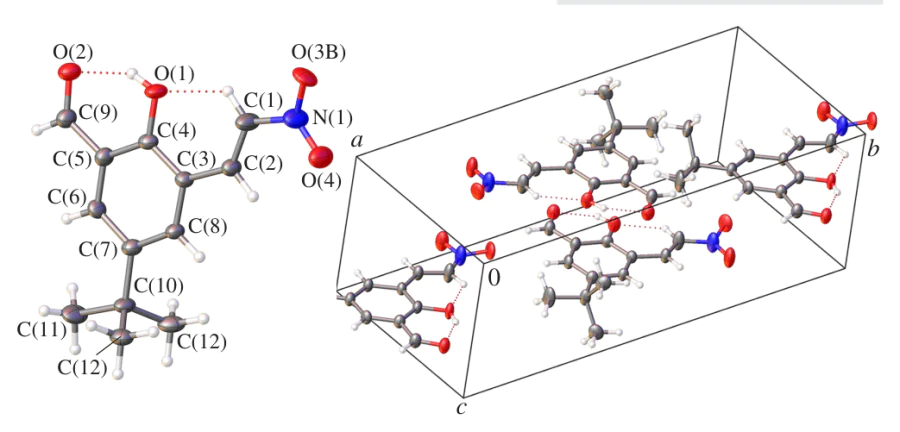
It should be noted that the X-ray crystallographic data for compound 2 (Figure 2)† do not support our hypothesis. In the crystal, the bond lengths in the aromatic ring (1.382–1.401 Å) and the C–O bond lengths of the phenol and aldehyde (1.349 and 1.224 Å) groups correspond to their standard values. However, these results cannot be considered an unambiguous refutation of our hypothesis, since the effect of keto–aldehyde tautomerism can manifest itself primarily in a highly polar medium (nitromethane/acetic acid, i.e. in solution). Interestingly, compound 2 represents a rare example of substituted 2-(2-hydroxyphenyl)-1-nitroethylenes,[29] studied by XRD analysis. Intramolecular hydrogen bond O(2)···H–O(1) in 2 (∠148°, O(2)···H 1.87 Å, H–O(1) 0.82 Å, O(2)–O(1) 2.60 Å) may be described as moderate in terms of strength.[30] Furthermore, intramolecular hydrogen bonds in 1 and 2 are characteristic in IR spectra (1657 and 1651 cm–1, respectively; cf. 1686 cm–1 for 3 and 1686 cm–1 for 4).
To unambiguously confirm this hypothesis, we obtained TBS-protected (TBS is ButMe2Si) phenol 3 (see Scheme 1). The stable silyl protecting group should have prevented the establishment of tautomeric equilibrium, however it was destroyed under the synthesis conditions (i.e. prolonged heating in AcOH). As a result, the non-symmetrical derivative 2 was again obtained as the sole product.
Replacement of OH by OMe using a known method[31] yielded stable methyl ether 4 (see Scheme 1). It should be noted that aldehyde resonances for compounds 3 and 4 in the 1H NMR spectra are quite narrow. The general Knoevenagel condensation procedure yielded symmetrical bis(nitrovinyl) compound 5 as the sole product. Interestingly, that in this case, we did not detect a condensation product at only one formyl group. Apparently, the formation of a strong mesomeric acceptor (nitrovinyl group) in the structure, when the compound cannot be converted to a keto tautomeric form, leads to a significant increase in the electrophilicity of the second formyl group. Consequently, the monocondensation product is more active and does not accumulate in the reaction mixture. Preliminary attempts to remove methyl O–Me protecting group in 5 (which contains sensitive vinyl groups) by action of BBr3[] resulted in predominant uncontrolled polymerization.
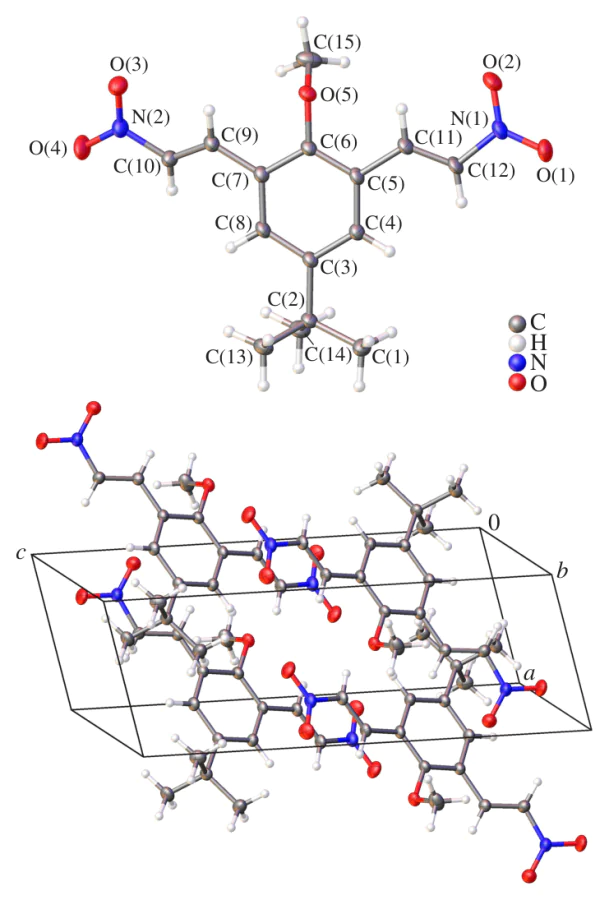
The molecular structure of compound 5 was studied in a crystal by XRD analysis (Figure 3).† The C(sp2)–C(sp2) bond lengths in the nitrovinylic fragments are 1.332 and 1.329 Å, which are slightly shortened compared to a typical isolated double bond due to conjugation with the electron-withdrawing nitro group. The C(Ph)–O bond length (1.377 Å) is unremarkable and falls within the standard range for C(aryl)–O bonds (1.36–1.39 Å).
Upon analysis of the crystal packings of compounds 2 and 5, we found that both compounds exhibited different supramolecular architectures. Despite the fact that the centroid-to-centroid distance between aromatic rings in compound 2 is 3.934 Å, the shortest interplanar distance is approximately 3.4 Å, indicating the presence of a π···π interaction with a significant mutual slip of the aromatic rings. This leads to the formation of supramolecular chains aligned along the c-axis [see Online Supplementary Materials, Figure S20(a)].
In compound 5, the distance between the centroids of the nearest aromatic fragments is 5.85 Å, indicating the absence of π···π interactions. However, the introduction of a second NO2 group into the structure results in the formation of a network of N–O···π interactions. The corresponding O···Cg distances (Cg is the centroid of the aromatic fragment) show only minor differences, being 3.465 and 3.347 Å, respectively. This network leads to the formation of a supramolecular layered structure [Figure S20(b)]. Furthermore, the packing of both compounds is stabilized by multiple C–H···O interactions, with H···O distances ranging from 2.404 to 2.591 Å (see Online Supplementary Materials, Table S12).
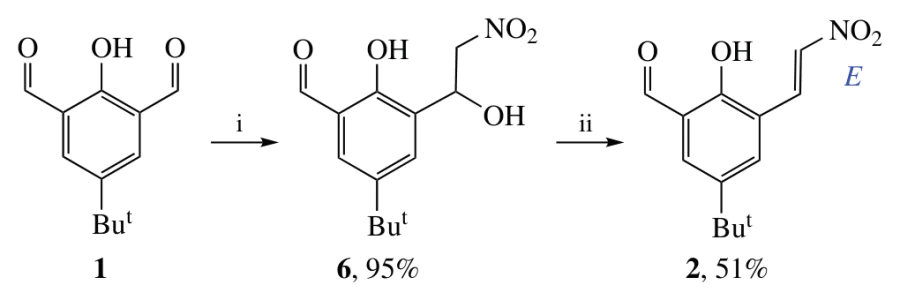
In order to study the influence of intramolecular hydrogen bonding on the condensation process, we investigated the Henry reaction in the presence of sodium hydroxide. However, despite the complete conversion of the starting aldehyde, it was not possible to isolate any individual products due to the formation of a complex mixture of compounds. The reaction of dialdehyde 1 with excess nitromethane in the presence of imidazole as a base (Scheme 2) gave selectively the monocondensation product 6 (yield 95%); the absence of the second condensation can be attributed to low solubility of nitro alcohol 6. The dehydration of the latter led to the corresponding nitroalkene 2 (51%). Thus, the use of imidazole is effective for obtaining monocondensation Henry products of type 2, but does not allow condensation at both carbonyl groups. However, the preparation of monosubstituted products under acidic conditions remains preferable, since this route is a single-step process (see Scheme 1; also compare total yields of 61 vs. 48%).
In conclusion, the high selectivity of the condensation of 4-tert-butyl-2,6-diformylphenol with nitromethane and the impossibility to drive the reaction at both formyl groups under standard conditions were demonstrated. A novel strategy involving the reduction of tautomerism for the preparation of bis(nitrovinyl)-substituted phenol was developed. These results can serve as a foundation for new possibilities in the synthesis of symmetrical and nonsymmetrical precursors for the subsequent preparation of NON pincer ligands with flexible ‘arms’.
The registration of NMR spectra in this work was supported in part by M. V. Lomonosov Moscow State University Program of Development. The article was prepared within the framework of the state assignment of the Department of Organic Chemistry of M. V. Lomonosov Moscow State University (no. AAAA-A21-121012290046-4 ‘Synthesis and study of physical, chemical and biological properties of organic and organoelement compounds’).
Crystal data
† Crystal data for 2. C13H15NO4 (M = 249.26), space group Pbcm, a = 8.738(3), b = 20.276(6) and c = 6.849(2) Å, β = 90°, V = 1213.5(7) Å3, Z = 4, μ(MoKα) = 0.102 mm–1. Single crystal X-ray study was performed at 120 K with a Bruker APEX II diffractometer (MoKα radiation, ω-scanning). An the angles 4.2 < 2θ < 52.79°, total of 11349 reflections were measured, 1352 unique reflections (Rint = 0.0784), 990 reflections with I > 4σ(I ). The final R1 = 0.0980, wR2 = 0.1942 (all data) and R1 = 0.0731, wR2 = 0.1799 [I > 2σ(I )], GOOF = 1.083. Largest diff. peak/hole 0.52 and –0.27 e Å–3. Crystal data for 5. C15H18N2O5 (M = 306.31), space group P\(\bar{1}\), a = 5.9374(5), b = 9.4363(7) and c = 14.7316(14) Å, α = 102.708(3)°, β = 100.263(3)°, γ = 104.130(3)°; V = 756.97(11) Å3, Z = 2, μ(MoKα) = 0.102 mm–1. Single crystal X-ray diffraction analysis was performed on a Bruker D8 Venture diffractometer equipped with a CCD
Funders
References