
Abstract
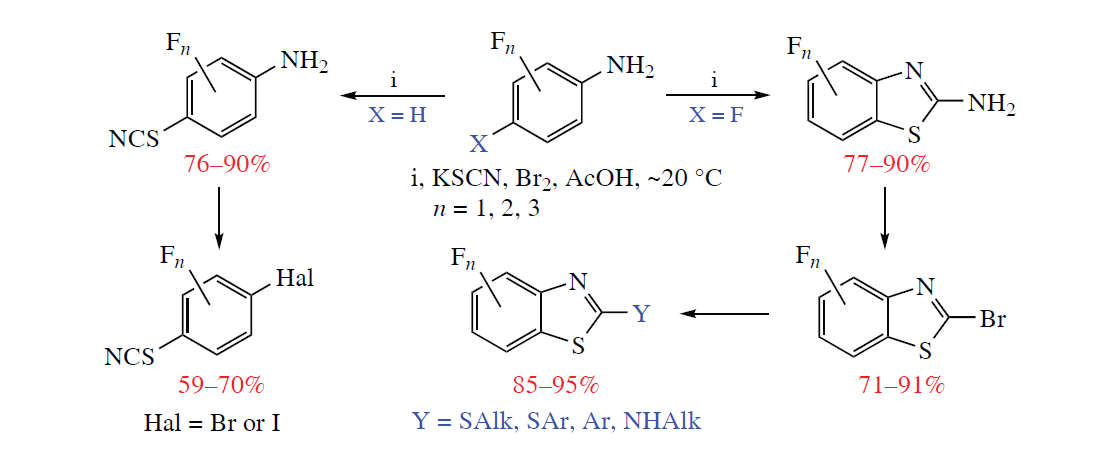
The reaction of fluorinated anilines with the KSCN/Br2/AcOH reagent system at room temperature affords the corresponding 4-thiocyanatoanilines when the substrates contain para-positioned hydrogen atom; if this position is occupied by fluorine, the ‘NCS+’ attack occurs at the ortho position thus leading to fluorinated 2-aminobenzothiazoles. The diazotization of these amino derivatives enables the facile synthesis of new bromine- and iodine-containing analogues. In such 2-bromo(polyfluoro)benzothiazoles, the bromine atom can be readily replaced by organylthio, aryl, or alkylamino groups.
Keywords
Communication
Organofluorine compounds exhibit special properties and improved biological activity compared to molecules of a similar structure without fluorine atoms.[1] Currently, about 20% of the commercial drugs are fluoropharmaceuticals.[2] Commercial fluorinated anilines play a noticeable role in organic fluorine chemistry serving as versatile building blocks for a wide range of significant chemicals, including biologically active heterocycles,[3, 4] in particular, benzothiazoles.[5, 6]
The purpose of this work was to study the reactivity of polyfluoroanilines 1a–f in the KSCN/Br2/AcOH reagent system to obtain practically important fluorinated compounds. In fact, the reaction products were either aryl thiocyanates 2a,b or 2-aminobenzothiazoles 3a–d (Scheme 1). The use of 2,4,5-trifluoroaniline proved ineffective: none of individual compounds was isolated from the reaction mass which was a complex mixture of initial reactant and unidentified substances (19F NMR data).
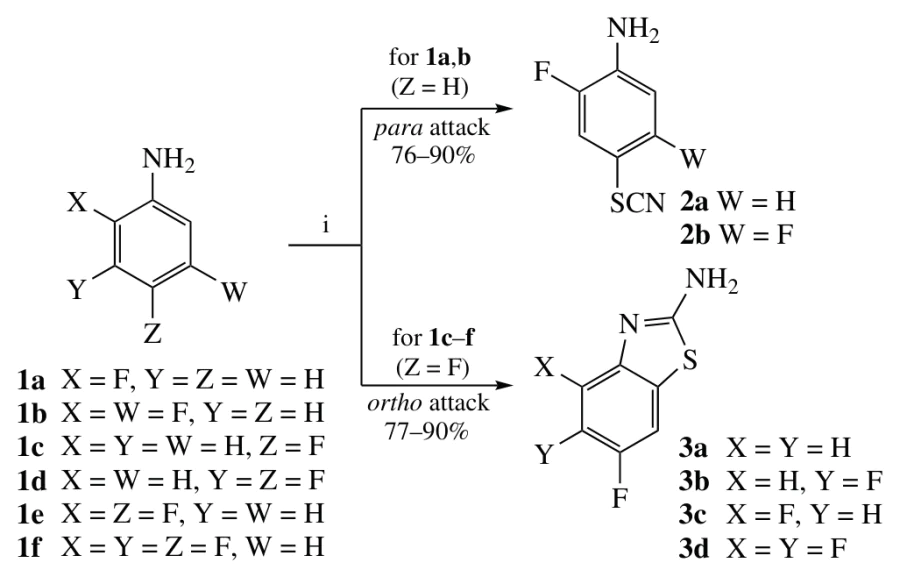
It is noteworthy that the precursors of thiocyanates 2a,b were anilines 1a,b containing a hydrogen atom in the para-position, while 2-aminobenzothiazoles 3a–d were formed from para-fluoro anilines 1c–f. A number of test experiments were carried out to understand the mechanism of the transformations (see Scheme 1 as well as Scheme S1 of Online Supplementary Materials). Using 1e as an example, it was found that the addition of excess KSCN to fluorinated anilines in AcOH at room temperature followed by stirring of the reaction mixture for 20 h does not lead to N-arylated thioureas (compound 1e remained unchanged). This indicates that thiocyanic or isothiocyanic acids, into which KSCN should be transformed in AcOH, are not enough strong electrophiles to react with amino group of fluorinated anilines. On the other hand, it was found that careful addition of an equimolar amount of Br2 to 1c in AcOH leads to non-selective bromination of this substrate: after 20 h, the reaction mass was a multicomponent complex mixture (19F NMR). From this observation, it can be supposed that the selective formation of 2 and 3 does not include the stage of electrophilic aromatic bromination of fluorinated anilines. Based on these experimental facts, it can be suggested that the active electrophile involved in the transformation of 1 into 2 and 3 can be in situ generated thiocyanogen (SCN)2 arisen from the reaction of KSCN with Br2 in AcOH (cf. ref. [7], see Scheme S1). Apparently, the precursor of the heterocyclic product 3 is 2-thiocyanatoaniline which would undergo the further heterocyclization.[7] So, the mechanism of the formation of 2-aminobenzothiazoles 3 from aniline in the KSCN/Br2/AcOH system, widely used in laboratory practice,[8] differs from that of two-step procedure[9, 10] consisting in the preparation of N-arylthiourea (formed by heating of aniline with KSCN in an acidic medium) and its subsequent cyclization by the action of bromine. In our case, the reaction begins with the attack of the electrophile (SCN)2 on the carbon atom in the aromatic ring of aniline, while in the second case[9, 10] the electrophile HSCN attacks the amino group.
Aryl thiocyanates are of interest in the preparation of sulfur-containing compounds;[7, 11] accordingly, many methods of their synthesis have been developed.[12] For the direct introduction of the SCN-group into the aromatic ring, thiocyanatosaccharin with FeCl3,[13] KSCN with NBS,[14] NH4SCN with o-iodoxybenzoic acid,[15] electrogenerated thiocyanogen[16] and other reagents[17] were used. Herein, we found that the KSCN/Br2/AcOH reagent system is a good contribution to the abovementioned pool applicable to 4-H-anilines with acceptor substituents.
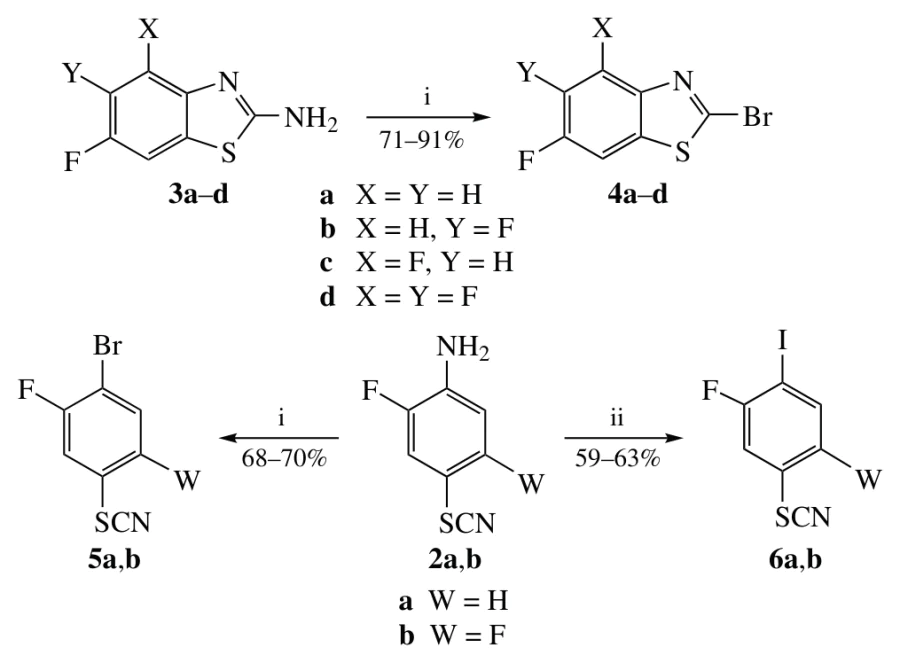
To study the synthetic potential of amino derivatives 2 and 3, we subjected them to diazotization with mild, easy-to-handle and environmentally friendly tert-butyl nitrite[18] in the presence of CuBr2[19] or I2[20] in MeCN at room temperature. As a result, new bromine- (4, 5) and iodine-containing (6) (het)arenes were obtained (Scheme 2).
Fluorinated halo(het)arenes 4–6 were then subjected to reactions with nucleophiles (Scheme 3), the cross-coupling reactions being the formal versions of nucleophilic substitutions. 2-Bromobenzothiazole 4b gave a Suzuki cross-coupling product 10 by reacting with 4-methoxyphenylboronic acid in 88% yield (reaction iii). However, an attempt to introduce aryl iodide 6a into the Sonogashira cross-coupling with (ethynyl)triisopropylsilane (Pri 3SiC≡CH, PdCl2(PPh3)2, CuI, Et3N, DMF, room temperature, 72 h) was unsuccessful: the substrate 6a unexpectedly underwent S-decyanation to afford thiophenol derivative 7 of formula 3-F-4-IC6H3SH (95% yield). No examples of similar transformations could be found in the literature, although it is known that aryl thiocyanates themselves can be obtained via the Au-catalyzed reactions of aryl iodides and AgSCN.[21] In any case, additional research is required to explain this experimental fact.
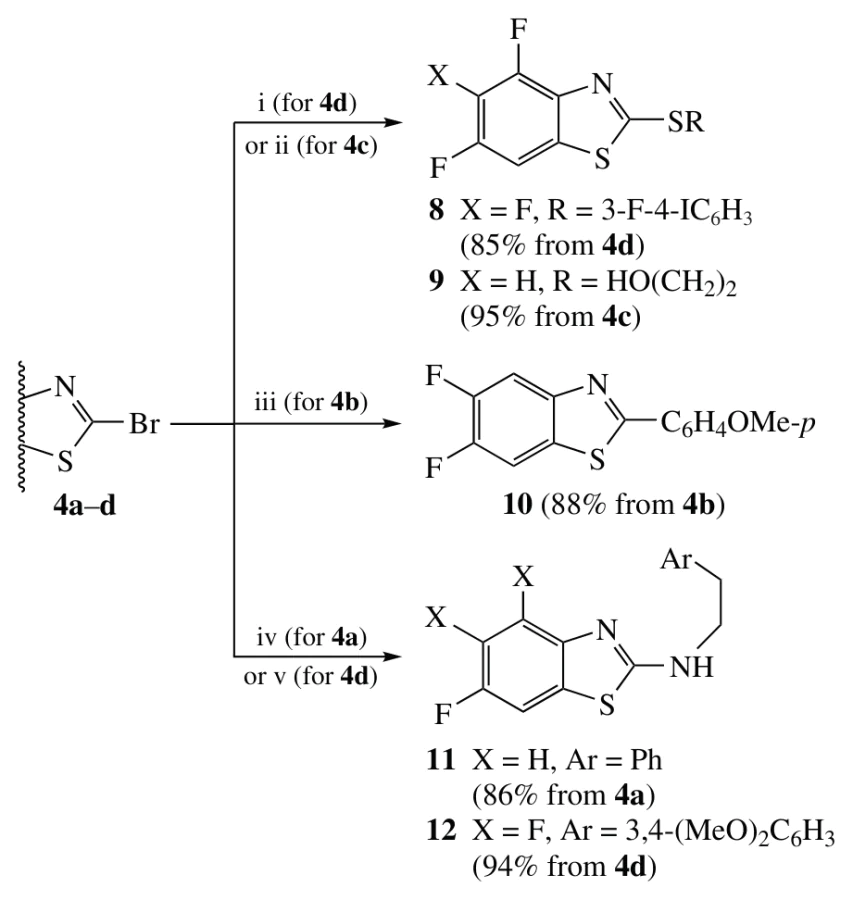
The abovementioned thiophenol derivative 7 was successfully utilized as the S-nucleophile in the reaction with 2-bromo-4,5,6-trifluorobenzothiazole 4d to produce sulfide 8 (see Scheme 3, reaction i). Analogous reaction of substrate 4c with 2-mercaptoethanol (reaction ii) afforded sulfide 9. The reaction of trifluoro bromide 4d with primary amine (reaction v) carried out in the presence of DIPA in MeCN at 50 °C for 24 h led to secondary amine 12 in excellent yield. A decrease in the number of fluorine atoms in the benzene ring caused a serious decrease in electrophilicity of substrate 4a as 240 h heating at 70 °C was required to achieve 86% yield of product 11 from phenethylamine (reaction iv). Unlike fluorinated 2-bromothiazoles 4, bromoaryl thiocyanates 5 did not react with nucleophiles under similar reaction conditions remaining intact.
In conclusion, the study of the reactivity of fluorinated anilines in the KSCN/Br2/AcOH system indicates that the substrate structure affects the type of product, namely, 4-H-anilines give rise to 4-thiocyanatoanilines while 2-aminobenzothiazoles are formed from 4-F-anilines. The halogen derivatives 4a–d and 6a (7) obtained via the diazotization of fluorinated 2-aminobenzothiazoles 3 and 4-thiocyanatoaniline 2a were used in the synthesis of more complex benzothiazole objects 8–12 being of interest for biological study. The reactivity of 2-bromobenzothiazoles towards nucleophiles increases with an increase in the number of fluorine atoms in the benzene ring of the substrate due to the cumulative acceptor effect of these substituents.
The author is grateful to the Multi-Access Chemical Service Center of SB RAS for spectral and analytical measurements.
References