Abstract
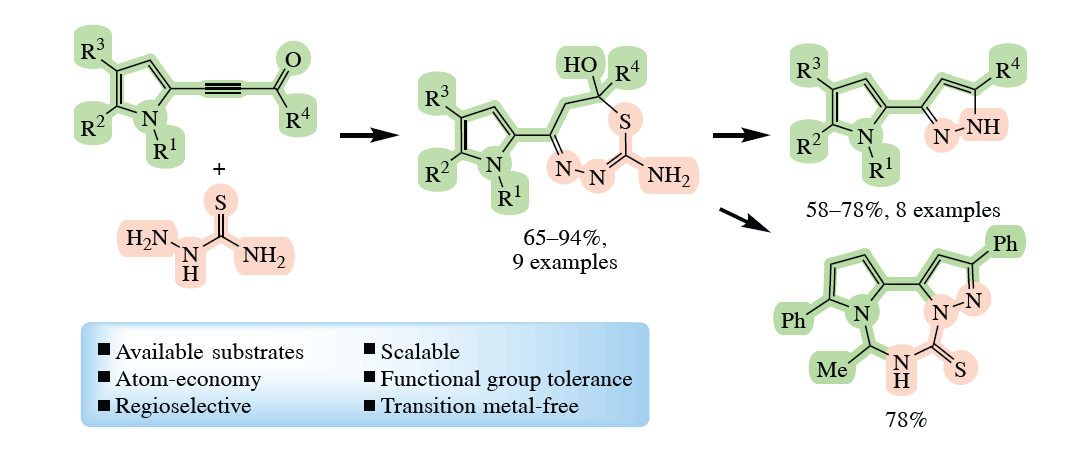
New (pyrrol-2-yl)-1,3,4-thiadiazepin-7-ols were prepared by the base-assisted [3 + 4] cyclization of 2-(acylethynyl)pyrroles and thiosemicarbazide (NaOH, DMF, room temperature, 1–3 h) in 65–94% yield. The subsequent TsOH-catalyzed dehydration provides either 3-(pyrrol-2-yl)pyrazoles or unexpected pyrazolo[1,5-e]pyrrolo[2,1-g][1,3,5]triazepine-5-thione derivative.
Keywords
Communication
Among seven-membered heterocyclic systems, thiadiazepines have emerged a considerable interest due to their synthetic prospects[1-3] and biological properties.[4-11] The overwhelming majority of thiadiazepines reported have a ring system fused with benzene or triazole rings, the literature data on the synthesis of the monocyclic thiadiazepine heterocycle are scarce and unpractical.[1-3] Among the few systematic studies, a [4 + 3] cascade cyclization of pyridinium 1,4-zwitterionic thiolates with azoalkenes under mild conditions to afford 2,5-dihydro-1,4,5-thiadiazepines has been described.[12] Acetylenic ketones have found limited application in thiadiazepine synthesis. The known examples reported to date involves the cycloaddition of thiosemicarbazides with 1-acyl-2-phenylacetylenes, which afforded representatives of dihydro-1,3,4-thiadiazepin-7-ols in 71–86% yield.[13, 14] Notably, pyrrole-containing thiadiazepine derivatives have not yet been described.
Herein we report on a base-assisted assembly of (pyrrol-2-yl)-1,3,4-thiadiazepines from readily accessible[15, 16] activated 2-(acylethynyl)pyrroles and thiosemicarbazide under mild conditions. The feasibility of this synthesis was examined using the model 2-(benzoylethynyl)pyrrole 1a (Scheme 1). The labile NH proton of the pyrrole ring provides additional reactivity,[17] potentially leading to competing cyclizations involving the triple bond, the pyrrole ring, and the C=S group, which could result in thiazole formation.[18, 19] The Glotova conditions[13] for the cyclization of thiosemicarbazide with 1-acyl-2-phenylacetylenes (MeOH, reflux, 2 h) proved completely ineffective in our case; only starting material 1a was detected in the reaction mixture, underscoring the significant influence of the pyrrole ring on the electronic structure and, consequently, the reactivity of 2-(acylethynyl)pyrroles.
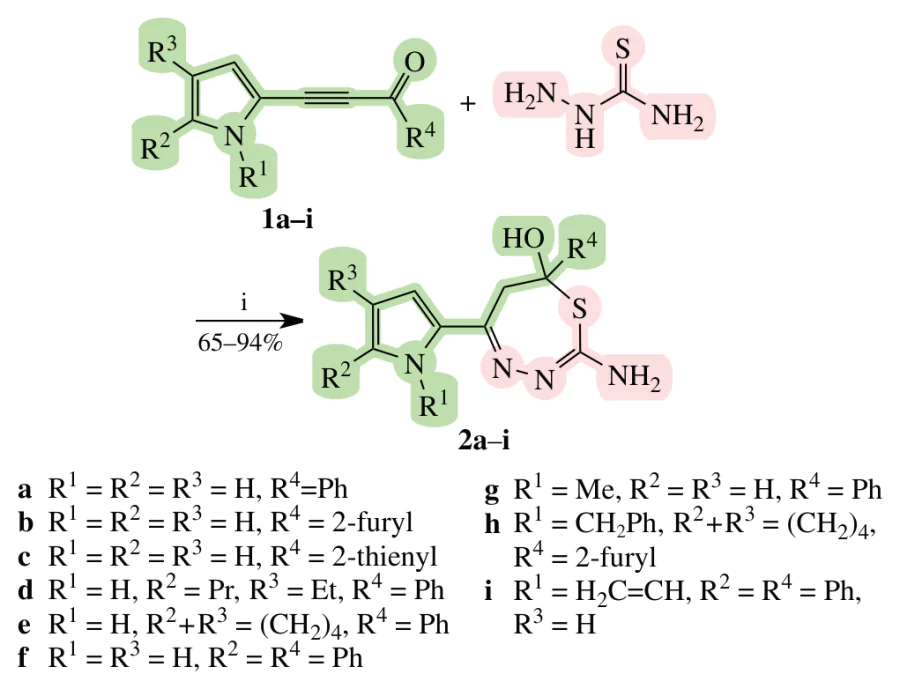
We hypothesized that carrying out the reaction under basic conditions (widely applied for self-organization of heterocycles[20]) could facilitate the nucleophilic addition of thiosemicarbazide to the triple bond. After a series of experiments (see Online Supplementary Materials, Table S4), we have found opimal conditions (NaOH, DMF, 20–25 °C, 1 h) under which thiadiazepin-7-ols 2a–i were synthesized in high yields of up to 94% (see Scheme 1).
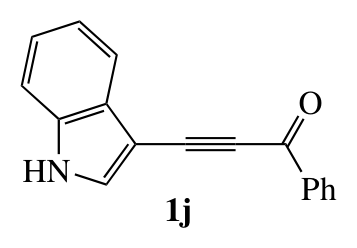
Noticeable reaction decelerating for N-substituted representatives 2g–i can be explained by pyrrole NH-deprotonation of 2a–f under basic conditions: enhanced push–pull effect in pyrrolate anions increases polarity and, consequently, the reactivity of the acetylenic bond toward thiosemicarbazide addition. 3-Ethynylindole 1j was inactive under the reaction conditions and was recovered unchanged. This could be attributed to electronic influence of large indole π-system, decreasing activity of triple bond.
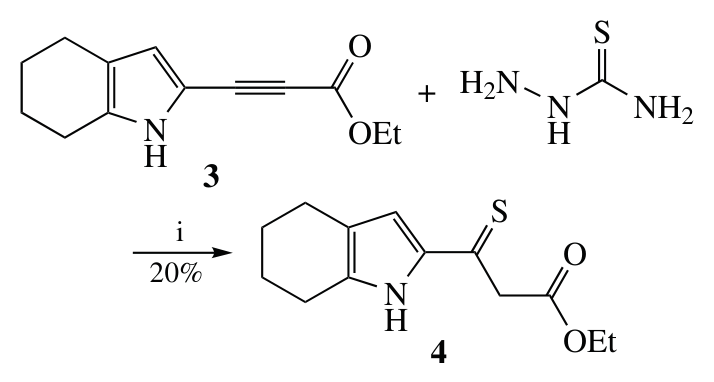
In contrast to keto ethynylpyrroles 1a–i, analogous ester 3 was not converted into the desired thiadiazepin-7-ol. Instead, only thione 4 was obtained in 20% yield (Scheme 2). Apparently, a poorer electron-withdrawing group such as CO2Et diminishes the push–pull activating effect, thus lowering the reactivity of the acetylenic bond. As a result, instead of the expected [3 + 4] cyclization, the formation of an unstable S‑adduct of thiosemicarbazide to the triple bond of 3 occurs, and the subsequent hydrolysis with trace amounts of water gives thione 4.
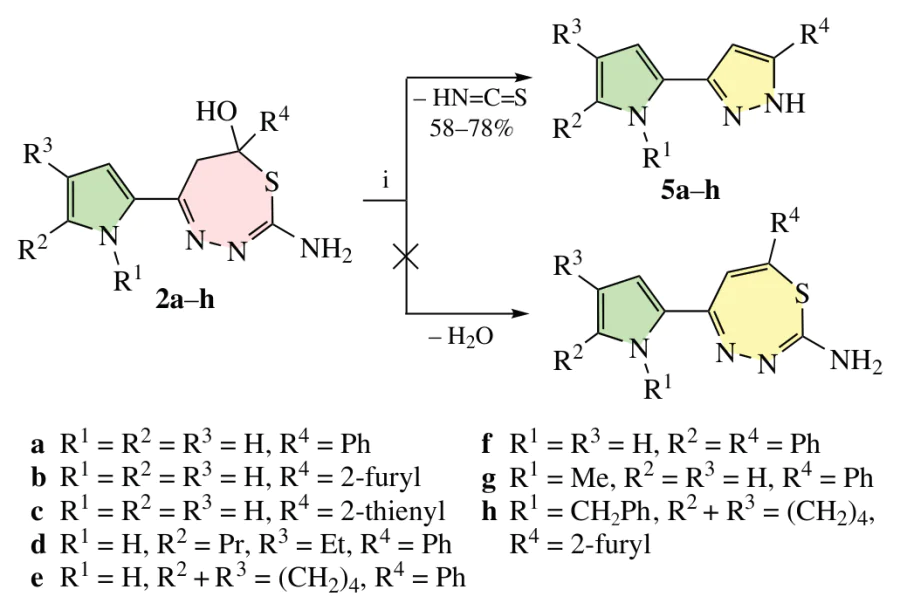
Attempts to dehydrate thiadiazepin-7-ols 2a–h to access the corresponding 1,3,4-thiadiazepines delivered only traces of the desired seven-membered structures, detected by HRMS. Instead, under acidic conditions or upon heating, thiadiazepin-7-ols 2a–h underwent chemoselective cleavage of the C–S bond with release of isothiocyanic acid affording pyrrole–pyrazole ensembles 5a–h (Scheme 3). Mild dehydration systems, often used for the transformation of tertiary alcohols to the respective alkenes, also demonstrate pyrazoles formation (BF3 · Et2O/CH2Cl2, POCl3/pyridine, SOCl2/pyridine, AlCl3/PPh3/toluene) or complete recovering of the starting thiadiazepin-7-ol (P2O5/benzene, AcOH/Ac2O/CHCl3). The transformation of thiadiazepin-7-ols 2a–h into pyrazoles 5a–h is likely driven by the antiaromatic destabilization of the expected 1,3,4-thiadiazepines and low energy of the C–S bond.
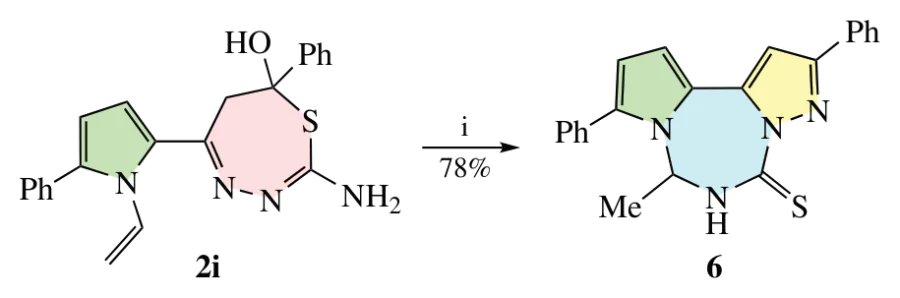
The behavior of N-vinylated derivative 2i under these dehydration conditions is completely different. It would undergo an unexpected acid-catalyzed cascade reaction involving the vinyl substituents to afford pyrazolo[1,5-e]pyrrolo[2,1-g][1,3,5]-triazepine-5-thione 6, the first representative of a previously unknown class of fused tricyclic systems combining three nitrogen heterocycles (Scheme 4). The formation of triazepine 6 likely proceeds via the cycloaddition of isothiocyanic acid (released at the pyrazole formation step) to the 3-(1-vinylpyrrol-2-yl)pyrazole intermediate.
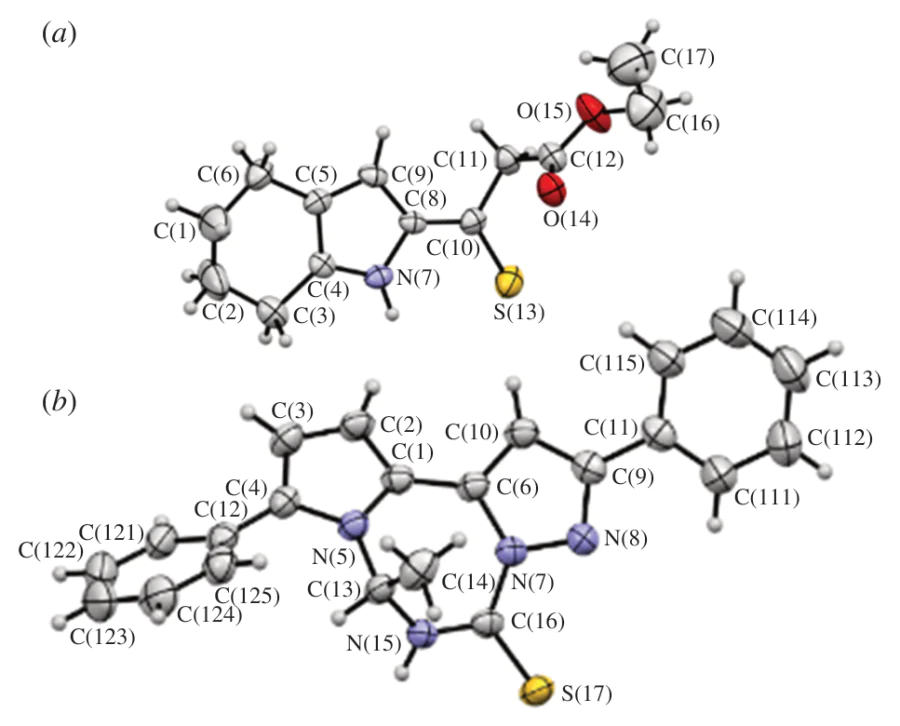
Structures of compounds 4 and 6 were unambiguously determined by X-ray analysis (Figure 1).†
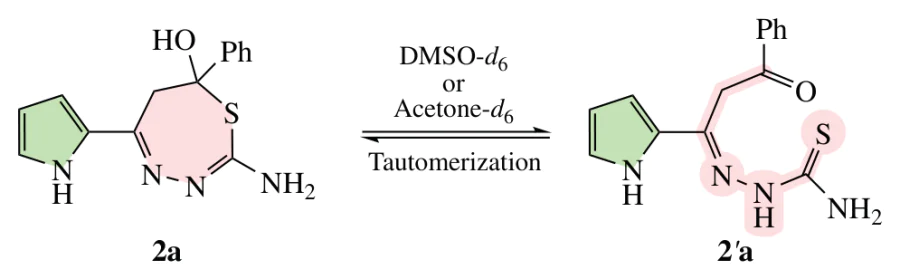
The structures of compounds 2a–i and 5a–h were confirmed by 1H and 13C NMR spectroscopy. In the DMSO‑d6 or acetone‑d6 solutions (but not in CDCl3), thiadiazepin-7-ols 2a–i were found to undergo reversible ring–chain tautomerization involving cleavage of the C–S bond, establishing an equilibrium between the cyclic thiadiazepin-7-ol and its open‑chain thiosemicarbazone tautomers in an approximate ratio of 1 : 1 (Scheme 5). The structure of the chain tautomer was established for the representative compound 2'a using 2D NMR spectroscopy. The NMR spectra of thiadiazepine 2a were recorded immediately after sample preparation and showed either the cyclic form of 2a only (in CDCl3) or 2a/2'a equilibrium (in DMSO‑d6 or acetone‑d6), remaining unchanged after 24 h. Upon heating to 60 and 80 °C, the equilibrium shifted toward the cyclic form (2a/2'a ratio ~2 : 1) and returned upon cooling to room temperature (see Online Supplementary Materials, Figure S3). Furthermore, when the same sample of the 2a/2'a mixture was evaporated from acetone‑d6 and re-dissolved in CDCl3, only the individual tautomer 2a was observed. The observed reversible C–S cleavage occurs at room temperature, thus confirming the above proposition and explaining the preferential pyrazole formation. Solvent-dependent existence of thiadiazepines and thiadiazines in equilibrium with their open-chain tautomers has been documented previously.[21-23]
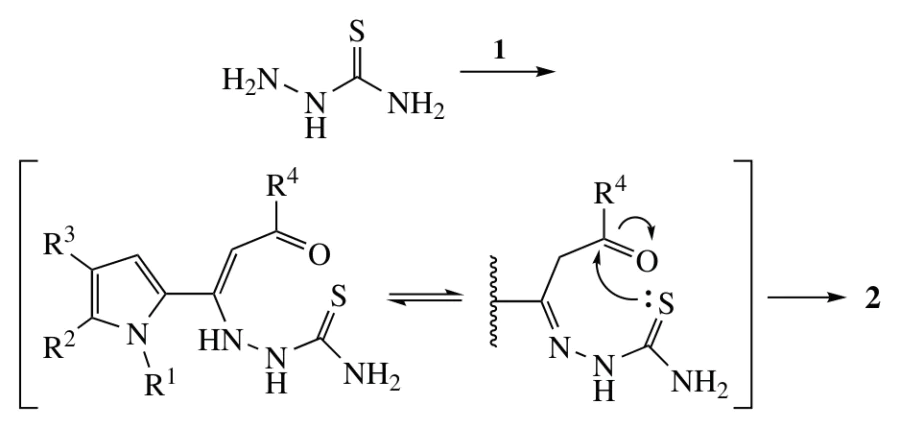
Mechanistically, the [4 + 3] cyclization involves the initial addition of the more nucleophilic[24] NH2 group of the hydrazine fragment of thiosemicarbazide to the triple bond, followed by ring closure via intramolecular attack of the sulfur atom on the carbonyl carbon (Scheme 6). The role of the base may consist in the polarization of the N–H bond of thiosemicarbazide, thereby activating it for nucleophilic attack on the acetylenic group.
In conclusion, we have successfully developed an approach to a new class of heterocyclic ensembles comprising a pharmacologically promising monocyclic thiadiazepine core linked to a pyrrole ring and bearing an NH2 group. The methodology is based on the use of readily available activated 2-(acylethynyl)pyrroles, privileged representatives of the acetylenic ketones bearing a pyrrole unit. These highly valuable building blocks undergo smooth, selective [3 + 4] cyclization with commercially available thiosemicarbazide under basic conditions to afford 2-amino-5-(pyrrol-2-yl)-6,7-dihydro-1,3,4-thiadiazepin-7-ols in high yields. Subsequent ring contraction of the thiadiazepin-7-ols in the presence of TsOH provides access to 3-(pyrrol-2-yl)pyrazoles.
Authors acknowledge Baikal Analytical Center for collective use SB RAS and Shared Research Facilities for Physical and Chemical Ultramicroanalysis LIN SB RAS (HRMS-TOF Spectra) for the equipment.
Crystal data
† Crystal data for 4. The crystals were grown by slow evaporation of a solution in n-hexane. There are two conformers in the independent part of the unit crystal cell. C13H17NO2S, M = 251.33, monoclinic space group P21/n, 296 K, a = 11.228(3), b = 14.101(3) and c = 17.525(4) Å, α = 90°, β = 103.483(8)°, γ = 90°, Z = 8, V = 2698.1(11) Å3. The crystal with dimensions 0.550 × 0.065 × 0.035 mm was selected, and intensities with 32446 reflections were measured. Crystal data for 6. The crystals were grown by slow evaporation of a solution in CHCl3. The sample obtained was a co-crystal with the solvent. C23H19N4SCl3, M = 489.83, triclinic space group P1 –, 296 K, a = 9.8691(15), b = 10.1364(15) and c = 12.7812(19) Å, α = 97.206(5)°, β = 93.392(5)°, γ = 114.329(4)°, Z = 2, V = 1147.1(3) Å3. The crystal with dimensions 0.200 × 0.150 × 0.040 mm was selected, and intensities with 27741 reflections were measured. CCDC 2554443 and 2554444 contain the supplementary crystallographic data for this paper. These data can be obtained free of charge from The Cambridge Crystallographic Data Centre via https://www.ccdc.cam.ac.uk.
References