Abstract
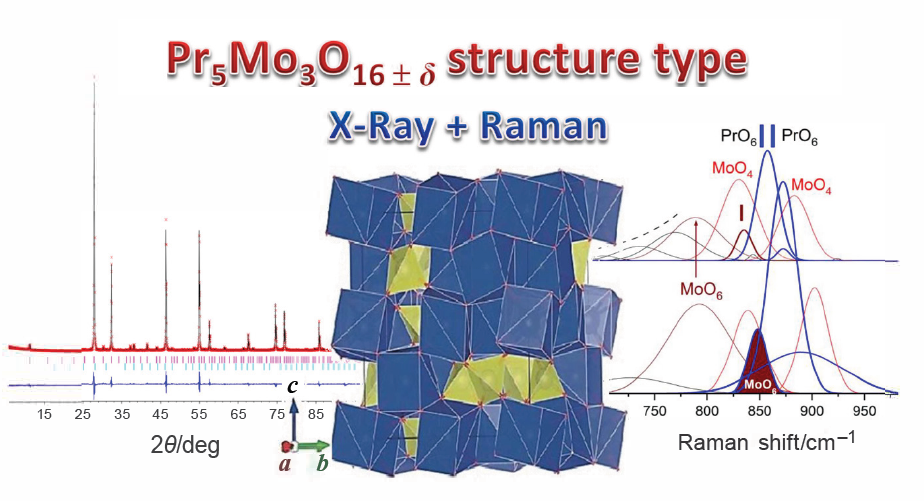
Anion-deficient praseodymium molybdate Pr5Mo2.7O16 – δ with a fluorite-type structure was synthesized by carboxylate technique. Using Raman spectroscopy, the simultaneous presence of MoO4 and MoO6 polyhedra, as well as PrO6 and PrO8 polyhedra, was revealed for the first time in the Pr5Mo2.7O16 – δ structure. The predicted high ionic conductivity in these structures is due to the percolation network of MoO4–MoO6 polyhedra.
Keywords
Communication
Molybdenum‑containing oxides crystallizing in perovskite and fluorite structures have been recently considered among the most promising electrode materials for symmetric solid oxide fuel cells. The advantage of molybdenum in such oxides is its ability to readily change its oxidation state under variations in the partial pressure of oxygen while maintaining the crystalline structure.[1] In addition, oxygen vacancies form quite easily in such structures. This ensures rapid transport of oxygen ions, which helps to increase the efficiency of the oxygen reduction reaction at the cathode.
Recently,[2] the cause of the high conductivity and instability of lanthanum molybdate was understood: a non-autonomous phase, La5Mo3O16, with high transport properties forms at the interface between the La2Mo2O9 and La2Mo3O12 phases. Similar phases containing Nd or Pr are stable.[3-8] This has driven practical interest in the production and study of fluorite-like Pr5Mo3O16 – δ (PMO). PMOs were obtained via standard ceramic technique, which requires long sintering times, high temperatures, and often does not ensure true compositional homogeneity.[3, 5-9] Considering that the practically significant properties of complex oxide materials (the degree of defectiveness, porosity, size and spatial morphology of crystallites) are determined by the synthesis method, it seems advisable to use solution methods to obtain Pr5Mo3O16 – δ. These techniques allows one to control the concentration of target defects by reducing the synthesis temperature. For example, using the sol–gel method to produce single-phase neodymium molybdate Nd5Mo3O16 + δ reduces the synthesis temperature by 200 K.[7] The structure of the Ln5Mo3O16 + δ single crystals has been studied by X-ray diffraction (XRD) methods, high-resolution transmission electron microscopy (HRTEM), energy-dispersive X-ray spectroscopy (EDXS) microanalysis and X-ray absorption near edge structure (XANES) spectroscopy.[5-7] However, we did not find a single study on the local structure of these materials using Raman spectroscopy. The only work[9] that presents experimental data on Raman spectra refers to molybdates with a different cationic composition.
At the first stage of this study, samples of the known composition Pr5Mo3O16 – δ were synthesized using precursor methods. Analysis of X-ray diffraction patterns by the Rietveld method showed that, in addition to the phase with a fluorite-like structure and cubic symmetry (space group Pn3n, No. 222), a small amount of another cubic phase is always present in the material. The amount of the impurity phase decreases with reducing oxygen activity in the atmosphere during annealing or synthesis, but it is not possible to eliminate it completely. Based on our experience with oxide materials having a fluorite-type structure, we assumed that this impurity phase is related to molybdenum-rich regions. To test this hypothesis, a new composition with reduced molybdenum content (Pr5Mo2.7O16 – δ) has been selected, which is presumably single-phase.
The aim of this study has been to develop new synthesis methods of the fluorite-like material of Pr5Mo3O16 – δ type and to investigate its composition and structure, including the local symmetry, using Raman scattering (for details, see Online Supplementary Materials). Two synthetic routes: a sol–gel method and a carboxylate precursor method, in which formic acid[10] was used as the carboxylic acid (Figures S1 and S2) were developed for the preparation of praseodymium molybdate Pr5Mo2.7O16 – δ (see Online Supplementary Materials).
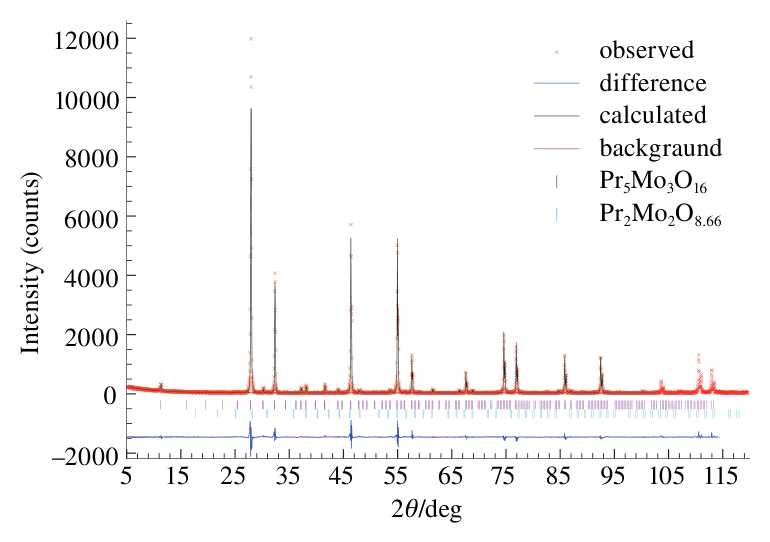
XRD analysis shows that Pr5Mo3O16 – δ prepared by the formate method contains 95.4 wt% of the main fluorite‑type phase (space group Pn3n) and only 4.6 wt% of Pr2Mo2O8.66 impurity, whereas the sol–gel product has 12.5 wt% impurity (Figure S3). By synthesizing Pr5Mo2.7O16 – δ via the formate route, the impurity content is further reduced to 0.2 wt% (Figure 1). Refined crystallographic parameters are given in Tables S1 and S2.[6, 7] These results demonstrate that the formate method is optimal for synthesizing the molybdenum‑deficient Pr5Mo2.7O16 – δ composition. Therefore, all subsequent studies were conducted on the sample prepared by the formate route.
SEM study (Figure S4) reveals crystallisation of Pr and Mo formates as spherical aggregates and fibrous crystals, respectively. The thermolysis products Pr6O11 and Mo2O3 inherit the precursor morphology (pseudomorphism). Agglomerates of Pr5Mo2.7O16 – δ are morphologically identical to Pr6O11, with uniform elemental distribution (see EDX in Figure S5).
According to the XRD data (Table S2), it is safe to assume the existence of only two allowed positions for Pr and Mo atoms. Indeed, the Pr5Mo3O16 ± δ structure consists of edge-sharing PrO8 polyhedra and vertex-sharing MoO4 tetrahedra. Therefore, the MoO4 tetrahedra in Pr5Mo3O16 form a fairly compact and mobile structural unit, capable of migrating along the loose fluorite-like structure.[5-7] However, in some rare-earth molybdates, three types of molybdenum coordination were observed simultaneously: tetrahedral (MoO4), trigonal-bipyramidal (MoO5) and octahedral (MoO6).[11, 12] Neutron diffraction data for Pr5Mo3O16 ± δ single crystals showed that Mo atoms in the main positions are surrounded by four oxygen atoms, while Mo atoms localized near the Pr positions are surrounded by six oxygen atoms.[6] Thus, a number of structural studies revealed a partial mutual substitution of Pr and Mo atoms in the Hubert structure.[5, 6, 11, 12]The disorder of the oxygen sublattice, caused by the redistribution of Pr and Mo cations, ensures the continuity of the oxygen migration network. To clarify the local structural features of the Pr5Mo2.7O16 – δ sample obtained by the formate method, Raman spectroscopy was employed.
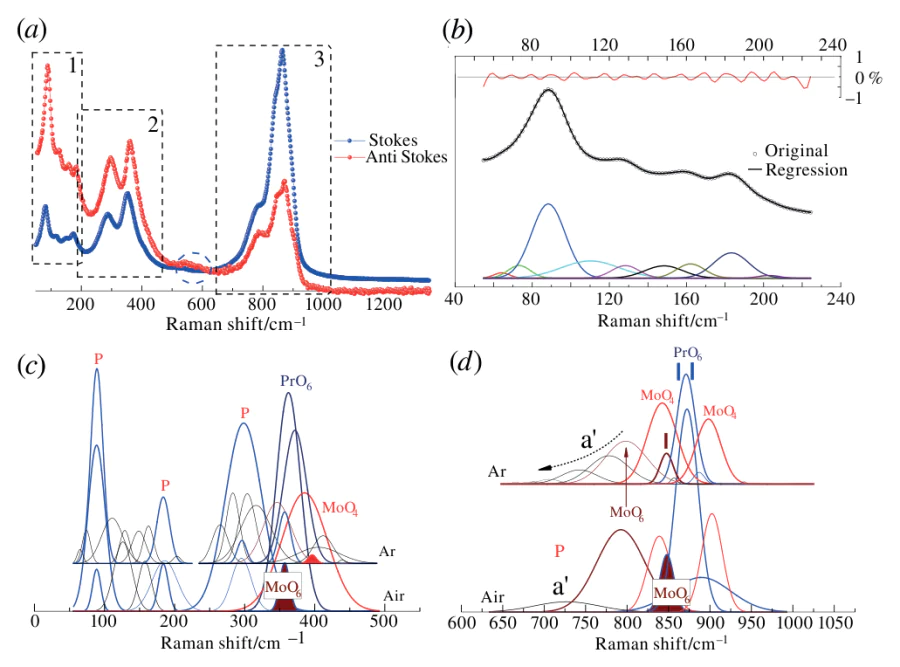
The Raman spectrum of Pr5Mo2.7O16 – δ (Figure 2(a)) differs strongly from that of pure fluorite which has only one line. To circumvent a strong photoluminescence background from anion vacancies complicating the spectrum,[13] we used anti‑Stokes acquisition. The position of the structural lines does not depend on the laser wavelength, but the luminescence lines shift significantly. The anti‑Stokes intensity decays exponentially (Figure S6), allowing reconstruction of pure structural Raman lines. Spectra obtained by the anti-Stokes method contain only structural modes. They were distinguished into a set of Gaussian lines using the Peak Separation 2 package. An example of decomposition is shown in Figure 2(b). Deconvolution into Gaussian components yields the spectra shown in Figure 2(c) and (d) for samples annealed in air and argon.
The application of this approach to the study of praseodymium molybdate proved difficult because of the complex nature of the spectrum. Therefore, we developed an alternative method for reliable identification of structural lines.[14] When an electromagnetic wave of frequency f0 hits a set of charges, they begin to vibrate, utilizing the incident energy. Of all possible frequencies, the strongest amplitudes will be observed for the frequencies of natural vibrations of the charge system jk. Because of inelastic scattering, a network of vibrations with frequencies appears: f0 + jk and f0 – jk, for k = 1…N.
Lines at 88, 183, 299, 357, 847, 871 and 888 cm–1 are independent of oxygen activity, while others shift by ~10 cm–1 with oxygen activity (362–370, 792–799, 839–843 and 902–898 cm–1). The three low-frequency lines (88, 183 and 299 cm–1) are assigned to the pyrochlore structure which is marked as ‘P’ in Figure 2(c) and Figure 2(d).[15] For classical fluorite, only one F2g mode would appear, but local symmetry lowering to pyrochlore is typical for cation‑disordered fluorites.[13] Molybdenum in molybdates can be four‑ or six‑coordinated (Table S3). Comparison with the known Raman spectra of MoO4[16] (Table S4) shows good agreement for the three lines highlighted in red in Figure 2(c) and Figure 2(d). The disappearance of the mode at 933 cm–1 indicates the absence of distortions in the tetrahedra (a decrease in the polarizability of MoO4). The asymmetric vibrational modes retain their Raman activity. According to the Raman spectra, the sample is a fluorite-type solid solution with a random cation distribution. The high concentration of oxygen vacancies promotes the formation of highly symmetrical MoO4 polyhedra. Only the combination of XRD (long-range) and Raman (short-range) provides this insight.
Literature data for MoO6 (Table S5) allow assignment of lines at 356, 847 cm–1 (oxygen‑independent) and 793/798 cm–1 (forming satellites under reducing conditions). Two intense lines at 887 and 871 cm–1 and those at 372 and 362 cm–1 are related to the PrO6 polyhedron – the first such assignment. Pr4+ in PrO6 is not known; these correspond to Pr3+.[17] Very weak lines [blue circle in Figure 2(a)] may also arise from Pr3+ polyhedra. External lattice vibrations are a superposition of librational and translational modes.[9] The 88, 183 and 299 cm–1 modes (pyrochlore) do not depend on oxygen activity. The diffuse band near 726 cm–1 (air‑annealed sample) corresponds to the F2g pyrochlore mode; its oxygen‑pressure sensitivity confirms the assignment. The 299 cm–1 mode weakens and develops satellites in argon, indicating dynamic disorder.
Pyrochlore is built of MeO8 polyhedra. Only Pr can form such polyhedra (Table S3). It should be taken into account that the MoO6 and MoO4 polyhedra are smaller than the basic polyhedra of the PrO8 lattice, which results in the ‘loosening’ of Mo‑containing polyhedra. For such loose polyhedra, anion transport can occur via rotation around the central cation – the paddle‑wheel mechanism – with significantly lower activation energy than vacancy hopping. Therefore, oxygen ion transport through the MoO6–MoO4 percolation network allows one to predict the high ionic conductivity of these molybdates.[5-18]
The nominal composition Pr5Mo2.7O16 – δ suggests a mixed valence state for Mo as Mo5+/6+ and Pr as Pr3+/4+.[19] To clarify the actual valence states, X‑ray photoelectron spectroscopy (XPS) was used. The survey spectrum (Figure 3(a)) reveals peaks for Pr, Mo, O and C, as well as Auger features. The C1s peak at 284.5 eV from adsorbed carbon served for charge referencing. The Pr3d spectrum (Figure 3(b)) displays two main peaks at 932.6 eV (Pr3d5/2) and 952.1 eV (Pr3d3/2). The spin–orbit splitting of 20.5 eV and the satellite structure indicate Pr3+.[20] Although the XPS signatures of PrO2 and Pr2O3 are similar, making it difficult to distinguish Pr3+ from Pr4+ when both are present,[18, 19] no characteristic features of Pr4+ are observed, implying that the surface is predominantly trivalent.
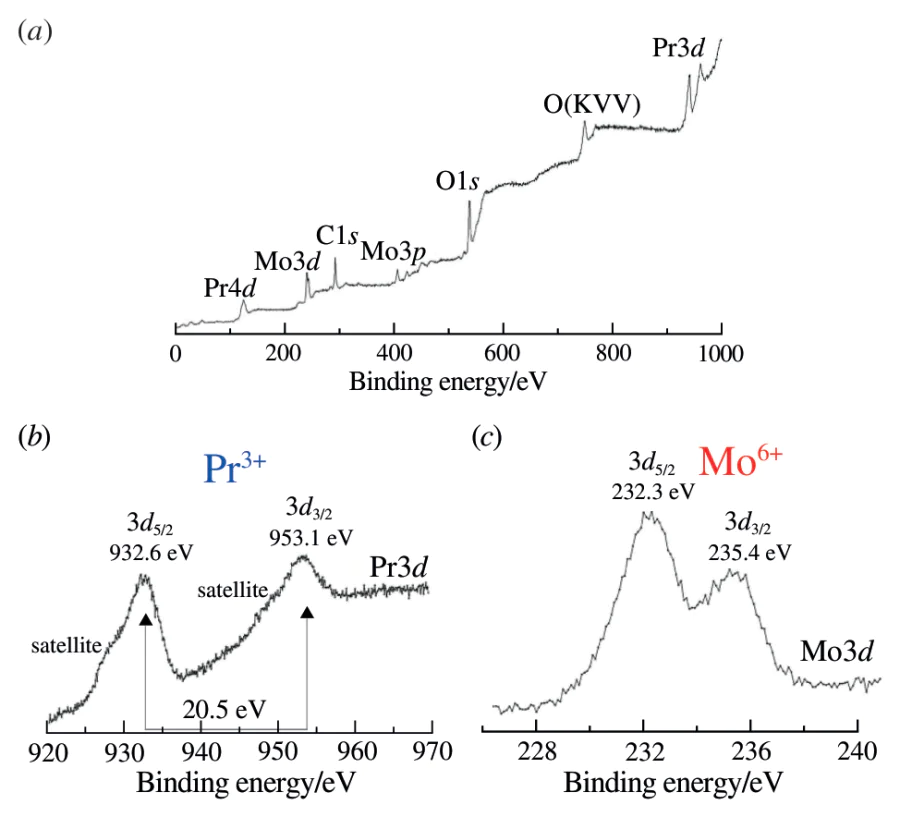
The Mo3d spectrum (Figure 3(c)) consists of a doublet at 232.3 eV (Mo3d5/2) and 235.4 eV (Mo3d3/2) which matches Mo6+.[20] Signals from Mo5+ or Mo4+ are absent. Consequently, XPS confirms the nominal composition – praseodymium oxide doped with Mo6+, with praseodymium mainly in the Pr3+ state on the surface.
Thus, the possibility of obtaining a new single‑phase Pr5Mo2.7O16 – δ using precursor technique has been demonstrated and realised. The chemical composition of the material –praseodymium oxide doped with molybdenum – was confirmed by XPS, which shows that praseodymium in the surface layers is in the ground state Pr3+ and molybdenum is present as Mo6+. Raman scattering spectra were studied using an improved method that eliminates the contamination of structural lines by photoluminescence from intrinsic defects (oxygen vacancies). Comparison with literature data allowed us to assign the observed lines to the MoO4 and MoO6 polyhedra. A set of high‑intensity lines, similar to that of the MoO6 polyhedron, is assigned to the PrO6 polyhedron. The lattice is based on a pyrochlore‑type structure built from PrO8 polyhedra. Molybdenum cations accumulate oxygen vacancies in their environment, forming a network of MoO4 and MoO6 polyhedra. The transport of oxygen anions through the MoO6–MoO4 percolation network can provide high anionic conductivity for this type of molybdate. The existence of PrO6 polyhedra is noteworthy, as it indicates that Pr‑containing polyhedra are also involved in stabilizing MoO4 polyhedra. The set of Raman lines for this polyhedron is reported for the first time.
This work was carried out in accordance with the state assignment and research plans of IHTE UB RAS and ISSC UB RAS.
Funders
References