
Abstract
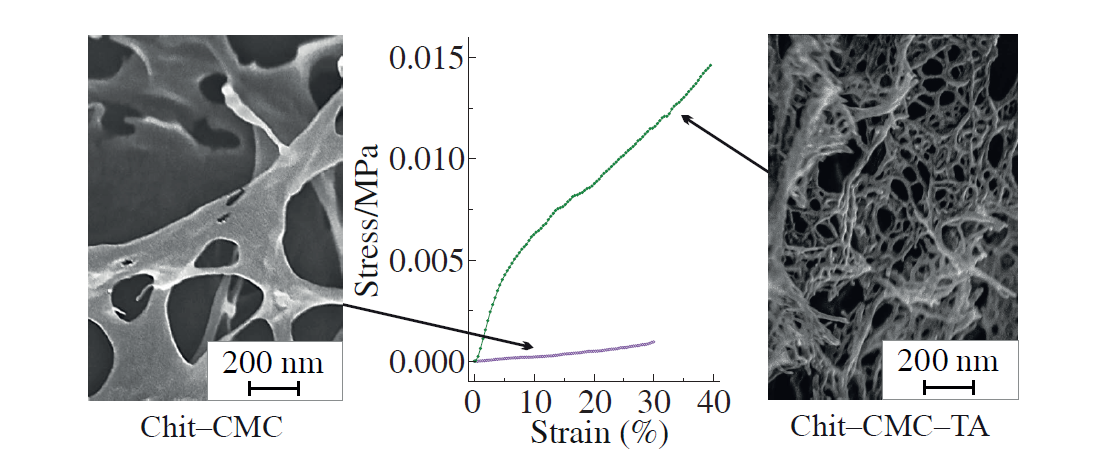
A chitosan hydrogel with tannic acid was obtained by introducing carboxymethylcellulose, which formed a polyelectrolyte complex with the cationic polysaccharide. The combination of electrostatic interactions and hydrogen bonds of the polyphenol with both polysaccharides resulted in dual crosslinking, which led to an almost thousand-fold increase in the mechanical strength of the hydrogel. Furthermore, tannic acid retained pronounced antimicrobial activity, which makes the developed hydrogel promising for biomedical applications such as wound dressings.
Keywords
Communication
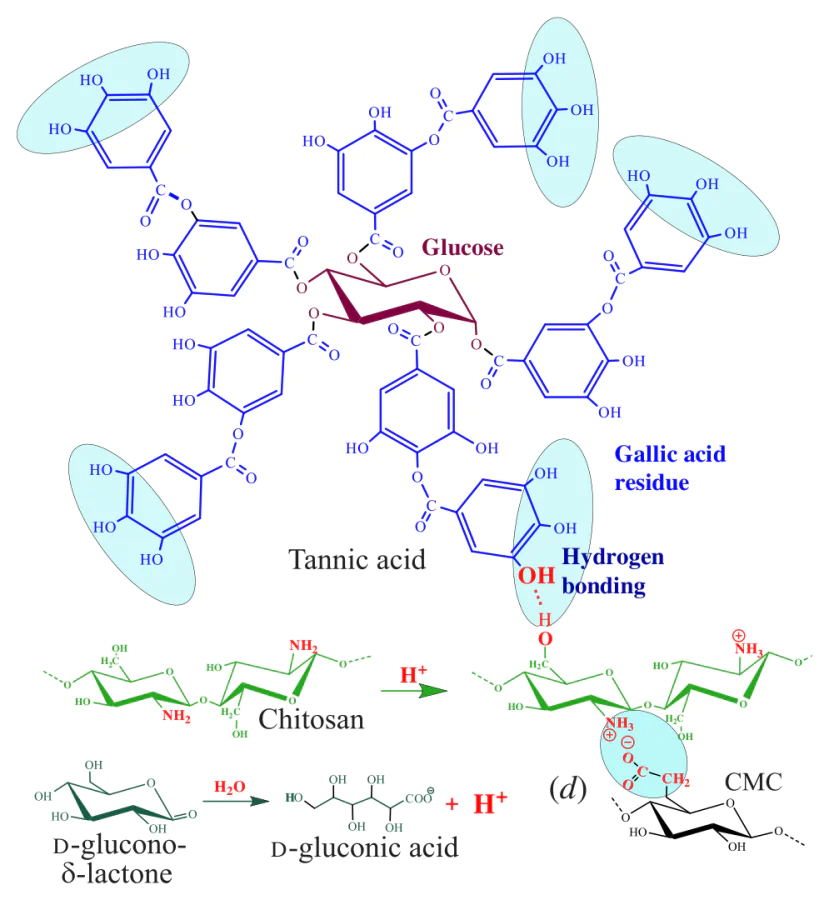
Chitosan (Chit) and polyphenol tannic acid (TA), which structural formulae are shown in Figure 1, are well-studied polymers with a wide range of biological activities. They both are non-toxic, biocompatible, and biodegradable, which allows them to be used in biomedical technologies, cosmetics, food industry, and materials contacting with humans.[1-4] However, the practical application of Chit and TA is limited by their high solubility in water and their inability to form hydrogels. When used together, they form a complex in which TA, as believed,[5] serves as a crosslinker. However, the entrapment of the polyphenol into Chit films, described earlier,[6] did not lead to an increase, but, on the contrary, to a decrease in mechanical strength, which indicates the weakening of intermolecular interactions. Strengthening of Chit–TA structures is achieved predominantly through covalent crosslinking. The most common approach is the oxidation of TA in an alkaline medium, leading to the formation of a quinone form, which is capable of interacting with amino groups of Chit via Michael addition and/or Schiff reaction.[7] It should be emphasized that oxidation is accompanied by the loss of a significant part of the reducing potential of TA, its antioxidant activity, and its ability to form hydrogen bonds and complexes, as well as by a number of biological functions.[5, 8] Thus, oxidation and covalent bonding are inevitably associated with the loss of some unique properties of the polyphenol, which limits its application possibilities.
The aim of this work was to develop stable and mechanically strong hydrogels based on Chit and TA while maintaining the polyphenol in its reduced form. To achieve this, a dual crosslinking strategy was applied, in which Chit acted as a coordinating component forming a polyelectrolyte complex with carboxymethyl cellulose (CMC), while TA bound to both polysaccharides via multiple hydrogen bonds. The use of dual crosslinking provided a (a) (b) (c) pronounced synergistic effect, resulting in an almost thousand-fold increase in the mechanical strength of the obtained hydrogels. Another important issue was to preserve the biological activity, primarily the antimicrobial action of TA, which makes the developed materials promising for biomedical applications.
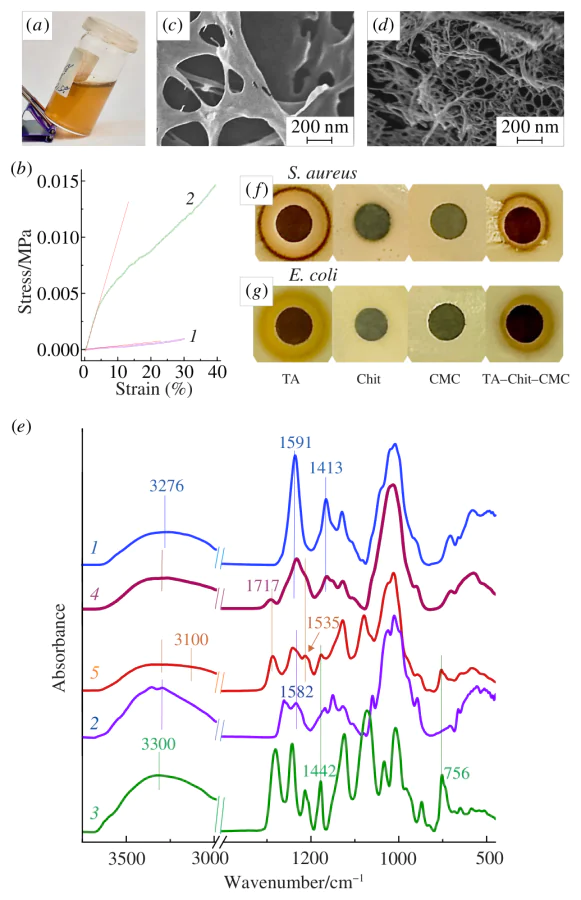
Mixing Chit and TA† solutions resulted in the formation of a white gel-like mass, which, after several hours, transformed into a viscous, transparent light brown solution (Figure 2(a)). Varying the concentrations of the starting materials did not reveal conditions under which stable gelation occurred.
† Chit was dissolved in water at pH 3–4 adjusted with acetic or hydrochloric acid; solutions of solubilized tannic acid had pH ~3.4. Chit/CMC hydrogels were prepared by charge-regulated method: Chit powder was dispersed in the CMC solution at pH ≥ 6 and then it was gradually reduced to ~4 by D-gluconic acid formed in the course of slow hydrolysis of D-glucono-δ-lactone.[9] ATR–FTIR spectra were recorded with IR Tracer100 (Shimadzu). Morphology was examined by SEM (Hitachi S5500). Mechanical characteristics were measured using Haake Mars III (Thermo Scientific). Antimicrobial activity was studied by disk diffusion assay.
Chit-based hydrogels were prepared using CMC according to the method suggested earlier.[10] It consisted of gradually charging a cationic polysaccharide, pre-dispersed in an uncharged state in a solution of an oppositely charged polyelectrolyte at pH ≥ 6. The charging was carried out by slow acidification with D-gluconic acid, which was formed during the slow hydrolysis of D-glucono-δ-lactone (abbreviated as lactone) after its contact with water (Figure 1(c)).[9]
The hydrogel prepared from Chit and CMC demonstrated satisfactory stability and elasticity; however, its mechanical strength remained low. Thus, Young’s modulus of a complex containing 1 wt% Chit and 1 wt% CMC was only 0.0027 MPa. Under uniaxial compression, samples fractured at 30–40% strain, and further loading led to complete structural failure.
The situation changed markedly upon incorporation of TA. The ternary Chit–CMC–TA hydrogels demonstrated significantly enhanced mechanical strength compared to the binary Chit–CMC systems. Introduction of TA led to an increase in Young’s modulus to 1.1 MPa, corresponding to an increase of almost three orders of magnitude (Figure 2(b)). Furthermore, the hydrogels retained their integrity under uniaxial compression up to 80% strain without signs of cracking or fracture. The absence of disintegration indicates the formation of a mechanically strong and failure-resistant three-dimensional network structure in the Chit–CMC–TA system.
The use of SEM made it possible to reveal a potential cause of the strengthening of Chit–CMC hydrogels upon the introduction of TA. As seen in Figure 2(c), the morphology of the binary Chit–CMC system is characterized predominantly by thin lamellar structures, while in the ternary mixture containing TA, a fibrillar network with a thickness of 30–50 nm can be observed (Figure 2(d)). In the latter case, there is a pronounced three-dimensional cellular organization due to the presence of numerous crosslinks between the fibrils. Such an architecture appears to provide significantly higher mechanical strength and resistance to failure compared to individual plate-like elements typical for a binary polyelectrolyte complex.
The formation of a robust network structure is attributed to additional intermolecular interactions. In the binary systems, Chit and CMC self-assemble into a three-dimensional network stabilized predominantly by electrostatic interactions between protonated amino groups and carboxyl groups carrying positive and negative charges, respectively (Figure 1(d)). In the three-component hydrogel, this electrostatically stabilized polyelectrolyte complex is also present, but it is further reinforced by interactions with TA. Owing to the galloyl residues, each containing three hydroxyl groups (Figure 1(a)), TA can form numerous hydrogen bonds with both Chit and CMC, thereby strengthening macromolecular association and promoting the formation of a more durable and stable network architecture.
The conclusions made are based on the ATR–FTIR spectra of the individual biopolymers, as well as of the binary system and the three-component hydrogel presented in Figure 2(e). The presence of TA is unambiguously confirmed by the characteristic bands at 1442 and 756 cm−1 (Figure 2(e), curve 3), corresponding to the ring carbon–carbon stretching vibrations of the C=C–C aromatic bond and the vibration of C=C in benzene rings, respectively.[6, 11] Their positions remain nearly unchanged, indicating that the aromatic framework of TA is preserved upon entrapment. In the case of amino and carboxyl groups, pronounced spectral shifts are observed, reflecting changes in their state. Thus, the amino group in the spectrum of pristine Chit appears as a band at 1585 cm−1,[11] while in the spectrum of the hydrogel, a peak at 1535 cm−1 can be found instead, assigned to the asymmetric deformation vibrations of –NH3+, which indicates its protonation (Figure 2(e), curve 3).[12] Pristine CMC, taken in the salt form, is characterized by the bands at 1591 and 1413 cm−1, corresponding to the asymmetric and symmetric stretching vibrations of the –COO− groups (Figure 2(e), curve 1).[11] In the hydrogel spectrum, a new band is observed at 1717 cm−1, corresponding to the C=O stretching vibration. Its appearance is associated with a shift of the system pH to the mildly acidic region upon addition of the lactone (Figure 1(c)), resulting in a partial transformation of CMC into the acidic form.
The formation of hydrogen bonds can be inferred from the spectral region corresponding to the hydroxyl stretching vibration ν(O–H).[11] In this region, the broad peaks are observed at 3324 cm−1 for Chit (Figure 2(e), curve 2), 3276 cm−1 for CMC (Figure 2(e), curve 1), and 3300 cm−1 for TA (Figure 2(e), curve 3). Upon mixing these three biopolymers, the band becomes markedly broadened due to the appearance of the low-frequency shoulder with a maximum at 3100–3050 cm−1 (Figure 2(e), curve 5). Notably, this shoulder is noted solely in the spectrum of hydrogel, i.e., only after the introduction of TA, whereas it is actually absent in the spectrum of the binary system (Figure 2(e), curve 4). The observed shift toward lower frequencies (Figure 2(e), curve 5) indicates the formation of hydrogen bonds,[12] to which polyphenols, and TA in particular,[4] are highly susceptible due to their multiple hydroxyl groups (Figure 1(a)).
The combination of these hydrogen bonds with electrostatic interactions results in a dual-crosslinking network. In our view, their interplay leads to a pronounced synergy, manifested in the substantial increase in mechanical strength when changing from the Chit–CMC binary mixture to the Chit–CMC–TA hydrogel (Figure 2(b)).
The antimicrobial activity of the hydrogels was investigated by the disk diffusion method against gram-positive Staphylococcus aureus KMM 434 (Figure 2(f)) and gram-negative Escherichia coli KMM 8450 (Figure 2(g)) bacteria from the Collection of Marine Microorganism Cultures of the G. B. Elyakov Pacific Institute of Bioorganic Chemistry, Far East Branch of the Russian Academy of Sciences, as described previously.[13] The results showed that the antimicrobial effect is predominantly associated with TA. CMC showed no signs of inhibition of microbial growth, while Chit had only a very weak effect, and solely against S. aureus. In contrast, the three-component Chit–CMC–TA hydrogel showed a pronounced antimicrobial activity toward both test strains (Figure 2(f),(g)). Since in control experiments the well-pronounced activity was predominantly detected only for the polyphenol, it can be concluded that TA is the key antimicrobial component in the Chit–CMC–TA system, imparting the biological functionality of the developed hydrogels.
IP, OK and YS were supported from the budget of the Institute of Chemistry, Far Eastern Branch, Russian Academy of Sciences (state assignment no. FWFN-2025-0005).
Funders
References