Abstract
The photophysical properties of the promising photoactivated anticancer complex [{(bpy)2Ru(dpp)}2RhCl2]5+ [bpy = 2,2'-bipyridine, dpp = 2,3-di(pyridin-2-yl)pyrazine] were investigated using ultrafast transient absorption spectroscopy and laser flash photolysis. It was found that photoexcitation of the complex leads to the formation of a metal-to-metal charge transfer (MMCT) excited state with a lifetime of 1–2 ns.
Keywords
Communication
Photoactivated chemotherapy (PACT)[1-5] is a promising light-based strategy for cancer treatment that complements photodynamic therapy (PDT),[1, 3, 6-9] a widely used clinical modality. In most cases, the mechanism of PDT relies on the generation of singlet oxygen (1O2) via triplet–triplet energy transfer from a light-excited photosensitizer to a 3O2 molecule.[1] In PACT, an inert form of a metal complex (typically based on platinum-group metals) is administered to the body and subsequently activated by light directly within the tumor region. For example, PtIV complexes can undergo two-electron photoreduction; the resulting PtII complexes mimic the cytotoxic action of the well-known anticancer drug cisplatin.[1, 10, 11] An additional cytotoxic effect can be achieved through the generation of reactive free radicals, such as •N3 (in the case of extensively studied diazido-PtIV complexes).[10, 11] A key advantage of PACT over conventional PDT is its independence from the presence of dissolved molecular oxygen, making it particularly valuable for treating hypoxic tumor tissues.[1, 12]
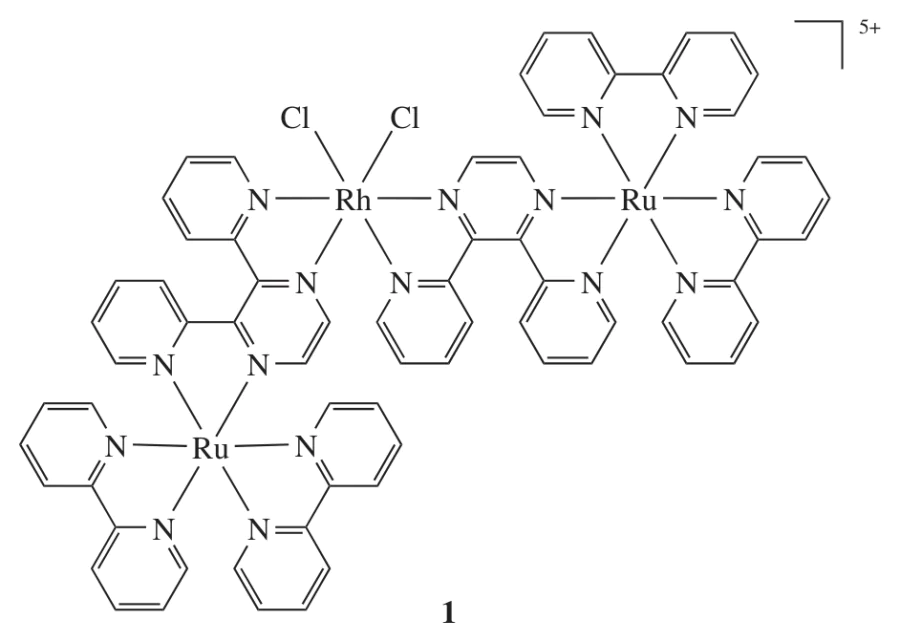
Among the platinum-group metal complexes investigated for application in the PACT method, supramolecular triads (hereinafter referred to as triads), developed by Karen Brewer’s group, are of particular interest.[13-21] The general formulae of these complexes are [{(LA)2MII(BL)}2MIIICl2]5+ or [{(LA)ClMII(BL)}2RuCl2]3+, where MII is RuII or OsII, MIII is RhIII or OsIII, LA is a light-absorbing ligand, and BL is a bridging ligand. An example of such a complex is [{(bpy)2RuII(dpp)}2RhIIICl2]5+ 1, where bpy is 2,2'-bipyridine and dpp is 2,3-di(pyridin-2-yl)pyrazine.
The photophysical properties of the triads are determined primarily by the nature of the lowest excited electronic state: this may be a metal-to-ligand charge transfer (3MLCT) state, characterized by localization of the LUMO on the π* orbital of the bridging ligand (BL), or a metal-to-metal charge transfer (3MMCT) state, in which the LUMO is localized on the MIII metal ion.[15, 16] It has been shown that systems where the lowest excited state is 3MMCT are capable of photoinduced DNA cleavage, unlike systems where the lowest excited state is 3MLCT.[15] Complex 1 has been reported to induce photocleavage of pUC18 and pBluescript plasmids[15, 16] and to inhibit the growth of African green monkey kidney epithelial cells (Vero line)[19] upon irradiation with visible light (λ > 475 nm) in the absence of molecular oxygen, making it a promising agent for PACT. In addition, complex 1 has been tested in the photocatalytic production of hydrogen from water and has demonstrated promising results.[20]
Despite significant practical interest, the photophysics and photochemistry of many complexes exhibiting light-induced cytotoxicity have not been studied in sufficient detail. We are devoting significant effort to this area of research, as described in a recently published review article.[5] In particular, the photochemistry of complex 1 has not been investigated in depth. The published findings include the following. (i) Electrochemical experiments demonstrated the MMCT nature of the lowest excited electronic state.[15] (ii) The two-electron reduction of complex 1 to [{(bpy)2RuII(dpp)}2RhI]5+, accompanied by the release of Cl− ions, was achieved both electrochemically and photochemically in the presence of an electron donor, dimethylaniline (DMA).[18] (iii) Room-temperature phosphorescence was reported, with a maximum at 760 nm and a very low quantum yield (j = 7.9 × 10⁻⁵).[18] This low quantum yield was attributed to intramolecular electron transfer from the 3MLCT state to the 3MMCT state, a conclusion supported by quenching experiments using DMA. (iv) TD-DFT calculations were performed to determine the structures and energetic characteristics of a series of triads.[21] The calculated orbital energies of the fragments helped explain, in part, the differences in their ability to induce DNA photocleavage.
The aim of this work was to obtain direct information about the lowest excited electronic state of complex 1 using ultrafast transient absorption (TA) spectroscopy and nanosecond laser flash photolysis.
Complex 1, in both aqueous and acetonitrile solutions, was derived from the salt [{(bpy)2RuII(dpp)}2RhIIICl2](PF6)5, synthesized according to a previously described procedure.[17] Experimental details are provided in Online Supplementary Materials.
The UV-VIS spectrum of complex 1 in aqueous solution is shown in Figure S2(a) (see Online Supplementary Materials). The molar extinction coefficient values are in satisfactory agreement with previously published data.[14, 16, 17] The spectrum in acetonitrile solution appears similar [Figure S2(b)]. Our interpretation of the spectrum is presented in Figure S2(a). In accordance with Ref. 17, we attribute the bands in the visible region with maxima at 514 and 413 nm to MLCT transitions, Ru(dπ) → dpp(π*) and Ru(dπ) → bpy(π*), respectively. We also concur that the shoulder in the 310–350 nm range, as well as the maxima at 283 and 244 nm, correspond to intraligand (IL) transitions, as indicated in Ref. 17. However, contrary to the interpretation proposed in Ref. 17, we consider the band at 283 nm to be associated with the dpp ligand, whereas the shoulder in the 310–350 nm range arises predominantly from transitions within the bpy ligand. This is supported by the fact that the dpp spectrum exhibits a distinct π → π* transition band centered precisely at 283 nm,[22] while the shoulder at 310–350 nm could be attributed to the broad, shallow maximum in the 305–315 nm region characteristic of the bpy absorption spectrum.[23] Both ligands contribute to the complex’s band at 244 nm.
The results of laser flash photolysis and ultrafast TA spectroscopy experiments on complex 1 in aqueous and acetonitrile solutions are as follows. No absorption by intermediate products was detected during laser flash photolysis experiments involving excitation at wavelengths of 266 and 355 nm, which correspond to different IL transitions. The minimum registration time of the setup, determined by electrical and optical interference, is approximately 100 ns, implying that the lifetime of any potential intermediates does not exceed 100 ns. Additionally, the absence of an instantaneous decrease in the absorption of the initial complex indicates that the quantum yield of any potential photochemical reactions is rather low.
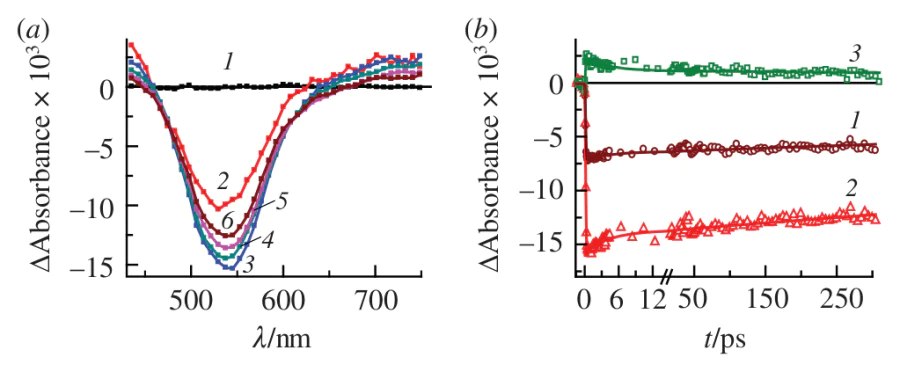
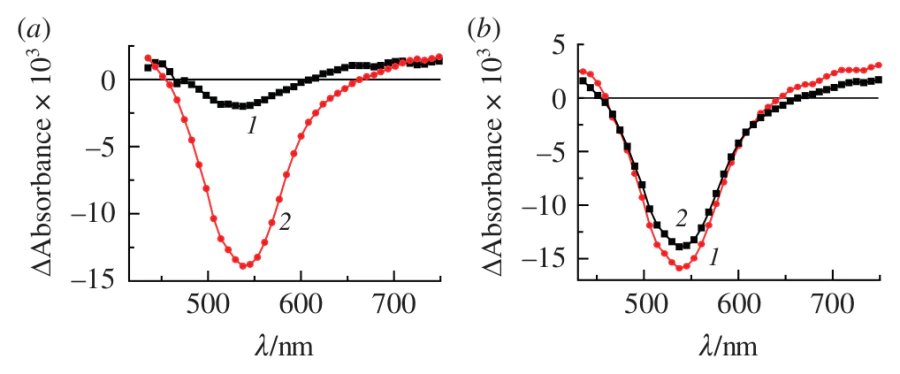
The results of the ultrafast TA experiment in H2O upon excitation at 400 nm are presented in Figure 1. TA spectra at various time delays between the pump and probe pulses are shown in Figure 1(a). Examples of kinetic curves, along with the results of a biexponential global fit [equation (1)], are given in Figure 1(b). The TA spectra exhibit bleaching in the 460–630 nm spectral range and intermediate absorption at λ < 460 nm and λ > 630 nm. The bleaching is definitely caused by the disappearance of the initial complex. The intensity of both the bleaching and the positive signal at λ < 460 nm and λ > 630 nm decreases during the experiment; however, their characteristic decay time exceeds the duration of the experiment itself. The satisfactory description of the experimental data by equation (1), which does not include a residual, indicates the absence of intermediate absorption on the time scale of the laser flash photolysis experiment.
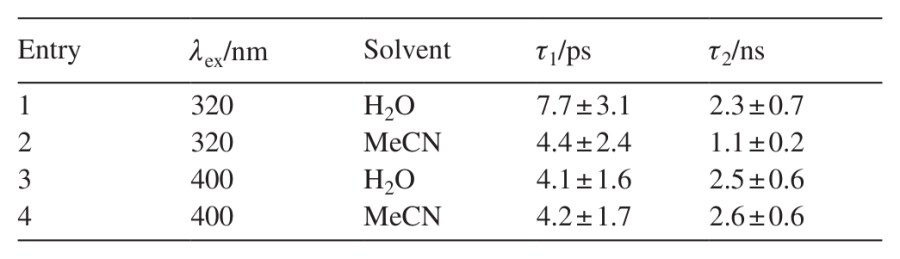
The spectra of the amplitudes A1 and A2, obtained from global fitting, are shown in Figure 2(a). The characteristic lifetimes are τ1 = 4.1 ± 1.6 ps and τ2 = 2.5 ± 0.6 ns. Based on the assumption of a sequential transition involving two intermediate states (A → B → → GS, where GS is the ground state of complex 1) and considering the significant difference between characteristic lifetimes, the species-associated difference spectra (SADS) of the intermediates can be readily calculated using approximate formulae (2) and (3) (exact formulae are provided in Online Supplementary Materials). The SADS are shown in Figure 2(b). Experimental TA data for complex 1 upon excitation in water (at 320 nm) and MeCN (at 400 and 320 nm) are presented in Figures S3–S8. The characteristic lifetimes for all cases are summarized in Table 1.
The main comments regarding the results of ultrafast TA experiments can be summarized as follows.
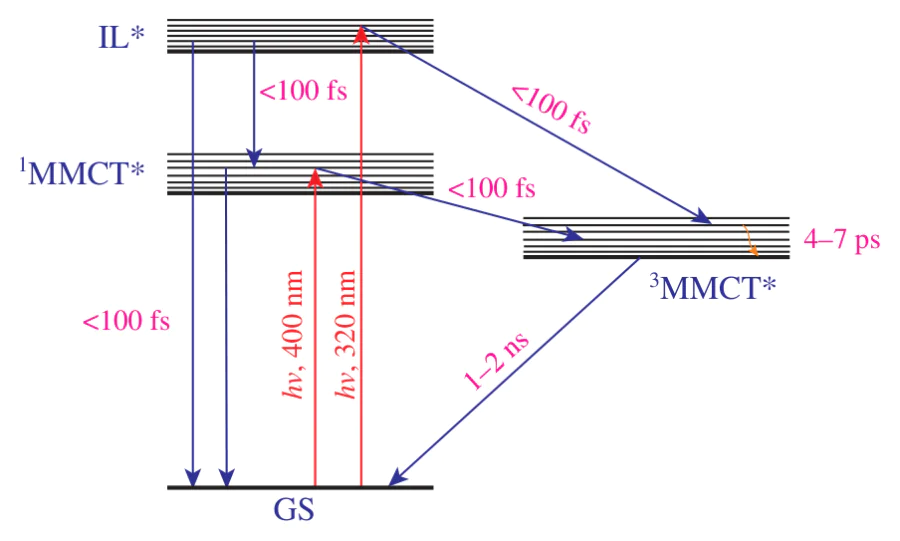
(i) All SADS profiles appear similar. No clear dependence on the excitation wavelength {320 and 400 nm correspond to IL(bpy) and MLCT transitions, respectively [see Figure S2(a)]} and on the solvent was observed. This could be explained by a fast (<100 fs) intersystem crossing from the hot Frank–Condon singlet excited state to the hot lowest excited electronic state, which, according to Ref. 17, is of 3MMCT nature. In the case of excitation at 320 nm, the transition from the IL(bpy) state to the 3MMCT state can occur either directly or via the singlet 1MLCT state. Ultrafast intersystem crossing, which could not be resolved in present work, is typical for transition metal complexes.[24] It should be noted that for transition metal complexes, different ultrafast processes may exhibit similar lifetimes, making it impossible to distinguish between them based solely on pump–probe data.[25]
(ii) In all cases, the intermediate absorption is low (ca. 0.002 in the region of greatest interest near 700 nm), which leads to significant errors in the determination of kinetic parameters.
(iii) The first observed process, with a characteristic lifetime of 4–7 ps, does not result in significant changes in the TA spectra; the amplitude A1 is small across the entire spectral range investigated [see Figure 2(a)]. This is typical of relaxation processes (vibrational cooling and solvent translational relaxation), which are often observed as a single convoluted process.[23] Lifetimes of approximately 5 ps for such relaxation processes are typical for transition metal complexes in aqueous[26, 27] and acetonitrile[28] solutions. An alternative explanation based on electronic transitions between energetically close 3MMCT states appears highly questionable, as a timescale of 3 ps seems too long for internal conversion in metal complexes; a fully allowed electron transition typically occurs on a timescale of tens of femtoseconds.[25, 29, 30]
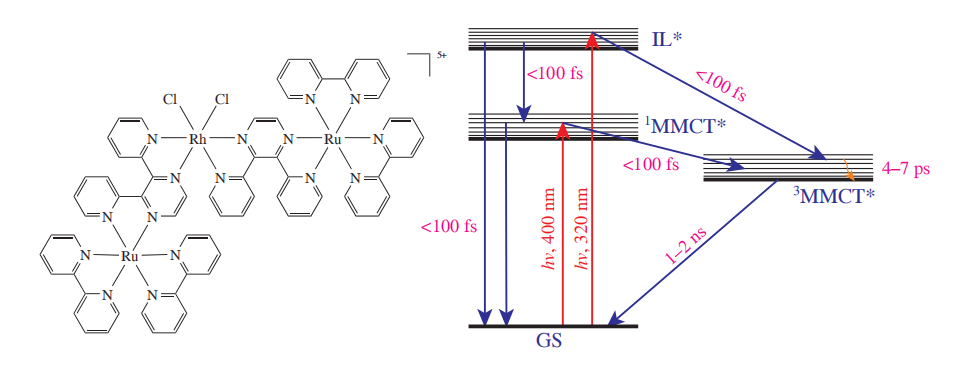
(iv) The complete disappearance of the intermediate absorption within a timescale of a few nanoseconds is consistent with the fact that no intermediate absorption (whether time-dependent or in the form of instantaneous bleaching) was observed in nanosecond laser flash photolysis experiments. The lowest excited electronic state, 3MMCT, rapidly relaxes to the ground state of the complex. All photochemical processes for complex 1 are expected to be characterized by low quantum yields. A scheme of the photophysical processes, constructed based on the results of our experiments, is presented in Figure 3.
Steady-state photolysis experiments involving complex 1 in aqueous and acetonitrile solutions revealed an extremely weak photochemical reaction. Primary experimental data and their analysis are provided in Online Supplementary Materials. Based on the similarity between the spectral changes observed in neat solvents (in the present work) and those reported in Ref. 18 (where photolysis was performed at high concentrations of the sacrificial electron donor DMA), we interpreted the observed processes as the two-electron photoreduction of RhIII to RhI. The quantum yields in argon-saturated aqueous and acetonitrile solutions were found to be as low as (2.7 ± 0.3) × 10–4 and (2.3 ± 0.3) × 10–4, respectively. These low quantum yield values are consistent with the absence of intermediate absorption in the laser flash photolysis experiments.
A brief description of the mechanism of photophysical and photochemical processes for complex 1 is presented by equations (S8)–(S19) (see Online Supplementary Materials). Within this mechanism, equations (S8)–(S15) describe photophysical processes, excluding vibrational cooling and solvent relaxation. Equations (S16)–(S19) describe the photoreduction of complex 1. As indicated by the quantum yield values, photoreduction is a minor process. It should be noted that we do not specify the excited electronic states from which photoreduction proceeds; equations (S16)–(S18) actually describe the net results of the photochemical reactions.
Inner-sphere electron transfer within the photoexcited complex [equation (S16)] appears to be the primary process in both aqueous and acetonitrile solutions. Electron transfer from acetonitrile to the photoexcited complex [equation (S17)], a process characteristic of platinum-group metal complexes,[28] could be ruled out, as the quantum yield in MeCN does not exceed that in H2O. Transfer of a second electron may occur via a secondary photochemical process [schematically represented by equation (S18)] in both aqueous and acetonitrile solutions. Additionally, a thermal reduction process [equation (S19)] appears possible in MeCN. In the presence of dissolved oxygen, the back-oxidation of RhI to RhIII leads to a further decrease in quantum yield to (5.0 ± 0.6) × 10–5 and (1.9 ± 0.2) × 10–4 in water and MeCN, respectively. The more pronounced effect of oxygen in aqueous solutions is probably due to differences in the pathways of chlorine atom disappearance in air-saturated water vs. acetonitrile.
Finally, this work involved investigating the mechanisms underlying the photophysics and photochemistry of the [{(bpy)2Ru(dpp)}2RhCl2]5+ complex. It was determined that the lifetime of the lowest excited electronic state is very short (1–2 ns), while the quantum yield of the photochemical reaction is extremely low (hundredths of a percent). This implies that the mechanism of photoactivated cytotoxicity for this complex, as described by Karen Brewer’s group, involves either prior intercalation into DNA or an external electrostatic interaction, specifically the binding of cations to the negatively charged phosphate groups of DNA. This issue warrants particular attention.
V. A. M., I. P. P. and E. M. G. (V. V. Voevodsky Institute of Chemical Kinetics and Combustion, SB RAS) acknowledge the core funding from the Ministry of Science and Higher Education of the Russian Federation (grant no. FWGF-2026-0011).
Funders
References