Abstract
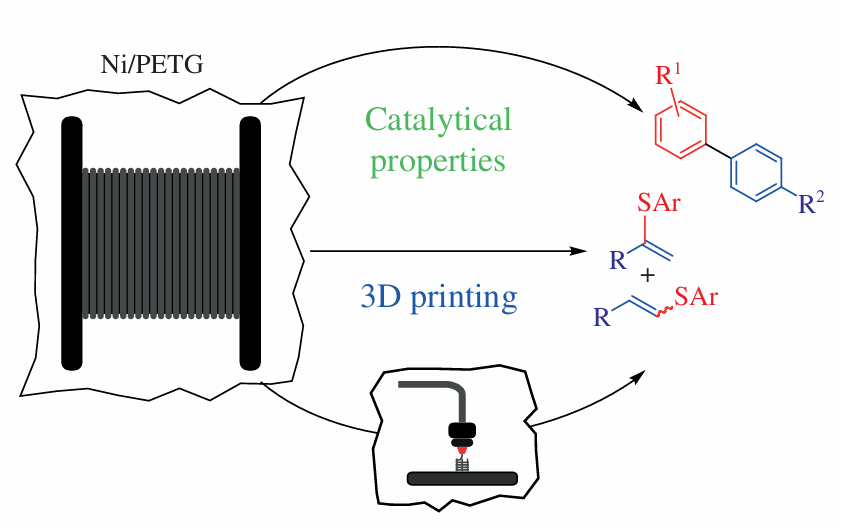
A Ni/PETG [PETG is poly(ethylene terephthalate glycol)] composite material was prepared and characterized by X-ray diffraction analysis and scanning electron microscopy. Its catalytic properties were tested in the Suzuki–Miyaura coupling and hydrothiolation of alkynes giving products in reasonable yields. The feasibility of 3D printing with this material by fused filament fabrication was demonstrated, and the potential of the printed structures for use as catalysts was examined.
Keywords
Communication
Additive technologies represent a rapidly developing field in modern science and technology. A highly promising direction in modern science is the development of composite materials suitable for use in 3D printing. The mixing of polyvinyl alcohol and cellulose acetate butyrate with carbon nanotubes made it possible to obtain composite inks for 3D printing, which allow the creation of energy-efficient gas sensors.[1] An antibacterial and antioxidant composite material for 3D printing based on cellulose, alginate, and curcumin extract was used to create scaffolds for regenerative medicine.[2] 3D printing with composite materials is widely employed in the development of catalytically active structures of various shapes and morphologies, which find application in the processes of industrial sulfuric acid production,[3] catalytic reforming and hydrotreating,[3-6] photocatalytic degradation,[4-7] biomass processing,[4, 5, 8] synthetic fuel production,[4] air purification,[5] and some others.[9] Every year, the range of processes in which 3D printed catalytic compositions demonstrate efficiency increases.
A promising direction in modern catalysis is the search for alternatives to catalytically active precious metals, and the most promising options are cheaper transition metals, such as nickel. Nickel and its compounds are capable of catalyzing hydrogenation and dehydrogenation, alcohol oxidation, carbon dioxide reduction, cross-coupling reactions, Mizoroki–Heck and Sonogashira reactions, cycloaddition, polymerization, nanotube growth, and many others.[10-12] The breadth of applicability and availability of this metal underscores the promise of creating a composite material based on it or its compounds, suitable for use in 3D printing. Such a material was developed by Mackiewicz,[13] but its catalytic activity has not been demonstrated in practice. In this work, a different method for preparing a Ni/PETG (PETG is polyethylene terephthalate glycol) material is proposed, which does not require high temperature and melting of the plastic. To rationally evaluate the catalytic potential of the developed material, the hydrothiolation of alkynes and the Suzuki–Miyaura coupling were selected as model reactions. Both transformations are important for accessing valuable compounds[14, 15] and are known to be catalyzed by various nickel species, making them suitable benchmarks for testing new nickel-based catalysts.
First, selection of a catalytically active component and a polymer matrix was carried out. Metallic nickel was chosen as the catalytically active additive. The use of metallic nickel instead of its soluble salts is advantageous owing to its higher stability in organic media, allowing it to serve as a precatalyst that slowly leaches to generate the required amount of catalytically active species, and is also easily recovered from the reaction mixture (filtration, magnet). For the polymer carrier, PETG was chosen since it is a common thermoplastic material, and items produced from it by fused filament fabrication (FFF) 3D printing exhibit varying resistance to different organic solvents, which allows the properties of the catalytic structure to be varied by selecting the medium.[9, 16] Next, the process of preparing the composite material was carried out: granulated PETG was dissolved in dichloromethane to a viscous gel state, then nickel powder was added to it (mass ratio PETG/Ni = 4 : 1). The mixture was thoroughly mixed until homogeneous, after which the vessel cap was removed, and the solvent was slowly evaporated without additional heating, with uniform stirring until the system became too viscous to stir (see Online Supplementary Materials, Figure S1). The resulting mass was dried in an oven, ground to a particle size not exceeding 5 mm, and placed into an extruder, by which a filament strand was obtained (Figure S2).
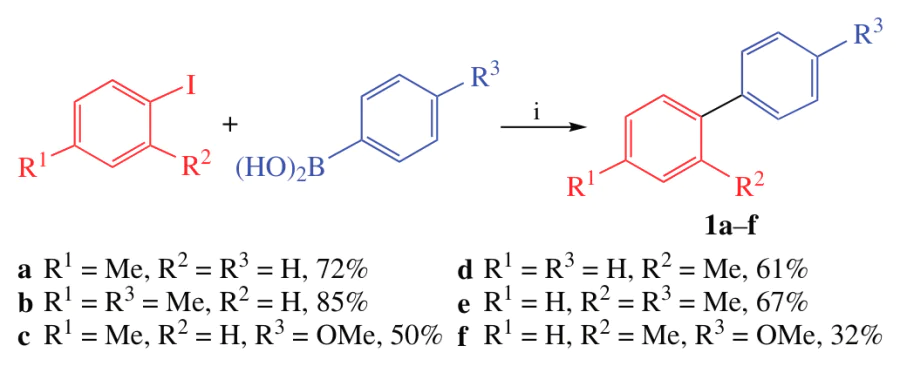
At the first stage, the catalytic properties of the obtained filaments were investigated in the Suzuki–Miyaura cross-coupling reaction between aryl iodides and arylboronic acids to give biaryls 1a–f (Scheme 1) according to a previously published procedure.[17] A defined mass of filament corresponding to 20 mol% of the substrate was placed into the reaction mixture. Under the harsh reaction conditions, the polymer support degrades, and nickel particles are released into solution, where they subsequently catalyze the process. Thus, the composite material serves as a convenient source of nickel powder, since the amount of nickel is determined by the length of the strand. In other words, there is no need to weigh out nickel powder and one simply needs to cut a strand of the required length. Estimated ratio of the weight to length was ~2.56 mg mm–1. Also, the gradual release of catalytically active species is useful in the case of a progressive deactivation of the catalyst.[18]
At the next stage, the catalytic properties of the resulting composite material were evaluated under conditions that would not lead to degradation of the polymer matrix. This would allow the printing of structures that can be recovered from the reaction medium and reused. The atom-economical hydrothiolation of alkynes was chosen as a model reaction. It is an attractive, atom-economical synthesis of alkenyl sulfides, which serve as versatile building blocks in organic synthesis.[19-21]
Optimization of the hydrothiolation reaction conditions (see Online Supplementary Materials, Table S1) showed that, in the absence of additives, none of the possible addition products was formed (entries 1, 2). The addition of a base increased the total yield to 21% (entry 3). The addition of PPh3 as a ligand markedly increased the conversion of the starting materials but decreased the selectivity of the reaction (entry 4). Replacement of PPh3 with PhPCy2 slightly improved the selectivity but lowered the total yield of the process (entry 5).
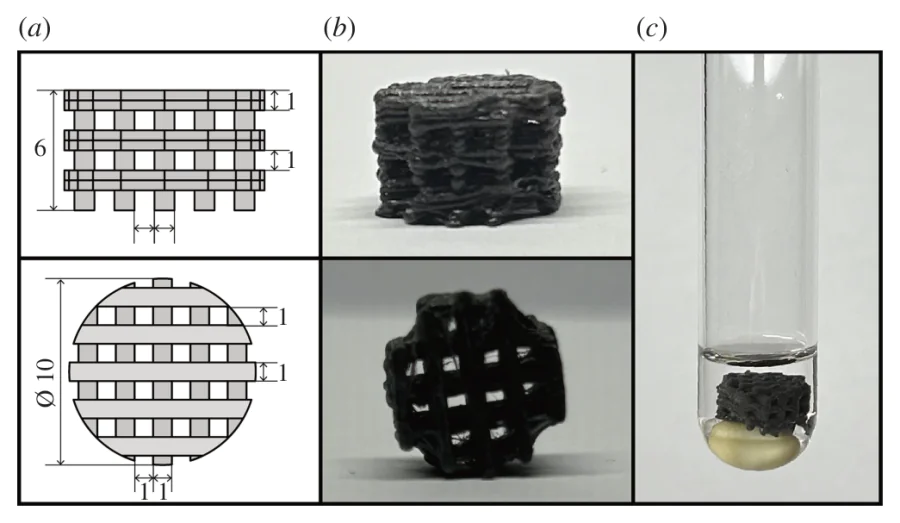
An important question was the possibility of using this composite filament for 3D printing by the FFF technology. We studied the printing of Ni/PETG on a commercial FFF printer and obtained three-dimensional lattice structures, which are capable of increasing the efficiency of the catalytic reaction due to the large contact area (Figure 1). Thus, obtained Ni/PETG is applicable for manufacturing structures with complex morphologies and developed surface area by FFF 3D printing. These structures can be integrated into various chemical reactors. In combination with possible defects during 3D printing (pores, cracks, etc.),[22] this can enhance the catalytic activity of the material. The resulting lattice structures were evaluated in hydrothiolation reactions with various alkynes and thiophenols giving isomeric alkenyl sulfides 2a–k and 3a–k (Scheme 2).
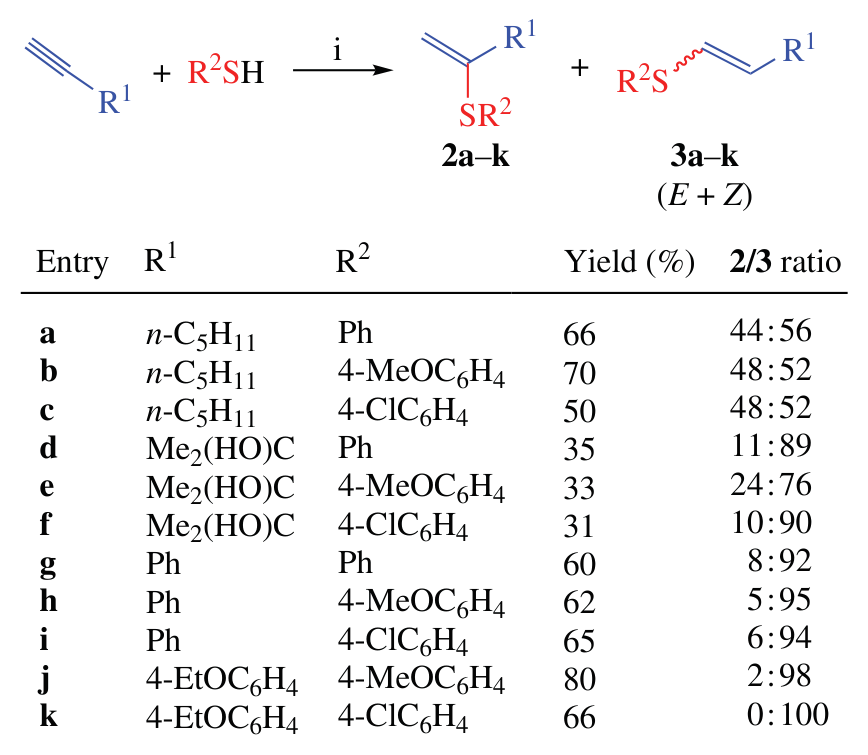
In the course of the reaction, slight swelling of the polymer matrix occurred in toluene upon heating, which led to the release of nickel particles. Subsequently, these were most probably converted into nickel thiolate and catalyzed the reaction. Thus, the resulting material serves as a source of the precatalyst, which is transformed into the Ananikov–Beletskaya catalytic system.[23] This catalytic system has an advantage of dynamic catalyst generation and it was developed to tolerate different catalyst sources.[24, 25] Interestingly, in our case different alkynes react via different pathways: for hept-1-yne, an almost equal ratio of α-and β-addition products is observed (products 2a–c/3a–c), whereas for other alkynes, β-addition products 3d–k are predominantly formed. To confirm the catalytic pathway of the reactions, a control experiment without the catalyst was carried out (Table S2).
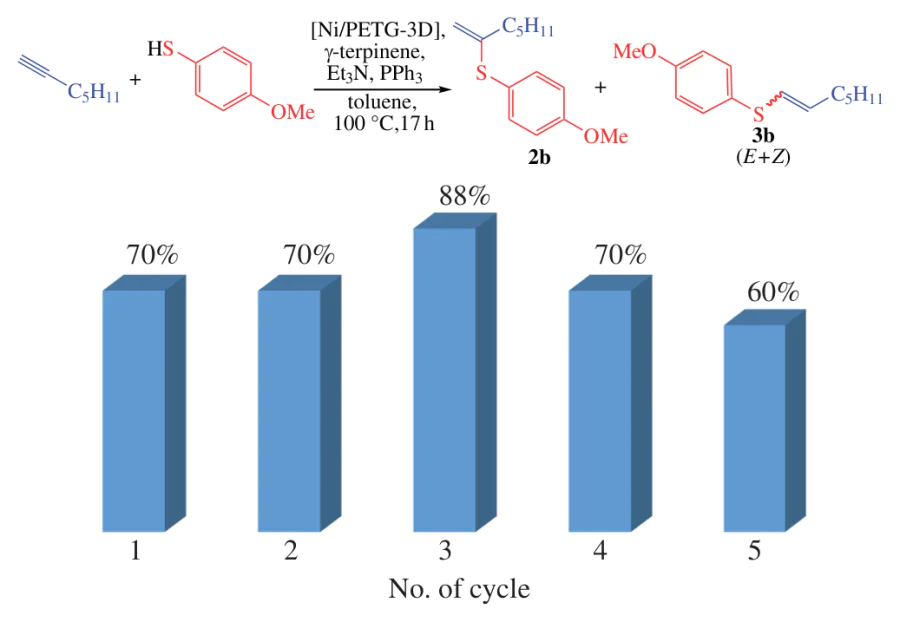
Recycling of the 3D printed lattice has shown good yields and 2b/3b ratio of ~1 : 1 in five consecutive cycles (Figure 2).
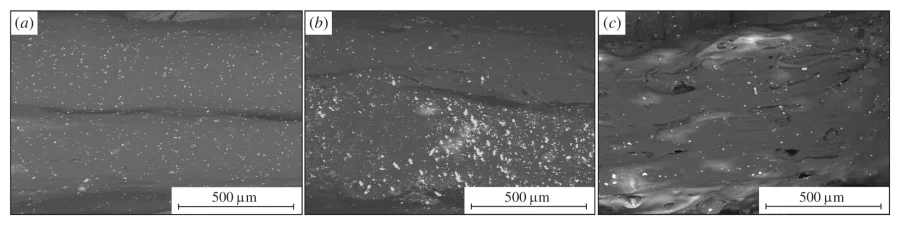
The behavior of the material in the hydrothiolation reaction was investigated for both the filament and the 3D printed structure. Analysis with scanning electron microscopy (SEM) after the reaction showed retention of particles on the surface. In this case, for better observation of metal particles, photodiode back-scattered electron detector was used (Figure 3 and S3). Particles with size 200–300 nm and their agglomerates were observed. Energy-dispersive spectroscopy (EDS) of the filament and lattice surfaces after the syntheses has shown the presence of sulfur and phosphorus (Figures S6, S8, S10, S12). Based on this, one may suppose that the reactants are adsorbed on the surface of the filament. It should be noted that the Ni particles are distributed regularly. Interestingly, distribution maps of Ni and S have shown higher concentration of S on Ni particles (Figures S11, S13). This observation suggests that thiols interact with Ni, resulting in [Ni(SAr)2]n cover.
Using a nanofishing approach, particles formed in the solution during the reaction were studied (Figures S4, S14).[26] Film-like fragments were observed in the solution. These are probably PETG particles separated from the filament. Elongated particles were also observed in the solution. As mentioned above, this reaction is accompanied by the formation of nickel thiolate polymer particles. Presumably, the second type of particles corresponds to this polymer. Powder X-ray diffraction (PXRD) analysis of the filaments showed that the crystalline phase of Ni0 is preserved during the reaction, i.e., part of the nickel does not undergo transformation and is retained in the polymer matrix (Figure S5). No additional phases were detected.
To summarize, the Ni/PETG composite material suitable for FFF 3D printing can be utilized as a catalyst in the Suzuki–Miyaura and alkyne hydrothiolation reactions. Moreover, the choice of reaction medium and conditions allows the Ni/PETG composite material to be used in one of two capacities: either as a convenient catalyst source or as a structure with a defined morphology that can be preserved after the reaction and reused. Furthermore, the possibility of performing the hydrothiolation reaction using metallic nickel powder was demonstrated and justified by a combination of physicochemical methods.
This work was supported by The Russian Science Foundation (grant no. 24-73-10165). Authors acknowledge Dr. Evgeniya S. Shutovskaya for the help with catalytic experiments.
Funders
References