Keywords
Abstract
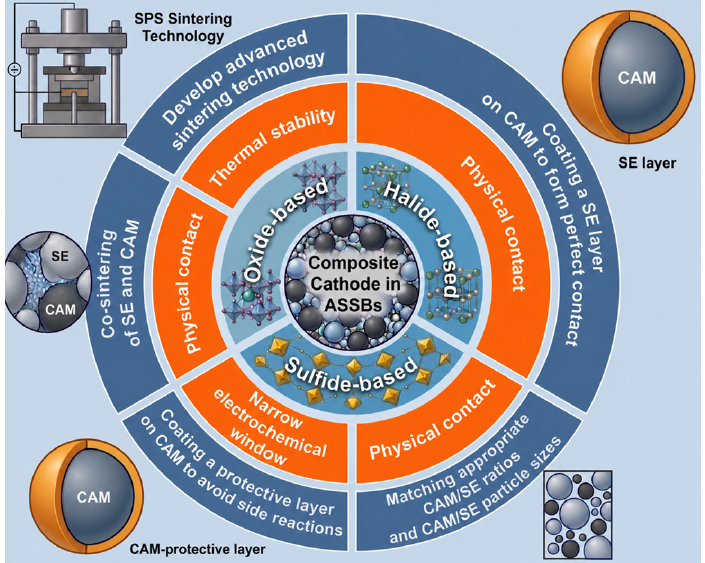
All-solid-state batteries (ASSBs), offering high safety and high energy density, have emerged as a promising option for next-generation energy storage systems. With the rapid progress in solid electrolyte (SE) materials, the large-scale production and practical applications of ASSBs have been significantly accelerated. In contrast to traditional lithiumion batteries, in which the liquid electrolyte readily infiltrates a microporous structure of the cathode to establish continuous ionic feeding pathways, ASSBs, instead, require the intentional incorporation of a certain fraction of SEs into the cathode making it of a composite origin thus enabling effective ionic transport. However, intrinsic issues of SEs give rise to a variety of interfacial challenges when they are combined with currently widely used cathode active materials to form composite cathodes, severely impairing the electrochemical performance of ASSBs. In this review, we systematically discuss the interfacial issues in composite cathodes across the major classes of oxide, sulfide and halide SEs together with corresponding mitigation strategies and key directions for future optimization.
References