Home / Articles / Machine learning-driven approach to designing carbon-based electrocatalysts for oxygen reduction reaction

Machine learning-driven approach to designing carbon-based electrocatalysts for oxygen reduction reaction

Yash V Kataria 1
Yash V Kataria
, 
Yaroslav D Rozhkov 1
Yaroslav D Rozhkov
, 
Varvara D Larina 1
Varvara D Larina
, 
Denis V Tokarev 1
Denis V Tokarev
, 
Anna Aleksandrovna Ulyankina 1
Anna Aleksandrovna Ulyankina
, 
Vera Pavlovna Kashparova 1
Vera Pavlovna Kashparova
, 
Nina Vladimirovna Smirnova 1
Nina Vladimirovna Smirnova
1 Research Institute of Nanotechnology and New Materials, Platov South-Russian State Polytechnic University, 346428 Novocherkassk, Russian Federation
Published 23 September 2026
Communication
0
Share
Cite this
GOST
 | 
Cite this
GOST
Kataria Y. V. et al. Machine learning-driven approach to designing carbon-based electrocatalysts for oxygen reduction reaction // Mendeleev Communications. 2026.
GOST all authors (up to 50)
Kataria Y. V., Rozhkov Y. D., Larina V. D., Tokarev D. V., Ulyankina A. A., Kashparova V. P., Smirnova N. V. Machine learning-driven approach to designing carbon-based electrocatalysts for oxygen reduction reaction // Mendeleev Communications. 2026.
RIS
 | 
Cite this
RIS
TY - JOUR
DO - 10.71267/mencom.8059
UR - https://mendcomm.colab.ws/publications/10.71267/mencom.8059
TI - Machine learning-driven approach to designing carbon-based electrocatalysts for oxygen reduction reaction
T2 - Mendeleev Communications
AU - Kataria, Yash V
AU - Rozhkov, Yaroslav D
AU - Larina, Varvara D
AU - Tokarev, Denis V
AU - Ulyankina, Anna Aleksandrovna
AU - Kashparova, Vera Pavlovna
AU - Smirnova, Nina Vladimirovna
PY - 2026
DA - 2026/09/23
PB - Mendeleev Communications
ER -
BibTex
Cite this
BibTex (up to 50 authors)
@article{2026_Kataria,
author = {Yash V Kataria and Yaroslav D Rozhkov and Varvara D Larina and Denis V Tokarev and Anna Aleksandrovna Ulyankina and Vera Pavlovna Kashparova and Nina Vladimirovna Smirnova},
title = {Machine learning-driven approach to designing carbon-based electrocatalysts for oxygen reduction reaction},
journal = {Mendeleev Communications},
year = {2026},
publisher = {Mendeleev Communications},
month = {Sep},
url = {https://mendcomm.colab.ws/publications/10.71267/mencom.8059},
doi = {10.71267/mencom.8059}
}
Views / Visits
55 / 55

Keywords

carbon-based electrocatalyst
eXtreme Gradient Boosting algorithm
machine learning
synthetic data
two-electron oxygen reduction reaction

Abstract

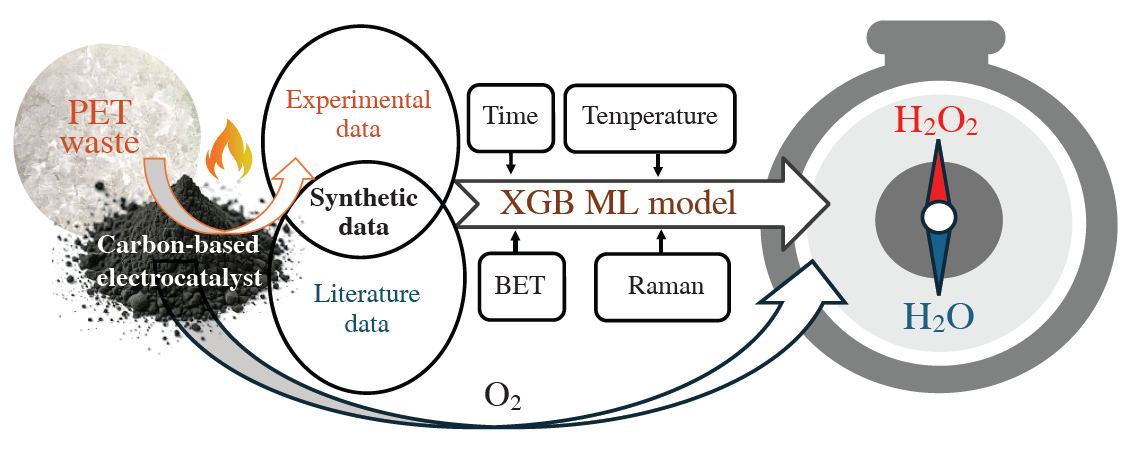
A machine learning-driven approach was used to evaluate a carbon-based electrocatalyst for H2O2 synthesis via a twoelectron oxygen reduction reaction. The R2 value of the optimal preliminary model, using the eXtreme Gradient Boosting (XGB) algorithm with only four H2O2 selectivity descriptors, was 0.61. The dilemma of small data for machine learning was demonstrated, and a simple strategy for overcoming it was proposed to provide a new perspective on catalyst design.

Funders

Russian Science Foundation
25-19-00280

References

1.

Progresses of in situ H2O2 generation and corresponding pollutant removal applications: a review
Ji J., Wang Z., Xu Q., Zhu Q., Xing M.
Chemistry - A European Journal, 2023
2.
Leveraging H 2 O 2 Levels for Biomedical Applications
Wang J., Zhang Y., Archibong E., Ligler F.S., Gu Z.
Advanced Biosystems, 2017
3.

Future perspectives for the advancement of electrochemical hydrogen peroxide production
Perry S.C., Mavrikis S., Wang L., Ponce de León C.
Current Opinion in Electrochemistry, 2021
5.
Sustainable cathode design for electrochemical hydrogen peroxide generation using waste-derived carbon from invasive biomass
Ramírez Á., López-Rivilla L., Muñoz-Morales M., López-Fernández E., Llanos J.
Environmental Technology and Innovation, 2025
6.
Chernysheva D.V., Klushin V.A., Alekseenko A.A., Moguchikh E.A., Kolesnikov E.A., Gorshenkov M.V., Kaichev V.V., Fesenko L.N., Smirnova N.V.
Mendeleev Communications, 2024
7.
Universal Catalyst Design Framework for Electrochemical Hydrogen Peroxide Synthesis Facilitated by Local Atomic Environment Descriptors
Liu Z., Liu Y., Zhang Y., Deng Y., Zheng Z., Knibbe R., Gao T., Li M., Wang Z., Zhang B., Jia X., Zhang D., Liu H., Shao X., Gao Z., et. al.
Angewandte Chemie - International Edition, 2025
8.
Machine-learning-guided predict and design of polymeric carbon nitride for H2O2 photosynthesis
Xu P., Yuan X., Wang H., Li K., Chen S., Zhang W., Jiang L.
Journal of Cleaner Production, 2025
9.

Data-Guided Exploration of Process Control in Carbon-Based Catalyst Design for Two-Electron Oxygen Reduction
Jiang Z., Cong L., Zhou X., Hu S., Zhao Y., Yuan Q., Wu Y., Sun K., Wang S., Jiang J., Fan M.
Langmuir, 2025
10.

Small data machine learning in materials science
Xu P., Ji X., Li M., Lu W.
npj Computational Materials, 2023
11.

Synthetic Data in AI: Challenges, Applications, and Ethical Implications
Shuang Hao, Wenfeng Han, Tao Jiang, Yiping Li, Haonan Wu, Chunlin Zhong, Zhangjun Zhou, He Tang
ArXiv, 2024
13.
A critical review on selecting performance evaluation metrics for supervised machine learning models in wastewater quality prediction
Khoshvaght H., Permala R.R., Razmjou A., Khiadani M.
Journal of Environmental Chemical Engineering, 2025