Home / Articles / Influence of hydroxyl group concentration on the structural relaxation rate of silica glass

Influence of hydroxyl group concentration on the structural relaxation rate of silica glass

0
Share
Cite this
GOST
 | 
Cite this
GOST
Lunin B. S., Kharlanov A. N. Influence of hydroxyl group concentration on the structural relaxation rate of silica glass // Mendeleev Communications. 2026.
GOST all authors (up to 50)
Lunin B. S., Kharlanov A. N. Influence of hydroxyl group concentration on the structural relaxation rate of silica glass // Mendeleev Communications. 2026.
RIS
 | 
Cite this
RIS
TY - JOUR
DO - 10.71267/mencom.8045
UR - https://mendcomm.colab.ws/publications/10.71267/mencom.8045
TI - Influence of hydroxyl group concentration on the structural relaxation rate of silica glass
T2 - Mendeleev Communications
AU - Lunin, Boris Sergeevich
AU - Kharlanov, Andrey Nikolaevich
PY - 2026
DA - 2026/09/23
PB - Mendeleev Communications
ER -
BibTex
Cite this
BibTex (up to 50 authors)
@article{2026_Lunin,
author = {Boris Sergeevich Lunin and Andrey Nikolaevich Kharlanov},
title = {Influence of hydroxyl group concentration on the structural relaxation rate of silica glass},
journal = {Mendeleev Communications},
year = {2026},
publisher = {Mendeleev Communications},
month = {Sep},
url = {https://mendcomm.colab.ws/publications/10.71267/mencom.8045},
doi = {10.71267/mencom.8045}
}
Views / Visits
50 / 50

Keywords

annealing
hydroxyl
relaxation of structure
Si–O–Si bond
silica glass

Abstract

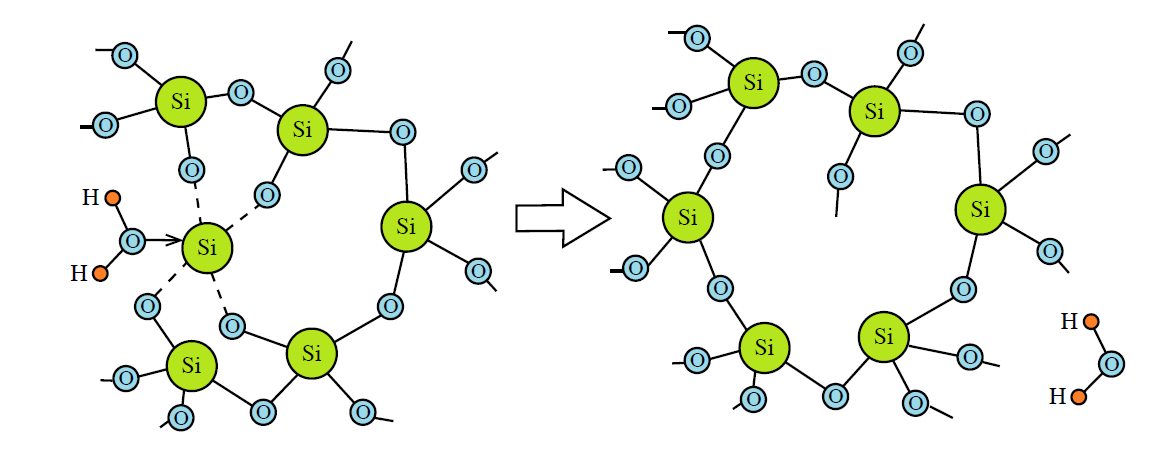
Experimental data on the structural relaxation rate of silica glasses with varying OH-group content are presented. As the concentration of OH groups in silica glass decreased from 0.15 mol dm--3 to values below the detection limit, the rate of structural relaxation at 910–930 °C decreased by a factor of about 5. This effect can be associated with the formation of molecular water in silica glass, its interaction with Si atoms through coordination bonds, and the accelerated formation of larger structural elements in the glass network with a change in the average Si–O–Si bond angle.

Funders

Ministry of Education and Science of the Russian Federation
AAAA-A21-121011990019-4

References

1.

Relaxation of KU-1 silica glass structure under annealing
Lunin B.S., Kharlanov A.N.
Moscow University Chemistry Bulletin, 2011
2.

A simple IR spectroscopic method for determining fictive temperature of silica glasses
Agarwal A., Davis K.M., Tomozawa M.
Journal of Non-Crystalline Solids, 1995
3.
Surface and bulk structural relaxation kinetics of silica glass
Agarwal A., Tomozawa M.
Journal of Non-Crystalline Solids, 1997
5.
Water diffusion and surface structural relaxation of silica glasses
Tomozawa M., Kim D., Agarwal A., Davis K.M.
Journal of Non-Crystalline Solids, 2001
6.
Поведение гидроксильных групп в кварцевом стекле при термообработке в интервале 750–950°С
Вельмужов А.П., Суханов М.В., Чурбанов М.Ф., Котерева Т.В., Шабарова Л.В., Кириллов Ю.П.
Неорганические материалы, 2018
7.

Reduction in internal friction in silica glass with high OH content
Lunin B.S., Tokmakov K.V.
Journal of the American Ceramic Society, 2018
8.
Raman and ESR studies of the thermal history of amorphous SiO2
10.
Atomic picture of structural relaxation in silicate glasses
Song W., Li X., Wang B., Anoop Krishnan N.M., Goyal S., Smedskjaer M.M., Mauro J.C., Hoover C.G., Bauchy M.
Applied Physics Letters, 2019
11.
Novakovskaya Y.V.
Radioelektronika, Nanosistemy, Informacionnye Tehnologii, 2020
12.

Oxide– and Silicate–Water Interfaces and Their Roles in Technology and the Environment
Bañuelos J.L., Borguet E., Brown G.E., Cygan R.T., DeYoreo J.J., Dove P.M., Gaigeot M., Geiger F.M., Gibbs J.M., Grassian V.H., Ilgen A.G., Jun Y., Kabengi N., Katz L., Kubicki J.D., et. al.
Chemical Reviews, 2023