
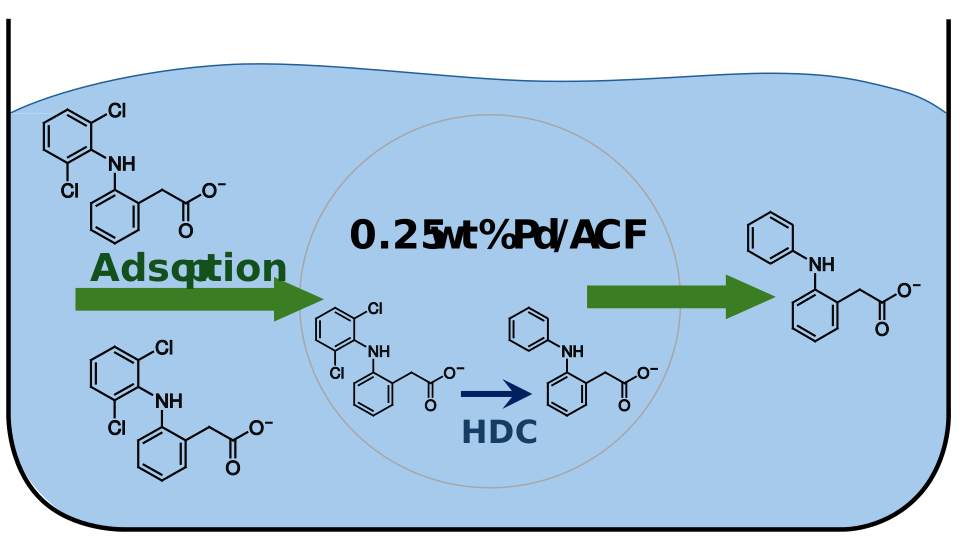
Keywords
active carbon
catalyst
catalyst reduction
diclofenac
hydrodechlorination
palladium
Abstract
High-strength activated carbon produced by pyrolysis of a furfural copolymer was used as a support in a palladium catalyst for hydrodechlorination (HDC) of diclofenac in water in the presence of hydrogen. Diclofenac was removed from water by HDC and adsorption, the contribution of which was dominant due to a high specific surface area of the microporous support, whereas HDC played a role to convert residual amounts of chlorinated organics into safer products. The prereduction conditions strongly affected the catalyst performance: reduction in aqueous solutions at 30 °C produced more efficient catalysts than those obtained by dry reduction at 30 and 300 °C.
References
1.

Xiong J., Ma Y., Yang W., Zhong L.
Journal of Hazardous Materials,
2018
2.
Lonappan L., Brar S.K., Das R.K., Verma M., Surampalli R.Y.
Environmental International,
2016
3.
Shishova V.V., Lokteva E.S., Maksimov G.S., Maslakov K.I., Kaplin I.Y., Maksimov S.V., Golubina E.V.
Moscow University Chemistry Bulletin,
2024
4.

Lokteva E.S., Pesotskiy M.D., Golubina E.V., Maslakov K.I., Kharlanov A.N., Shishova V.V., Kaplin I.Y., Maksimov S.V.
Kinetics and Catalysis,
2024
5.
ref-10.71267-mendc7468-1-10-1-0
V. V. Mukhin, V. V. Guryanov, A. A. Kurinkin and S. V. Alyzbishev
Usp. Khim. Khim. Tekhnol.,
2017
6.
Lokteva E.S., Shishova V.V., Maslakov K.I., Golubina E.V., Kharlanov A.N., Rodin I.A., Vokuev M.F., Filimonov D.S., Tolkachev N.N.
Applied Surface Science,
2023
7.
COQ B.
Journal of Catalysis,
1986