Home / Articles / Electrostatic and conformational analysis of piracetam and cyclo-L-prolylglycine to explain their potency difference

Electrostatic and conformational analysis of piracetam and cyclo-L-prolylglycine to explain their potency difference

, 
Arslan Ramilevich Shaimardanov
, 
Georgy A Polovinkin 1
Georgy A Polovinkin
, 
Vitaly S Frolov 1
Vitaly S Frolov
, 
Vladimir Alexandrovich Palyulin 1
Vladimir Alexandrovich Palyulin
Published 4 June 2026 , received 10 November 2025
Communication , Volume 36, Issue 4, 379-381
0
Share
Cite this
GOST
 | 
Cite this
GOST
Shulga D. A. et al. Electrostatic and conformational analysis of piracetam and cyclo-L-prolylglycine to explain their potency difference // Mendeleev Communications. 2026. Vol. 36. No. 4. pp. 379-381.
GOST all authors (up to 50)
Shulga D. A., Shaimardanov A. R., Polovinkin G. A., Frolov V. S., Palyulin V. A. Electrostatic and conformational analysis of piracetam and cyclo-L-prolylglycine to explain their potency difference // Mendeleev Communications. 2026. Vol. 36. No. 4. pp. 379-381.
RIS
 | 
Cite this
RIS
TY - JOUR
DO - 10.71267/mencom.7968
UR - https://mendcomm.colab.ws/publications/10.71267/mencom.7968
TI - Electrostatic and conformational analysis of piracetam and cyclo-L-prolylglycine to explain their potency difference
T2 - Mendeleev Communications
AU - Shulga, Dmitry Alexandrovich
AU - Shaimardanov, Arslan Ramilevich
AU - Polovinkin, Georgy A
AU - Frolov, Vitaly S
AU - Palyulin, Vladimir Alexandrovich
PY - 2026
DA - 2026/06/04
PB - Mendeleev Communications
SP - 379-381
IS - 4
VL - 36
ER -
BibTex
 | 
Cite this
BibTex (up to 50 authors)
@article{2026_Shulga,
author = {Dmitry Alexandrovich Shulga and Arslan Ramilevich Shaimardanov and Georgy A Polovinkin and Vitaly S Frolov and Vladimir Alexandrovich Palyulin},
title = {Electrostatic and conformational analysis of piracetam and cyclo-L-prolylglycine to explain their potency difference},
journal = {Mendeleev Communications},
year = {2026},
volume = {36},
publisher = {Mendeleev Communications},
month = {Jun},
url = {https://mendcomm.colab.ws/publications/10.71267/mencom.7968},
number = {4},
pages = {379--381},
doi = {10.71267/mencom.7968}
}
MLA
Cite this
MLA
Shulga, Dmitry Alexandrovich, et al. “Electrostatic and conformational analysis of piracetam and cyclo-L-prolylglycine to explain their potency difference.” Mendeleev Communications, vol. 36, no. 4, Jun. 2026, pp. 379-381. https://mendcomm.colab.ws/publications/10.71267/mencom.7968.
Views / Visits
18 / 18

Keywords

conformational analysis
cyclo-L-prolylglycine
molecular electrostatic potential
nootropic drugs
piracetam

Abstract

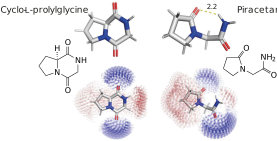
The molecular electrostatic potential of the classical nootropic drug piracetam in several of its probable conformations was shown to resemble that of the neuropeptide cyclo-L-prolylglycine in its rigidly fixed conformation. Furthermore, the probability of observing this specific conformation was found to be close to the activity ratio of piracetam to cyclo-L-prolylglycine. These results support the previously proposed hypothesis that cyclo-L-prolylglycine is an endogenous analog of piracetam.

Funders

Ministry of Education and Science of the Russian Federation
121021000105-7

References

1.

Identification of a novel endogenous memory facilitating cyclic dipeptide cyclo‐prolylglycine in rat brain
Gudasheva T.A., Boyko S.S., Akparov V.K., Ostrovskaya R.U., Skoldinov S.P., Rozantsev G.G., Voronina T.A., Zherdev V.P., Seredenin S.B.
FEBS Letters, 1996
2.
Plasma cyclic glycine proline/ IGF ‐1 ratio predicts clinical outcome and recovery in stroke patients
Fan D., Krishnamurthi R., Harris P., Barber P.A., Guan J.
Annals of Clinical and Translational Neurology, 2019
3.
ref-10.71267-mendc7453-1-5-1-0
R. U. Ostrovskaya, T. A. Gudasheva, T. A. Voronina and S. B. Seredenin
Eksp. Klin. Farmakol., 2002
4.

New endogenous dipeptide cycloprolyl-glycine is similar to piracetam by its mnemotropic selectivity
Gudasheva T.A., Ostrovskaya R.U., Trofimov S.S., Voronina T.A., Skoldinov A.P., Seredenin S.B.
Bulletin of Experimental Biology and Medicine, 1999
5.
ref-10.71267-mendc7453-1-8-1-0
K. N. Kolyasnikova, T. A. Gudasheva, G. A. Nazarova, P. I. Antipov, S. V. Nikolaev, T. A. Antipova, T. A. Voronina and S. B. Seredenin
Eksp. Klin. Farmakol., 2012
7.
A well-behaved electrostatic potential based method using charge restraints for deriving atomic charges: the RESP model
Bayly C.I., Cieplak P., Cornell W., Kollman P.A.
The Journal of Physical Chemistry, 1993
8.

Fast tools for calculation of atomic charges well suited for drug design
Shulga D.A., Oliferenko A.A., Pisarev S.A., Palyulin V.A., Zefirov N.S.
SAR and QSAR in Environmental Research, 2008