
Keywords
chromophore resonance forms
ellipticity of electron density
green fluorescent proteins
natural resonance theory
quantum chemical calculations
red fluorescent proteins
Abstract
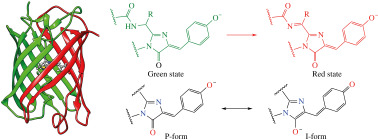
QM/MM calculations were performed to determine the energy differences between the green and red states of AzamiGreen fluorescent protein variants. The contributions of the resonance P- and I-forms of the chromophore were analyzed for a series of five proteins. A relationship was demonstrated between the contribution of the phenolate anionic form and the stabilization of the red state of the chromophore.
Funders
Russian Science Foundation
19-73-20032
References
1.

2.

Wiedenmann J., D’Angelo C., Nienhaus G.U.
Springer Series on Fluorescence,
2011
3.

Shinoda H., Shannon M., Nagai T.
International Journal of Molecular Sciences,
2018
4.

Zhao Y., Araki S., Wu J., Teramoto T., Chang Y., Nakano M., Abdelfattah A.S., Fujiwara M., Ishihara T., Nagai T., Campbell R.E.
Science,
2011
5.

Akerboom J., Carreras Calderón N., Tian L., Wabnig S., Prigge M., Tolö J., Gordus A., Orger M.B., Severi K.E., Macklin J.J., Patel R., Pulver S.R., Wardill T.J., Fischer E., Schüler C., et. al.
Frontiers in Molecular Neuroscience,
2013
6.
Lin M.Z., McKeown M.R., Ng H., Aguilera T.A., Shaner N.C., Campbell R.E., Adams S.R., Gross L.A., Ma W., Alber T., Tsien R.Y.
Chemistry & Biology,
2009
7.
Bindels D.S., Haarbosch L., van Weeren L., Postma M., Wiese K.E., Mastop M., Aumonier S., Gotthard G., Royant A., Hink M.A., Gadella T.W.
Nature Methods,
2016
8.

Tsien R.Y.
Annual Review of Biochemistry,
1998
9.
Zapata-Hommer O., Griesbeck O.
BMC Biotechnology,
2003
10.
Mo G.C., Posner C., Rodriguez E.A., Sun T., Zhang J.
Nature Communications,
2020
11.
Gadella T.W., van Weeren L., Stouthamer J., Hink M.A., Wolters A.H., Giepmans B.N., Aumonier S., Dupuy J., Royant A.
Nature Methods,
2023
12.

Ando R., Hama H., Yamamoto-Hino M., Mizuno H., Miyawaki A.
Proceedings of the National Academy of Sciences of the United States of America,
2002
13.

Green-to-red photoconvertible Dronpa mutant for multimodal super-resolution fluorescence microscopy.
Moeyaert B., Nguyen Bich N., De Zitter E., Rocha S., Clays K., Mizuno H., van Meervelt L., Hofkens J., Dedecker P.
ACS Nano,
2014
14.
Mishin A.S., Subach F.V., Yampolsky I.V., King W., Lukyanov K.A., Verkhusha V.V.
Biochemistry,
2008
15.
Imamura H., Otsubo S., Nishida M., Takekawa N., Imada K.
Proceedings of the National Academy of Sciences of the United States of America,
2023
16.
Zhang H., Tian X., Zhang J., Ai H.
Biosensors,
2024
17.
Stepanenko O.V., Stepanenko O.V., Kuznetsova I.M., Verkhusha V.V., Turoverov K.K.
International Review of Cell and Molecular Biology,
2013
18.
Wachter R.M., Watkins J.L., Kim H.
Biochemistry,
2010
19.
Subach F.V., Verkhusha V.V.
Chemical Reviews,
2012
20.
Miyawaki A., Shcherbakova D.M., Verkhusha V.V.
Current Opinion in Structural Biology,
2012
21.
Stepanyuk R.A., Polyakov I.V., Kulakova A.M., Marchenko E.I., Khrenova M.G.
Mendeleev Communications,
2024
22.
Olsen S., McKenzie R.H.
Chemical Physics Letters,
2010
23.
Ghosh D., Acharya A., Tiwari S.C., Krylov A.I.
Journal of Physical Chemistry B,
2012
24.
Silva Lopez C., R. de Lera A.
Current Organic Chemistry,
2011