Home / Publications / Antimicrobial protonated polydiallylamines: how to retain bactericidal efficiency at minimal toxicity

Antimicrobial protonated polydiallylamines: how to retain bactericidal efficiency at minimal toxicity

Yulia Aleksandrovna Simonova 1
Yulia Aleksandrovna Simonova
Ivan V Eremenko 1
Ivan V Eremenko
Nataliya Valer'evna Kozobkova 2
Nataliya Valer'evna Kozobkova
Margarita Olegovna Shleeva 2
Margarita Olegovna Shleeva
Mihail Yur'evich Eropkin 3
Mihail Yur'evich Eropkin
Larisa Matveevna Timofeeva 1
Larisa Matveevna Timofeeva
1 A. V. Topchiev Institute of Petrochemical Synthesis, Russian Academy of Sciences, 119071 Moscow, Russian Federation
2 Federal Research Centre ‘Fundamentals of Biotechnology’ of the Russian Academy of Sciences, 119071 Moscow, Russian Federation
3 A. A. Smorodintsev Research Institute of Influenza, 197376 St. Petersburg, Russian Federation
Published 2025-05-21
CommunicationVolume 35, Issue 4, 450-453
0
Share
Cite this
GOST
 | 
Cite this
GOST Copy
Simonova Y. A. et al. Antimicrobial protonated polydiallylamines: how to retain bactericidal efficiency at minimal toxicity // Mendeleev Communications. 2025. Vol. 35. No. 4. pp. 450-453.
GOST all authors (up to 50) Copy
Simonova Y. A., Eremenko I. V., Topchiy M. A., Kozobkova N. V., Shleeva M. O., Eropkin M. Y., Timofeeva L. M. Antimicrobial protonated polydiallylamines: how to retain bactericidal efficiency at minimal toxicity // Mendeleev Communications. 2025. Vol. 35. No. 4. pp. 450-453.
RIS
 | 
Cite this
RIS Copy
TY - JOUR
DO - 10.71267/mencom.7621
UR - https://mendcomm.colab.ws/publications/10.71267/mencom.7621
TI - Antimicrobial protonated polydiallylamines: how to retain bactericidal efficiency at minimal toxicity
T2 - Mendeleev Communications
AU - Simonova, Yulia Aleksandrovna
AU - Eremenko, Ivan V
AU - Topchiy, Maxim Anatol'evich
AU - Kozobkova, Nataliya Valer'evna
AU - Shleeva, Margarita Olegovna
AU - Eropkin, Mihail Yur'evich
AU - Timofeeva, Larisa Matveevna
PY - 2025
DA - 2025/05/21
PB - Mendeleev Communications
SP - 450-453
IS - 4
VL - 35
ER -
BibTex
 | 
Cite this
BibTex (up to 50 authors) Copy
@article{2025_Simonova,
author = {Yulia Aleksandrovna Simonova and Ivan V Eremenko and Maxim Anatol'evich Topchiy and Nataliya Valer'evna Kozobkova and Margarita Olegovna Shleeva and Mihail Yur'evich Eropkin and Larisa Matveevna Timofeeva},
title = {Antimicrobial protonated polydiallylamines: how to retain bactericidal efficiency at minimal toxicity},
journal = {Mendeleev Communications},
year = {2025},
volume = {35},
publisher = {Mendeleev Communications},
month = {May},
url = {https://mendcomm.colab.ws/publications/10.71267/mencom.7621},
number = {4},
pages = {450--453},
doi = {10.71267/mencom.7621}
}
MLA
Cite this
MLA Copy
Simonova, Yulia Aleksandrovna, et al. “Antimicrobial protonated polydiallylamines: how to retain bactericidal efficiency at minimal toxicity.” Mendeleev Communications, vol. 35, no. 4, May. 2025, pp. 450-453. https://mendcomm.colab.ws/publications/10.71267/mencom.7621.

Keywords

antimicrobial activity
eukaryotic cells.
free radical polymerization
protonated poly(diallylammonium trifluoroacetate)
RAFT polymerization
toxicity

Abstract

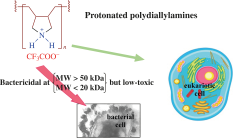
A family of antimicrobial protonated diallylammonium polymers has been synthesized by classical and RAFT polymerization in a wide range of molecular weights (MWs) of about (8--118) × 103 g mol−1. Based on the study on toxicity relative to eukaryotic cells (epithelioid line of human lung carcinoma and line of green monkey kidney) and bactericidal activity of polymers (relative to Staphylococcus aureus, Pseudomonas aeruginosa and M. smegmatis), we distinguish two groups of polymers promising as disinfectant and for medical applications. These are polymers with a sufficiently large MW (more than 50 × 103 g mol−1) and samples with a low MW (18 × 103 g mol−1 and lower); their biocidal activity is an order of magnitude higher or slightly higher (selectivity about 1.16) than their cytotoxicity.

Funders

Russian Science Foundation
23-23-00420

References

.
Polyelectrolyte Complexes of Natural Polymers and Their Biomedical Applications
Ishihara M., Kishimoto S., Nakamura S., Sato Y., Hattori H.
Polymers, 2019
.
Panova I.G., Lokova A.Y., Bagrov D.V., Loiko N.G., Nikolaev Y.A., Yaroslavov A.A.
Mendeleev Communications, 2023
.
Sinelnikova D.G., Novoskoltseva O.A., Loiko N.G., Nikolaev Y.A., Yaroslavov A.A.
Mendeleev Communications, 2024
.
Living Free-Radical Polymerization by Reversible Addition−Fragmentation Chain Transfer:  The RAFT Process
Chiefari J., Chong Y.K., Ercole F., Krstina J., Jeffery J., Le T.P., Mayadunne R.T., Meijs G.F., Moad C.L., Moad G., Rizzardo E., Thang S.H.
Macromolecules, 1998
.
Nontoxic, Hydrophilic Cationic Polymers-Identified as Class of Antimicrobial Polymers.
Strassburg A., Kracke F., Wenners J., Jemeljanova A., Kuepper J., Petersen H., Tiller J.C.
Macromolecular Bioscience, 2015
.
Advances in RAFT polymerization: the synthesis of polymers with defined end-groups
.
Secondary and Tertiary Polydiallylammonium Salts: Novel Polymers with High Antimicrobial Activity
Timofeeva L.M., Kleshcheva N.A., Moroz A.F., Didenko L.V.
Biomacromolecules, 2009
.
Structure−activity Relationships among Random Nylon-3 Copolymers That Mimic Antibacterial Host-Defense Peptides
Mowery B.P., Lindner A.H., Weisblum B., Stahl S.S., Gellman S.H.
Journal of the American Chemical Society, 2009
.
Fast-Acting Antibacterial, Self-Deactivating Polyionene Esters
Krumm C., Trump S., Benski L., Wilken J., Oberhaus F., Köller M., Tiller J.C.
ACS applied materials & interfaces, 2020
.
Antibacterial Activity of Polymers: Discussions on the Nature of Amphiphilic Balance
Palermo E.F., Lienkamp K., Gillies E.R., Ragogna P.J.
Angewandte Chemie - International Edition, 2019
.
Bioactive Synthetic Polymers
Jung K., Corrigan N., Wong E.H., Boyer C.
Advanced Materials, 2021
.
Acute Toxicity Testing in Vitro and the Classification and Labelling of Chemicals
Seibert H., Balls M., Fentem J.H., Bianchi V., Clothier R.H., Dierickx P.J., Ekwall B., Garle M.J., Gómez-Lechón M.J., Gribaldo L., Gulden M., Liebsch M., Rasmussen E., Roguet R., Shrivastava R., et. al.
ATLA Alternatives to Laboratory Animals, 1996
.
Protonated member of poly(diallylammonium) family: Hydrodynamic and conformational properties
Yevlampieva N., Vezo O., Simonova Y., Timofeeva L.
International Journal of Polymer Analysis and Characterization, 2018
.
Biologically active polymer systems based on hemoglobin
Kuznetsova N.P., Panarin E.F., Gudkin L.R., Mishaeva R.N.
Russian Chemical Bulletin, 2013
.
RAFT-derived antimicrobial polymethacrylates: elucidating the impact of end-groups on activity and cytotoxicity
Michl T.D., Locock K.E., Stevens N.E., Hayball J.D., Vasilev K., Postma A., Qu Y., Traven A., Haeussler M., Meagher L., Griesser H.J.
Polymer Chemistry, 2014
.
Pyrrolidine in Drug Discovery: A Versatile Scaffold for Novel Biologically Active Compounds
Li Petri G., Raimondi M.V., Spanò V., Holl R., Barraja P., Montalbano A.
Topics in Current Chemistry, 2021
.
Nonquaternary poly(diallylammonium) polymers with different amine structure and their biocidal effect on Mycobacterium tuberculosis and Mycobacterium smegmatis
Timofeeva L.M., Kleshcheva N.A., Shleeva M.O., Filatova M.P., Simonova Y.A., Ermakov Y.A., Kaprelyants A.S.
Applied Microbiology and Biotechnology, 2015
.
Xanthates as Chain-Transfer Agents in Controlled Radical Polymerization (MADIX): Structural Effect of the O-Alkyl Group
Destarac M., Bzducha W., Taton D., Gauthier-Gillaizeau I., Zard S.Z.
Macromolecular Rapid Communications, 2002
.
Molecular Design, Structures, and Activity of Antimicrobial Peptide-Mimetic Polymers
Takahashi H., Palermo E.F., Yasuhara K., Caputo G.A., Kuroda K.
Macromolecular Bioscience, 2013
.
Synthesis of High-Molecular Weight Polymers Based on N,N-Diallyl-N-Methylamine
Timofeeva L.M., Vasilieva Y.A., Klescheva N.A., Gromova G.L., Timofeeva G.I., Rebrov A.I., Topchiev D.A.
Macromolecular Chemistry and Physics, 2002
.
Pyrrolomycins as antimicrobial agents. Microwave-assisted organic synthesis and insights into their antimicrobial mechanism of action
Raimondi M.V., Listro R., Cusimano M.G., La Franca M., Faddetta T., Gallo G., Schillaci D., Collina S., Leonchiks A., Barone G.
Bioorganic and Medicinal Chemistry, 2019
.
Impact of the RAFT/MADIX agent on protonated diallylammonium monomer cyclopolymerization with efficient chain transfer to monomer
Simonova Y.A., Topchiy M.A., Filatova M.P., Yevlampieva N.P., Slyusarenko M.A., Bondarenko G.N., Asachenko A.F., Nechaev M.S., Timofeeva L.M.
European Polymer Journal, 2020
.
On the molecular mechanism of nonspecific antimicrobial action of protonated diallylammonium polymers on mycobacterial cells
Timofeeva L., Bondarenko G., Nikitushkin V., Simonova Y., Topchiy M., Eremenko I., Shleeva M., Mulyukin A., Kaprelyants A.
European Polymer Journal, 2022
.
Optimization of Methodology of Protonated Diallylammonium Monomers Free Radical Polymerization for the Obtaining Polymers with a Low Molecular Weight
Eremenko I., Simonova Y., Filatova M., Yevlampieva N., Bondarenko G., Kleshcheva N., Timofeeva L.
Russian Journal of Applied Chemistry, 2024