
Home / Publications / Catalytic Castagnoli--Cushman reaction-based synthesis of tetrahydroisoquinolone--glutarimide dyads and their evaluation as potential cereblon ligands

Catalytic Castagnoli--Cushman reaction-based synthesis of tetrahydroisoquinolone--glutarimide dyads and their evaluation as potential cereblon ligands

Anna Alekseevna Ananeva 1
Anna Alekseevna Ananeva
Grigoriy Pavlovich Kantin 1
Grigoriy Pavlovich Kantin
Dmitry Viktorovich Dar’in 1, 2
Dmitry Viktorovich Dar’in
Alexander Siyasatovich Bunev 3
Alexander Siyasatovich Bunev
Sebastian Ebeling 4
Sebastian Ebeling
Alexander Herrmann 4
Alexander Herrmann
Marcus D Hartmann 4
Marcus D Hartmann
Stanislav Alekseevich Kalinin 1
Stanislav Alekseevich Kalinin
Olga Yurievna Bakulina 1
Olga Yurievna Bakulina
2 St. Petersburg Research Institute of Phthisiopulmonology, 191036 St. Petersburg, Russian Federation
3 Medicinal Chemistry Center, Togliatti State University, 445020 Togliatti, Russian Federation
4 Department of Protein Evolution, Max Planck Institute for Biology, 72076 Tübingen, Germany
Published 2025-03-31
CommunicationVolume 35, Issue 3, 285-288
0
Share
Cite this
GOST
 | 
Cite this
GOST Copy
Ananeva A. A. et al. Catalytic Castagnoli--Cushman reaction-based synthesis of tetrahydroisoquinolone--glutarimide dyads and their evaluation as potential cereblon ligands // Mendeleev Communications. 2025. Vol. 35. No. 3. pp. 285-288.
GOST all authors (up to 50) Copy
Ananeva A. A., Kantin G. P., Dar’in D. V., Bunev A. S., Ebeling S., Herrmann A., Hartmann M. D., Kalinin S. A., Bakulina O. Y. Catalytic Castagnoli--Cushman reaction-based synthesis of tetrahydroisoquinolone--glutarimide dyads and their evaluation as potential cereblon ligands // Mendeleev Communications. 2025. Vol. 35. No. 3. pp. 285-288.
RIS
 | 
Cite this
RIS Copy
TY - JOUR
DO - 10.71267/mencom.7615
UR - https://mendcomm.colab.ws/publications/10.71267/mencom.7615
TI - Catalytic Castagnoli--Cushman reaction-based synthesis of tetrahydroisoquinolone--glutarimide dyads and their evaluation as potential cereblon ligands
T2 - Mendeleev Communications
AU - Ananeva, Anna Alekseevna
AU - Kantin, Grigoriy Pavlovich
AU - Dar’in, Dmitry Viktorovich
AU - Bunev, Alexander Siyasatovich
AU - Ebeling, Sebastian
AU - Herrmann, Alexander
AU - Hartmann, Marcus D
AU - Kalinin, Stanislav Alekseevich
AU - Bakulina, Olga Yurievna
PY - 2025
DA - 2025/03/31
PB - Mendeleev Communications
SP - 285-288
IS - 3
VL - 35
ER -
BibTex
 | 
Cite this
BibTex (up to 50 authors) Copy
@article{2025_Ananeva,
author = {Anna Alekseevna Ananeva and Grigoriy Pavlovich Kantin and Dmitry Viktorovich Dar’in and Alexander Siyasatovich Bunev and Sebastian Ebeling and Alexander Herrmann and Marcus D Hartmann and Stanislav Alekseevich Kalinin and Olga Yurievna Bakulina},
title = {Catalytic Castagnoli--Cushman reaction-based synthesis of tetrahydroisoquinolone--glutarimide dyads and their evaluation as potential cereblon ligands},
journal = {Mendeleev Communications},
year = {2025},
volume = {35},
publisher = {Mendeleev Communications},
month = {Mar},
url = {https://mendcomm.colab.ws/publications/10.71267/mencom.7615},
number = {3},
pages = {285--288},
doi = {10.71267/mencom.7615}
}
MLA
Cite this
MLA Copy
Ananeva, Anna Alekseevna, et al. “Catalytic Castagnoli--Cushman reaction-based synthesis of tetrahydroisoquinolone--glutarimide dyads and their evaluation as potential cereblon ligands.” Mendeleev Communications, vol. 35, no. 3, Mar. 2025, pp. 285-288. https://mendcomm.colab.ws/publications/10.71267/mencom.7615.

Keywords

Castagnoli�Cushman reaction
glutarimide
homophthalic anhydride
imines
PROTAC
tetrahydroisoquinolones.

Abstract

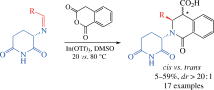
A series of imines derived from α-aminoglutarimide and alhehydes RCHO was introduced into the In(OTf)3-catalyzed Castagnoli--Cushman reaction with homophthalic anhydrides thus yielding novel glutarimide--tetrahydroisoquinolone dyads with moderate yields. Carrying out the reaction at room temperature affords isomers with cis-orientation of the R substituent and carboxy group whereas heating to 80 °C promotes conversion into more stable trans-isomers. Some selected compounds were evaluated in vitro, revealing mild or no antiproliferative effects, and tested for cereblon-binding, with the bestperforming compound showing an affinity in the range of canonical cereblon ligands.

Funders

Russian Science Foundation
22-13-00005

References

.
Crystal structure refinement withSHELXL
Sheldrick G.M.
Acta crystallographica. Section C, Structural chemistry, 2015
.
SHELXT– Integrated space-group and crystal-structure determination
Sheldrick G.M.
Acta Crystallographica Section A: Foundations and Advances, 2015
.
OLEX2: a complete structure solution, refinement and analysis program
Dolomanov O.V., Bourhis L.J., Gildea R.J., Howard J.A., Puschmann H.
Journal of Applied Crystallography, 2009
.

Sweet and Blind Spots in E3 Ligase Ligand Space Revealed by a Thermophoresis-Based Assay
Maiwald S., Heim C., Hernandez Alvarez B., Hartmann M.D.
ACS Medicinal Chemistry Letters, 2020
.

PROTAC targeted protein degraders: the past is prologue
Békés M., Langley D.R., Crews C.M.
Nature Reviews Drug Discovery, 2022
.
Chemical Ligand Space of Cereblon
Boichenko I., Bär K., Deiss S., Heim C., Albrecht R., Lupas A.N., Hernandez Alvarez B., Hartmann M.D.
ACS Omega, 2018
.

Lenalidomide Causes Selective Degradation of IKZF1 and IKZF3 in Multiple Myeloma Cells
Krönke J., Udeshi N.D., Narla A., Grauman P., Hurst S.N., McConkey M., Svinkina T., Heckl D., Comer E., Li X., Ciarlo C., Hartman E., Munshi N., Schenone M., Schreiber S.L., et. al.
Science, 2014
.
Synthesis of novel glutarimide ligands for the E3 ligase substrate receptor Cereblon (CRBN): Investigation of their binding mode and antiproliferative effects against myeloma cell lines
Krasavin M., Adamchik M., Bubyrev A., Heim C., Maiwald S., Zhukovsky D., Zhmurov P., Bunev A., Hartmann M.D.
European Journal of Medicinal Chemistry, 2023
.
The Myeloma Drug Lenalidomide Promotes the Cereblon-Dependent Destruction of Ikaros Proteins
Lu G., Middleton R.E., Sun H., Naniong M., Ott C.J., Mitsiades C.S., Wong K., Bradner J.E., Kaelin W.G.
Science, 2014
.
Identification of a Primary Target of Thalidomide Teratogenicity
Ito T., Ando H., Suzuki T., Ogura T., Hotta K., Imamura Y., Yamaguchi Y., Handa H.
Science, 2010
.
Novel CRBN-Recruiting Proteolysis-Targeting Chimeras as Degraders of Stimulator of Interferon Genes with In Vivo Anti-Inflammatory Efficacy
Liu J., Yuan L., Ruan Y., Deng B., Yang Z., Ren Y., Li L., Liu T., Zhao H., Mai R., Chen J.
Journal of Medicinal Chemistry, 2022
.
Development of Substituted Phenyl Dihydrouracil as the Novel Achiral Cereblon Ligands for Targeted Protein Degradation
Xie H., Li C., Tang H., Tandon I., Liao J., Roberts B.L., Zhao Y., Tang W.
Journal of Medicinal Chemistry, 2023
.
Cereblon neo-substrate binding mimics the recognition of the cyclic imide degron
Heim C., Spring A., Kirchgäßner S., Schwarzer D., Hartmann M.D.
Biochemical and Biophysical Research Communications, 2023
.
Discovery of a Selective and Orally Bioavailable FGFR2 Degrader for Treating Gastric Cancer
Ma L., Li Y., Luo R., Wang Y., Cao J., Fu W., Qian B., Zheng L., Tang L., Lv X., Zheng L., Liang G., Chen L.
Journal of Medicinal Chemistry, 2023
.

Design and Synthesis of Novel Cereblon Binders for Use in Targeted Protein Degradation
Norris S., Ba X., Rhodes J., Huang D., Khambatta G., Buenviaje J., Nayak S., Meiring J., Reiss S., Xu S., Shi L., Whitefield B., Alexander M., Horn E.J., Correa M., et. al.
Journal of Medicinal Chemistry, 2023
.
Proteolysis-targeting chimeras with reduced off-targets
Nguyen T.M., Sreekanth V., Deb A., Kokkonda P., Tiwari P.K., Donovan K.A., Shoba V., Chaudhary S.K., Mercer J.A., Lai S., Sadagopan A., Jan M., Fischer E.S., Liu D.R., Ebert B.L., et. al.
Nature Chemistry, 2023
.
Discovery and Characterization of a Novel Cereblon-Recruiting PRC1 Bridged PROTAC Degrader
Kabir M., Qin L., Luo K., Xiong Y., Sidi R.A., Park K., Jin J.
Journal of Medicinal Chemistry, 2024
.
Cyclic Anhydrides in Formal Cycloadditions and Multicomponent Reactions
.
Physicochemistry of Cereblon Modulating Drugs Determines Pharmacokinetics and Disposition
.
Immunomodulatory agents lenalidomide and pomalidomide co-stimulate T cells by inducing degradation of T cell repressors Ikaros and Aiolos via modulation of the E3 ubiquitin ligase complex CRL4CRBN
Gandhi A.K., Kang J., Havens C.G., Conklin T., Ning Y., Wu L., Ito T., Ando H., Waldman M.F., Thakurta A., Klippel A., Handa H., Daniel T.O., Schafer P.H., Chopra R., et. al.
British Journal of Haematology, 2013
.

Syntheses of antifungal isocoumarins. III. Synthesis and antifungal activity of 3-aryl-3,4-dihydro-4-substituted-isocoumarins.
NOZAWA K., YAMADA M., TSUDA Y., KAWAI K., NAKAJIMA S.
Chemical and Pharmaceutical Bulletin, 2011
.
Immunomodulatory Drugs (IMiDs) in Multiple Myeloma
Raza S., Safyan R., Suzanne L.
Current Cancer Drug Targets, 2017
.

The Castagnoli–Cushman Reaction
Ramiro J.L., Martínez-Caballero S., Neo A.G., Díaz J., Marcos C.F.
Molecules, 2023