
Home / Publications / Why naturally occurring quinone redox systems lack amino groups: consideration using 1,4-naphthoquinone derivatives

Why naturally occurring quinone redox systems lack amino groups: consideration using 1,4-naphthoquinone derivatives

Alexander Fedorovich Pozharskii 1
Alexander Fedorovich Pozharskii
Marina Pavlovna Vlasenko 1
Marina Pavlovna Vlasenko
Pavel Anatol'evich Knyazev 2
Pavel Anatol'evich Knyazev
Andrey Georgievich Starikov 2
Andrey Georgievich Starikov
1 Department of Chemistry, Southern Federal University, Rostov-on-Don, Russian Federation
2 Institute of Physical and Organic Chemistry, Southern Federal University, Rostov-on-Don, Russian Federation
Published 2024-02-19
CommunicationVolume 34, Issue 2, 246-250
0
Share
Cite this
GOST
 | 
Cite this
GOST Copy
Pozharskii A. F. et al. Why naturally occurring quinone redox systems lack amino groups: consideration using 1,4-naphthoquinone derivatives // Mendeleev Communications. 2024. Vol. 34. No. 2. pp. 246-250.
GOST all authors (up to 50) Copy
Pozharskii A. F., Vlasenko M. P., Knyazev P. A., Starikov A. G. Why naturally occurring quinone redox systems lack amino groups: consideration using 1,4-naphthoquinone derivatives // Mendeleev Communications. 2024. Vol. 34. No. 2. pp. 246-250.
RIS
 | 
Cite this
RIS Copy
TY - JOUR
DO - 10.1016/j.mencom.2024.02.028
UR - https://mendcomm.colab.ws/publications/10.1016/j.mencom.2024.02.028
TI - Why naturally occurring quinone redox systems lack amino groups: consideration using 1,4-naphthoquinone derivatives
T2 - Mendeleev Communications
AU - Pozharskii, Alexander Fedorovich
AU - Vlasenko, Marina Pavlovna
AU - Knyazev, Pavel Anatol'evich
AU - Starikov, Andrey Georgievich
PY - 2024
DA - 2024/02/19
PB - Mendeleev Communications
SP - 246-250
IS - 2
VL - 34
ER -
BibTex
 | 
Cite this
BibTex (up to 50 authors) Copy
@article{2024_Pozharskii,
author = {Alexander Fedorovich Pozharskii and Marina Pavlovna Vlasenko and Pavel Anatol'evich Knyazev and Andrey Georgievich Starikov},
title = {Why naturally occurring quinone redox systems lack amino groups: consideration using 1,4-naphthoquinone derivatives},
journal = {Mendeleev Communications},
year = {2024},
volume = {34},
publisher = {Mendeleev Communications},
month = {Feb},
url = {https://mendcomm.colab.ws/publications/10.1016/j.mencom.2024.02.028},
number = {2},
pages = {246--250},
doi = {10.1016/j.mencom.2024.02.028}
}
MLA
Cite this
MLA Copy
Pozharskii, Alexander Fedorovich, et al. “Why naturally occurring quinone redox systems lack amino groups: consideration using 1,4-naphthoquinone derivatives.” Mendeleev Communications, vol. 34, no. 2, Feb. 2024, pp. 246-250. https://mendcomm.colab.ws/publications/10.1016/j.mencom.2024.02.028.

Keywords

1
4-naphthoquinones
amines
oxidation
radical anions.
reduction

Abstract

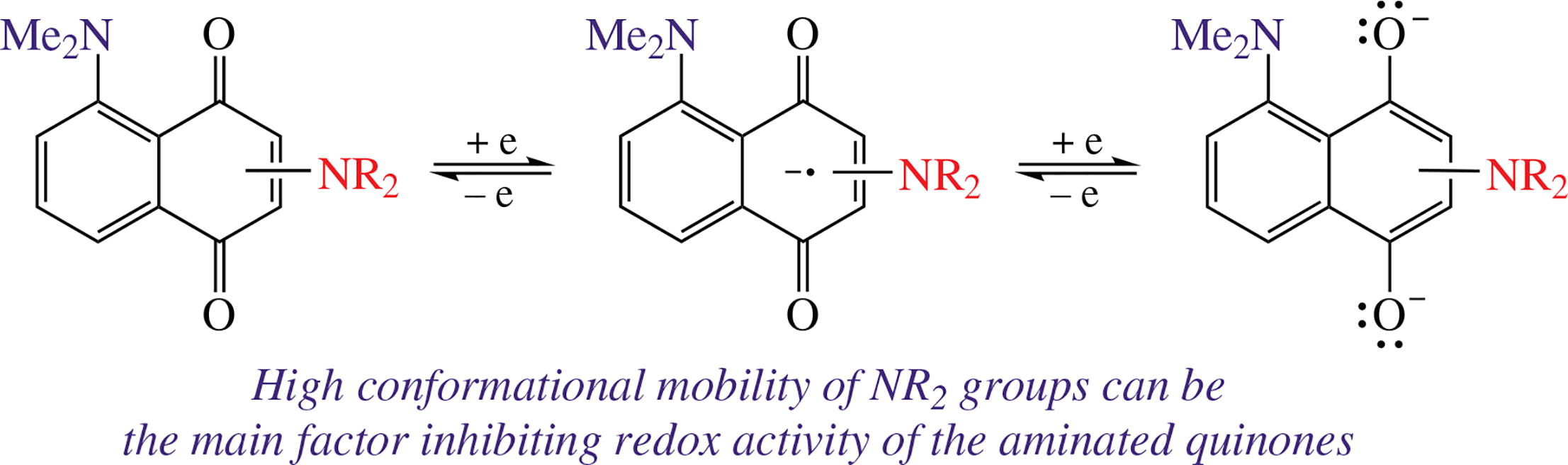
Four representatives of amino derivatives of 1,4-naphtho-quinone were examined by combination of cyclic voltammetry, ESR spectroscopy and quantum chemical calculations. The results obtained help to rationalize why natural quinonoid redox systems do not contain amino groups so common in proteins, nucleobases, numerous signal and other biologically important molecules.

References

.
Suttie J.
2013
.
Pozharskii A.F., Soldatenkov A.T., Katritzky A.R.
2011
.
Natural hybrid orbitals
Foster J.P., Weinhold F.
Journal of the American Chemical Society, 1980
.

A Practical Beginner’s Guide to Cyclic Voltammetry
Elgrishi N., Rountree K.J., McCarthy B.D., Rountree E.S., Eisenhart T.T., Dempsey J.L.
Journal of Chemical Education, 2017
.

Minkin V.I., Osipov O.A., Zhdanov Y.A.
2012
.
Spin density distributions and g values in semiquinones
Prabhananda B.S.
Journal of Chemical Physics, 1983
.

THE REACTION OF AMINES WITH METHYLENE CHLORIDE. A BRIEF REVIEW
Mills J.E., Maryanoff C.A., Cosgrove R.M., Scott L., McComsey D.F.
Organic Preparations and Procedures International, 1984
.
On the application of electron paramagnetic resonance in the study of naturally occurring quinones and quinols
Pedersen J.A.
Spectrochimica Acta - Part A: Molecular and Biomolecular Spectroscopy, 2002
.
Vlasenko M.P., Pozharskii A.F., Demidov O.P., Ozeryanskii V.A., Borodkin G.S.
Mendeleev Communications, 2023
.
Modelling biologically important NH...π interactions
Pozharskii Alexander F., Dyablo Olga V., Ozeryanskii Valery A., Pogosova Olga G.
Russian Chemical Reviews, 2022