
Keywords
carbon dioxide
CrIII complexes
DFT
epoxides
modeling.
Abstract
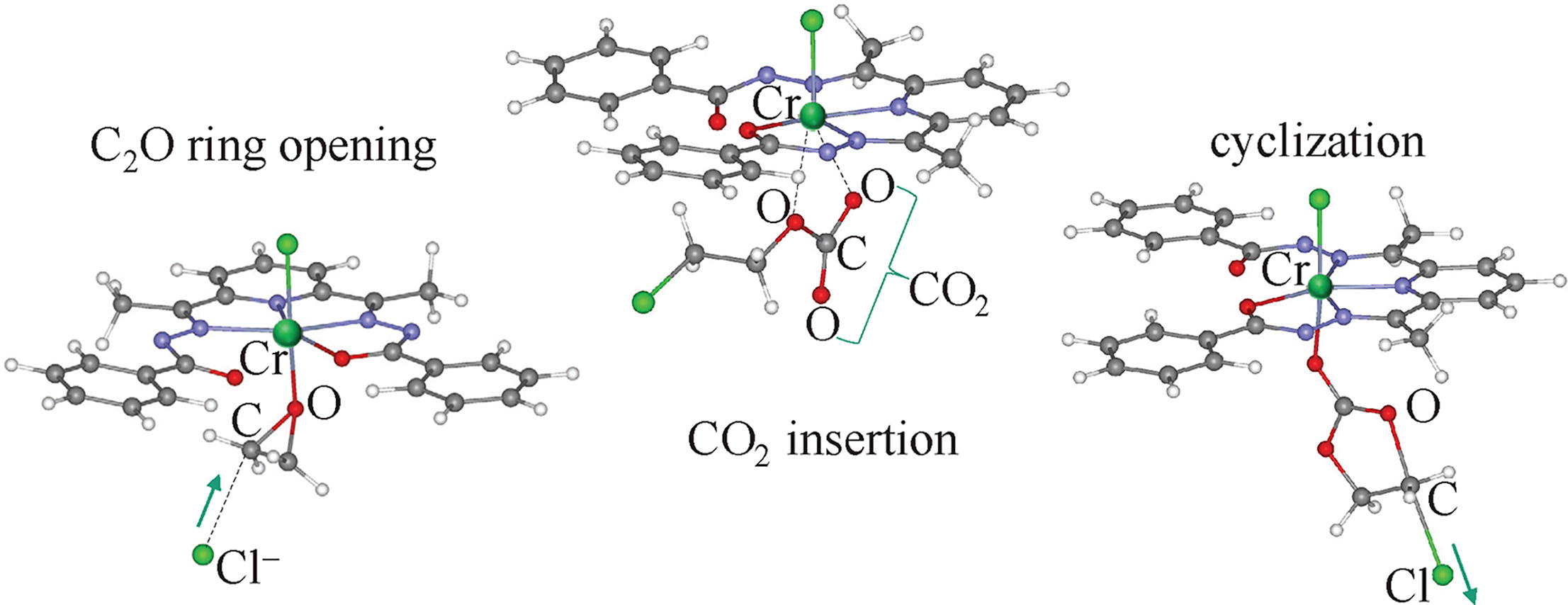
The mechanism of the carbon dioxide and alkene oxide reaction catalyzed by the pentagonal-bipyramidal CrIII complex, dichloro[2,6-diacetylpyridine bis(benzoylhydrazone)(1−)] chromium, includes the steps of sequential binding of the epoxide molecule, chloride ion and CO2 with the catalytic particle and subsequent cyclization, accompanied by dissociation of Cl−. The solvent effect is important for the formation of the cyclic carbonate product.
References
.

Perdew J.P., Burke K., Ernzerhof M.
Physical Review Letters,
1996
.

Laikov D.N., Ustynyuk Y.A.
Russian Chemical Bulletin,
2005
.

Laikov D.N.
Chemical Physics Letters,
1997
.

Chukanova O.M., Bazhenova T.A., Sheverdenkina O.G., Manakin Y.V., Yakushev I.A., Kornev A.B., Sedov I.V.
Kinetics and Catalysis,
2021
.
Bazhenova T.A., Zorina L.V., Simonov S.V., Manakin Y.V., Kornev A.B., Lyssenko K.A., Mironov V.S., Gilmutdinov I.F., Yagubskii E.B.
Inorganica Chimica Acta,
2021
.

Darensbourg D.J., Yeung A.D.
Polymer Chemistry,
2014
.

Childers M.I., Longo J.M., Van Zee N.J., LaPointe A.M., Coates G.W.
Chemical Reviews,
2014
.
Wang T., Xie Y., Deng W.
Journal of Physical Chemistry A,
2014
.
Deacy A.C., Phanopoulos A., Lindeboom W., Buchard A., Williams C.K.
Journal of the American Chemical Society,
2022
.
Darensbourg D.J., Yeung A.D.
Polymer Chemistry,
2015