


Keywords
chemical hardness
density functional theory
hydrolysis
iron complexes
nitrosyl complexes
sulfur complexes
thioformaldehyde
Abstract
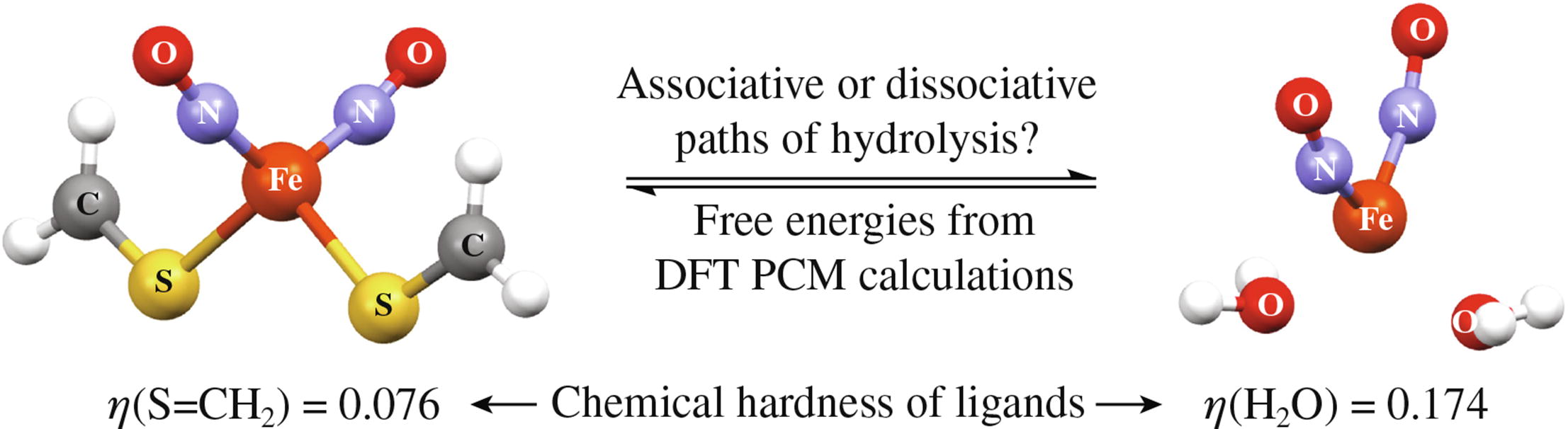
The mechanisms of hydrolysis of a model cationic dinitrosyl iron complex with a prototypic thioformaldehyde ligand have been studied using the density functional theory and polarizable continuum water model. The free-energy calculations have predicted that the associative mechanism of the thioformaldehyde ligand removal has a ∼34 kJ mol-1 lower activation barrier in water than the dissociative mechanism. The additional estimates of chemical hardness have provided useful qualitative characterization of the thio ligands binding.
References
1.

Vanin A.F.
International Journal of Molecular Sciences,
2021
2.
![Bioinorganic Chemistry of the Natural [Fe(NO)2] Motif: Evolution of a Functional Model for NO-Related Biomedical Application and Revolutionary Development of a Translational Model.](/storage/images/resized/iLiQsFqFaSEx6chlGQ5fbAwF6VYU3WWa08hkss0g_small_thumb.webp)
Lu T., Wang Y., Hung C., Chiou S., Liaw W.
Inorganic Chemistry,
2018
3.

Hsiao H., Chung C., Santos J.H., Villaflores O.B., Lu T.
Dalton Transactions,
2019
4.
Lewandowska H., Kalinowska M., Brzóska K., Wójciuk K., Wójciuk G., Kruszewski M.
Dalton Transactions,
2011
5.

Szaciłowski K., Chmura A., Stasicka Z.
Coordination Chemistry Reviews,
2005
6.

Beinert H., Holm R.H., Münck E.
Science,
1997
7.

Banerjee A., Sen S., Paul A.
Chemistry - A European Journal,
2018
8.
S. M. Aldoshin and N. A. Sanina, in Fundamental’nye nauki – meditsine: biofizicheskie meditsinskie tekhnologii (Fundamental Sciences for Medicine: Biophysical Medical Technologies), eds. A. I. Grigoriev and Yu. A. Vladimirov, MAKS Press, Moscow, 2015, vol. 1, pp. 72–102 (in Russian).
9.
Pokidova O.V., Emel'yanova N.S., Psikha B.L., Kulikov A.V., Tretyakov B.A., Kotel'nikov A.I., Sanina N.A., Aldoshin S.M.
Inorganica Chimica Acta,
2020
10.
Butler A.R., Glidewel C., Hyde A.R., McGinnis J., Seymour J.E.
Polyhedron,
1983
11.
Syrtsova L.A., Sanina N.A., Kabachkov E.N., Shkondina N.I., Kotelnikov A.I., Aldoshin S.M.
RSC Advances,
2014
12.

Pokidova O.V., Emel´yanova N.S., Shkondina N.I., Kotel´nikov A.I., Syrtsova L.A., Sanina N.A., Aldoshin S.M.
Russian Chemical Bulletin,
2017
13.
10.1016/j.mencom.2022.07.010_b0065
Schenk
J. Chem. Soc., Dalton Trans.,
2002
14.
Schenk W.A.
Dalton Transactions,
2011
15.
Andrews L., Citra A.
Chemical Reviews,
2002
16.
Zhao Y., Truhlar D.G.
Theoretical Chemistry Accounts,
2007
17.
Weigend F., Ahlrichs R.
Physical Chemistry Chemical Physics,
2005
18.

Cancès E., Mennucci B., Tomasi J.
Journal of Chemical Physics,
1997
19.
Marenich A.V., Cramer C.J., Truhlar D.G.
Journal of Physical Chemistry B,
2009
20.
Pokidova О.V., Luzhkov V.B., Emel'yanova N.S., Krapivin V.B., Kotelnikov A.I., Sanina N.A., Aldoshin S.M.
Dalton Transactions,
2020
21.
Luzhkov V.B., Österberg F., Acharya P., Chattopadhyaya J., Åqvist J.
Physical Chemistry Chemical Physics,
2002
22.
Westheimer F.H.
Accounts of Chemical Research,
1968
23.
Florián J., Warshel A.
Journal of Physical Chemistry B,
1998
24.
Hu C., Brinck T.
Journal of Physical Chemistry A,
1999
25.
Arantes G.M., Field M.J.
Journal of Physical Chemistry A,
2015
26.
Emel´yanova N.S., Shmatko N.Y., Sanina N.A., Aldoshin S.M.
Russian Chemical Bulletin,
2017
27.
Teixeira M.H., Curtolo F., Camilo S.R., Field M.J., Zheng P., Li H., Arantes G.M.
Journal of Chemical Information and Modeling,
2019
28.
Parr R.G., Pearson R.G.
Journal of the American Chemical Society,
1983
29.
Pearson R.G.
Journal of Chemical Sciences,
2005