

Home / Publications / Synthetic approaches to constructing proteolysis targeting chimeras (PROTACs)

Synthetic approaches to constructing proteolysis targeting chimeras (PROTACs)

Olga Yurievna Bakulina 1
Olga Yurievna Bakulina
Alexander Vladimirovich Sapegin 1
Alexander Vladimirovich Sapegin
Alexander Siyasatovich Bunev 2
Alexander Siyasatovich Bunev
Mikhail Yur'evich Krasavin 1, 3
Mikhail Yur'evich Krasavin
Published 2022-07-01
Focus articleVolume 32, Issue 4, 419-432
5
Share
Cite this
GOST
 | 
Cite this
GOST Copy
Bakulina O. Y. et al. Synthetic approaches to constructing proteolysis targeting chimeras (PROTACs) // Mendeleev Communications. 2022. Vol. 32. No. 4. pp. 419-432.
GOST all authors (up to 50) Copy
Bakulina O. Y., Sapegin A. V., Bunev A. S., Krasavin M. Y. Synthetic approaches to constructing proteolysis targeting chimeras (PROTACs) // Mendeleev Communications. 2022. Vol. 32. No. 4. pp. 419-432.
RIS
 | 
Cite this
RIS Copy
TY - JOUR
DO - 10.1016/j.mencom.2022.07.001
UR - https://mendcomm.colab.ws/publications/10.1016/j.mencom.2022.07.001
TI - Synthetic approaches to constructing proteolysis targeting chimeras (PROTACs)
T2 - Mendeleev Communications
AU - Bakulina, Olga Yurievna
AU - Sapegin, Alexander Vladimirovich
AU - Bunev, Alexander Siyasatovich
AU - Krasavin, Mikhail Yur'evich
PY - 2022
DA - 2022/07/01
PB - Mendeleev Communications
SP - 419-432
IS - 4
VL - 32
ER -
BibTex
 | 
Cite this
BibTex (up to 50 authors) Copy
@article{2022_Bakulina,
author = {Olga Yurievna Bakulina and Alexander Vladimirovich Sapegin and Alexander Siyasatovich Bunev and Mikhail Yur'evich Krasavin},
title = {Synthetic approaches to constructing proteolysis targeting chimeras (PROTACs)},
journal = {Mendeleev Communications},
year = {2022},
volume = {32},
publisher = {Mendeleev Communications},
month = {Jul},
url = {https://mendcomm.colab.ws/publications/10.1016/j.mencom.2022.07.001},
number = {4},
pages = {419--432},
doi = {10.1016/j.mencom.2022.07.001}
}
MLA
Cite this
MLA Copy
Bakulina, Olga Yurievna, et al. “Synthetic approaches to constructing proteolysis targeting chimeras (PROTACs).” Mendeleev Communications, vol. 32, no. 4, Jul. 2022, pp. 419-432. https://mendcomm.colab.ws/publications/10.1016/j.mencom.2022.07.001.
Views / Downloads
1 / 2

Keywords

Cereblon
E3 ubiquitin ligase
linkers
proteolysis-targeting chimeras
recruiter ligands
targeted protein degradation

Abstract

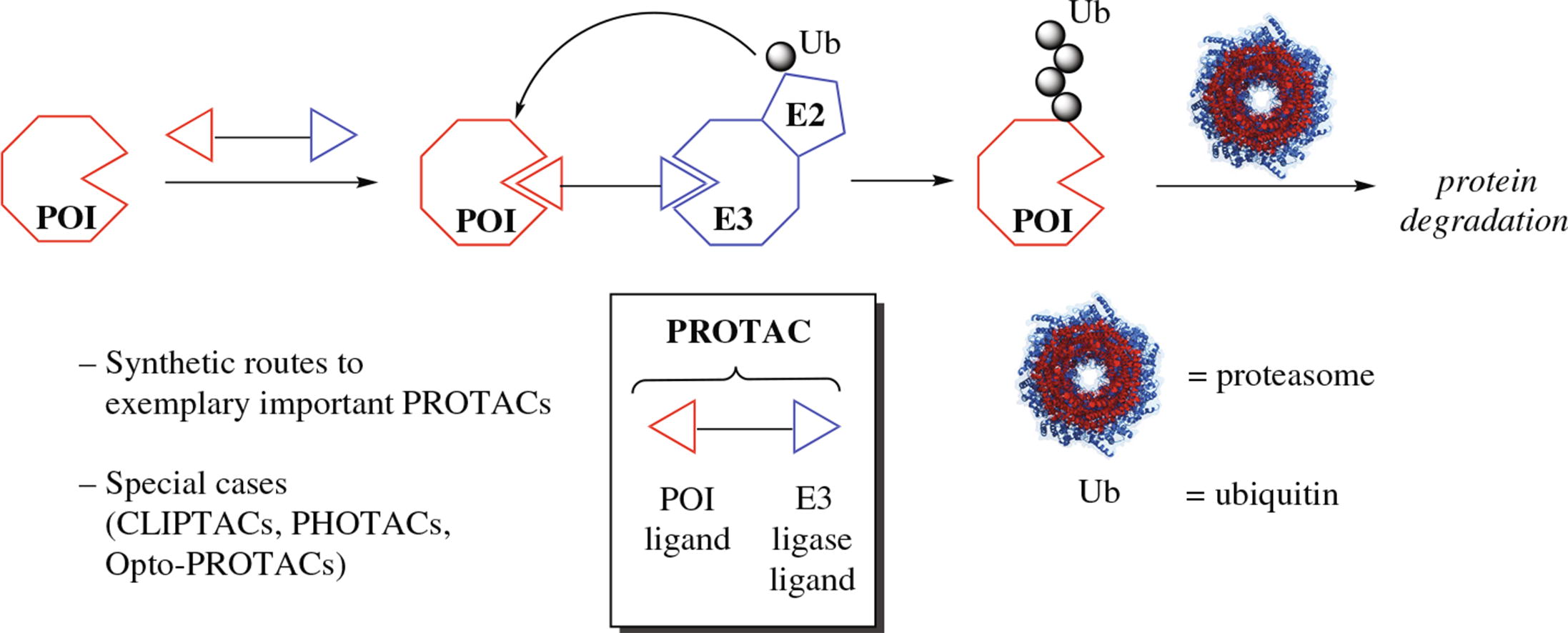
The development of various heterobifunctional constructs dubbed PRoteolysis-TArgeting Chimeras (PROTACs) has gained a significant impetus in the last few years. A viable alternative to the traditional occupancy-based inhibition of aberrantly hyperactive proteins, PROTACs operate by an event-based catalytic mechanism bringing together the protein of interest (POI, to be degraded) and E3 ubiquitin ligases. The formation of the ternary complex ‘POI–PROTAC–E3 ubiquitin ligase’ is the critical step which leads to the ubiquitination of the POI and its proteasomal degradation. The current Focused Review aims to highlight the syntheses of selected innovative PROTAC-type degraders of the therapeutically important protein targets as well as some notable chemical aspects of PROTAC construction. The overview is focusing on PROTACs aimed at recruiting Cereblon, the most exploited E3 ligase for targeted protein degradation.

References

2.
Development of therapeutic antibodies for the treatment of diseases
Lu R., Hwang Y., Liu I., Lee C., Tsai H., Li H., Wu H.
Journal of Biomedical Science, 2020
3.
Knocking down disease: a progress report on siRNA therapeutics
Wittrup A., Lieberman J.
Nature Reviews Genetics, 2015
4.
Cornerstones of CRISPR–Cas in drug discovery and therapy
Fellmann C., Gowen B.G., Lin P., Doudna J.A., Corn J.E.
Nature Reviews Drug Discovery, 2016
5.
Protein quality control and elimination of protein waste: The role of the ubiquitin–proteasome system
Amm I., Sommer T., Wolf D.H.
Biochimica et Biophysica Acta - Molecular Cell Research, 2014
7.
Protacs: Chimeric molecules that target proteins to the Skp1–Cullin–F box complex for ubiquitination and degradation
Sakamoto K.M., Kim K.B., Kumagai A., Mercurio F., Crews C.M., Deshaies R.J.
Proceedings of the National Academy of Sciences of the United States of America, 2001
9.
Bivalent Ligands for Protein Degradation in Drug Discovery
Scheepstra M., Hekking K.F., van Hijfte L., Folmer R.H.
Computational and Structural Biotechnology Journal, 2019
10.
Structural basis of PROTAC cooperative recognition for selective protein degradation
Gadd M.S., Testa A., Lucas X., Chan K., Chen W., Lamont D.J., Zengerle M., Ciulli A.
Nature Chemical Biology, 2017
11.
E3 Ligase Ligands in Successful PROTACs: An Overview of Syntheses and Linker Attachment Points
Bricelj A., Steinebach C., Kuchta R., Gütschow M., Sosič I.
Frontiers in Chemistry, 2021
12.
SCF and Cullin/RING H2-Based Ubiquitin Ligases
Deshaies R.J.
Annual Review of Cell and Developmental Biology, 1999
13.
von Hippel–Lindau tumor suppressor: not only HIF's executioner
Czyzyk-Krzeska M.F., Meller J.
Trends in Molecular Medicine, 2004
14.
Inhibitor of Apoptosis (IAP) Proteins-Modulators of Cell Death and Inflammation
Silke J., Meier P.
Cold Spring Harbor perspectives in biology, 2013
15.
10.1016/j.mencom.2022.07.001_b0075
Shi
J. Immunol. Res., 2017
16.
10.1016/j.mencom.2022.07.001_b0080
Iwakuma
Mol. Cancer Res., 2003
18.
10.1016/j.mencom.2022.07.001_b0090
Halford
Chem. Eng. News, 2021
19.
A MedChem toolbox for cereblon-directed PROTACs.
Steinebach C., Sosič I., Lindner S., Bricelj A., Kohl F., Ng Y.L., Monschke M., Wagner K.G., Krönke J., Gütschow M.
MedChemComm, 2019
20.
Identification of a Primary Target of Thalidomide Teratogenicity
Ito T., Ando H., Suzuki T., Ogura T., Hotta K., Imamura Y., Yamaguchi Y., Handa H.
Science, 2010
21.
Structure of the DDB1–CRBN E3 ubiquitin ligase in complex with thalidomide
Fischer E.S., Böhm K., Lydeard J.R., Yang H., Stadler M.B., Cavadini S., Nagel J., Serluca F., Acker V., Lingaraju G.M., Tichkule R.B., Schebesta M., Forrester W.C., Schirle M., Hassiepen U., et. al.
Nature, 2014
22.
Ligands for cereblon: 2017–2021 patent overview
Kazantsev A., Krasavin M.
Expert Opinion on Therapeutic Patents, 2021
23.
The therapeutic potential of PROTACs
Benowitz A.B., Jones K.L., Harling J.D.
Expert Opinion on Therapeutic Patents, 2021
24.
PROTAC targeted protein degraders: the past is prologue
Békés M., Langley D.R., Crews C.M.
Nature Reviews Drug Discovery, 2022
25.
Targeted protein degradation: expanding the toolbox
Schapira M., Calabrese M.F., Bullock A.N., Crews C.M.
Nature Reviews Drug Discovery, 2019
26.
PROteolysis TArgeting Chimeras (PROTACs) — Past, present and future
Pettersson M., Crews C.M.
Drug Discovery Today: Technologies, 2019
27.
PROTACs: great opportunities for academia and industry
Sun X., Gao H., Yang Y., He M., Wu Y., Song Y., Tong Y., Rao Y.
Signal Transduction and Targeted Therapy, 2019
28.
Troup R.I., Fallan C., Baud M.G.
Exploration of Targeted Anti-tumor Therapy, 2020
29.
10.1016/j.mencom.2022.07.001_b0145
Borsari
J. Med. Chem., 1908
30.
Impact of linker length on the activity of PROTACs
Cyrus K., Wehenkel M., Choi E., Han H., Lee H., Swanson H., Kim K.
Molecular BioSystems, 2011
31.
Chemically Induced Degradation of Anaplastic Lymphoma Kinase (ALK)
Powell C.E., Gao Y., Tan L., Donovan K.A., Nowak R.P., Loehr A., Bahcall M., Fischer E.S., Jänne P.A., George R.E., Gray N.S.
Journal of Medicinal Chemistry, 2018
32.
Proteolysis Targeting Chimeras (PROTACs) of Anaplastic Lymphoma Kinase (ALK)
Zhang C., Han X., Yang X., Jiang B., Liu J., Xiong Y., Jin J.
European Journal of Medicinal Chemistry, 2018
33.
Bruton’s tyrosine kinase (Btk): function, regulation, and transformation with special emphasis on the PH domain
Mohamed A.J., Yu L., Bäckesjö C., Vargas L., Faryal R., Aints A., Christensson B., Berglöf A., Vihinen M., Nore B.F., Edvard Smith C.I.
Immunological Reviews, 2009
34.
Targeting Bruton's tyrosine kinase in B cell malignancies
Hendriks R.W., Yuvaraj S., Kil L.P.
Nature Reviews Cancer, 2014
37.
PROTAC-induced BTK degradation as a novel therapy for mutated BTK C481S induced ibrutinib-resistant B-cell malignancies
Sun Y., Zhao X., Ding N., Gao H., Wu Y., Yang Y., Zhao M., Hwang J., Song Y., Liu W., Rao Y.
Cell Research, 2018
38.
Targeting the C481S Ibrutinib-Resistance Mutation in Bruton’s Tyrosine Kinase Using PROTAC-Mediated Degradation
Buhimschi A.D., Armstrong H.A., Toure M., Jaime-Figueroa S., Chen T.L., Lehman A.M., Woyach J.A., Johnson A.J., Byrd J.C., Crews C.M.
Biochemistry, 2018
40.
Design, synthesis and biological evaluation of Proteolysis Targeting Chimeras (PROTACs) as a BTK degraders with improved pharmacokinetic properties
Jaime-Figueroa S., Buhimschi A.D., Toure M., Hines J., Crews C.M.
Bioorganic and Medicinal Chemistry Letters, 2020
41.
Inhibition of BET bromodomain proteins as a therapeutic approach in prostate cancer
Wyce A., Degenhardt Y., Bai Y., Le B., Korenchuk S., Crouthamel M., McHugh C.F., Vessella R., Creasy C.L., Tummino P.J., Barbash O.
Oncotarget, 2013
42.
Selective inhibition of BET bromodomains
Filippakopoulos P., Qi J., Picaud S., Shen Y., Smith W.B., Fedorov O., Morse E.M., Keates T., Hickman T.T., Felletar I., Philpott M., Munro S., McKeown M.R., Wang Y., Christie A.L., et. al.
Nature, 2010
43.
Phthalimide conjugation as a strategy for in vivo target protein degradation
Winter G.E., Buckley D.L., Paulk J., Roberts J.M., Souza A., Dhe-Paganon S., Bradner J.E.
Science, 2015
44.
Discovery of QCA570 as an Exceptionally Potent and Efficacious Proteolysis Targeting Chimera (PROTAC) Degrader of the Bromodomain and Extra-Terminal (BET) Proteins Capable of Inducing Complete and Durable Tumor Regression
Qin C., Hu Y., Zhou B., Fernandez-Salas E., Yang C., Liu L., McEachern D., Przybranowski S., Wang M., Stuckey J., Meagher J., Bai L., Chen Z., Lin M., Yang J., et. al.
Journal of Medicinal Chemistry, 2018
45.
A biphenyl inhibitor of eIF4E targeting an internal binding site enables the design of cell-permeable PROTAC-degraders
Fischer P.D., Papadopoulos E., Dempersmier J.M., Wang Z., Nowak R.P., Donovan K.A., Kalabathula J., Gorgulla C., Junghanns P.P., Kabha E., Dimitrakakis N., Petrov O.I., Mitsiades C., Ducho C., Gelev V., et. al.
European Journal of Medicinal Chemistry, 2021
46.
Histone deacetylase 6 in health and disease.
Seidel C., Schnekenburger M., Dicato M., Diederich M.
Epigenomics, 2015
48.
Development of the first small molecule histone deacetylase 6 (HDAC6) degraders
Yang K., Song Y., Xie H., Wu H., Wu Y., Leisten E.D., Tang W.
Bioorganic and Medicinal Chemistry Letters, 2018
49.
Selective Histone Deacetylase 6 Inhibitors Bearing Substituted Urea Linkers Inhibit Melanoma Cell Growth
Bergman J.A., Woan K., Perez-Villarroel P., Villagra A., Sotomayor E.M., Kozikowski A.P.
Journal of Medicinal Chemistry, 2012
50.
Development of Multifunctional Histone Deacetylase 6 Degraders with Potent Antimyeloma Activity
Wu H., Yang K., Zhang Z., Leisten E.D., Li Z., Xie H., Liu J., Smith K.A., Novakova Z., Barinka C., Tang W.
Journal of Medicinal Chemistry, 2019
52.
Synthesis of complex alkoxyamines using a polymer-supported N-hydroxyphthalimide
54.
Development of Next-Generation Poly(ADP-Ribose) Polymerase 1–Selective Inhibitors
Ngoi N.Y., Leo E., O'Connor M.J., Yap T.A.
Cancer journal (Sudbury, Mass.), 2021
55.
Identification of probe-quality degraders for Poly(ADP-ribose) polymerase-1 (PARP-1)
Zhang Z., Chang X., Zhang C., Zeng S., Liang M., Ma Z., Wang Z., Huang W., Shen Z.
Journal of Enzyme Inhibition and Medicinal Chemistry, 2020
56.
Rational Design and Synthesis of Novel Dual PROTACs for Simultaneous Degradation of EGFR and PARP
Zheng M., Huo J., Gu X., Wang Y., Wu C., Zhang Q., Wang W., Liu Y., Liu Y., Zhou X., Chen L., Zhou Y., Li H.
Journal of Medicinal Chemistry, 2021
57.
Surfing the p53 network
Vogelstein B., Lane D., Levine A.J.
Nature, 2000
58.
Mutational spectrum of p53 mutations in primary breast and ovarian tumors
Feki A., Irminger-Finger I.
Critical Reviews in Oncology/Hematology, 2004
59.
Functions of the MDM2 oncoprotein
Freedman D.A., Wu L., Levine A.J.
Cellular and Molecular Life Sciences, 1999
60.
Therapeutics Targeting p53-MDM2 Interaction to Induce Cancer Cell Death
Koo N., Sharma A.K., Narayan S.
International Journal of Molecular Sciences, 2022
62.
Development of selective small molecule MDM2 degraders based on nutlin
Wang B., Wu S., Liu J., Yang K., Xie H., Tang W.
European Journal of Medicinal Chemistry, 2019
64.
Discovery of RG7112: A Small-Molecule MDM2 Inhibitor in Clinical Development
Vu B., Wovkulich P., Pizzolato G., Lovey A., Ding Q., Jiang N., Liu J., Zhao C., Glenn K., Wen Y., Tovar C., Packman K., Vassilev L., Graves B.
ACS Medicinal Chemistry Letters, 2013
65.
10.1016/j.mencom.2022.07.001_b0325
Shu
Org. Process Res. Dev., 1866
67.
How Big Is Too Big for Cell Permeability?
Matsson P., Kihlberg J.
Journal of Medicinal Chemistry, 2017
68.
Protein Degradation by In-Cell Self-Assembly of Proteolysis Targeting Chimeras
Lebraud H., Wright D.J., Johnson C.N., Heightman T.D.
ACS Central Science, 2016
69.
Tetrazine Ligation: Fast Bioconjugation Based on Inverse-Electron-Demand Diels−Alder Reactivity
Blackman M.L., Royzen M., Fox J.M.
Journal of the American Chemical Society, 2008
70.
In-gel activity-based protein profiling of a clickable covalent ERK1/2 inhibitor
Lebraud H., Wright D.J., East C.E., Holding F.P., O'Reilly M., Heightman T.D.
Molecular BioSystems, 2016
71.
Photopharmacology: Beyond Proof of Principle
Velema W.A., Szymanski W., Feringa B.L.
Journal of the American Chemical Society, 2014
72.
Reversible Spatiotemporal Control of Induced Protein Degradation by Bistable PhotoPROTACs
Pfaff P., Samarasinghe K.T., Crews C.M., Carreira E.M.
ACS Central Science, 2019
73.
PHOTACs enable optical control of protein degradation
Reynders M., Matsuura B.S., Bérouti M., Simoneschi D., Marzio A., Pagano M., Trauner D.
Science advances, 2020
74.
Photoremovable Protecting Groups in Chemistry and Biology: Reaction Mechanisms and Efficacy
Klán P., Šolomek T., Bochet C.G., Blanc A., Givens R., Rubina M., Popik V., Kostikov A., Wirz J.
Chemical Reviews, 2012
75.
Optical Control of Small Molecule-Induced Protein Degradation
Naro Y., Darrah K., Deiters A.
Journal of the American Chemical Society, 2020
76.
Light-induced control of protein destruction by opto-PROTAC
Liu J., Chen H., Ma L., He Z., Wang D., Liu Y., Lin Q., Zhang T., Gray N., Kaniskan H.Ü., Jin J., Wei W.
Science advances, 2020
77.
Light-Induced Protein Degradation with Photocaged PROTACs
Xue G., Wang K., Zhou D., Zhong H., Pan Z.
Journal of the American Chemical Society, 2019
78.
Semiconducting polymer nano-PROTACs for activatable photo-immunometabolic cancer therapy
Zhang C., Zeng Z., Cui D., He S., Jiang Y., Li J., Huang J., Pu K.
Nature Communications, 2021
79.
Cancer Selective Target Degradation by Folate-Caged PROTACs
Liu J., Chen H., Liu Y., Shen Y., Meng F., Kaniskan H.Ü., Jin J., Wei W.
Journal of the American Chemical Society, 2021
80.
TF-PROTACs Enable Targeted Degradation of Transcription Factors
Liu J., Chen H., Kaniskan H.Ü., Xie L., Chen X., Jin J., Wei W.
Journal of the American Chemical Society, 2021