

Keywords
high purity
magnesiothermic reduction
nanoporous silicon carbide
naturally porous structure
phosphorus–potassium compound fertilizer
rice husk
Abstract
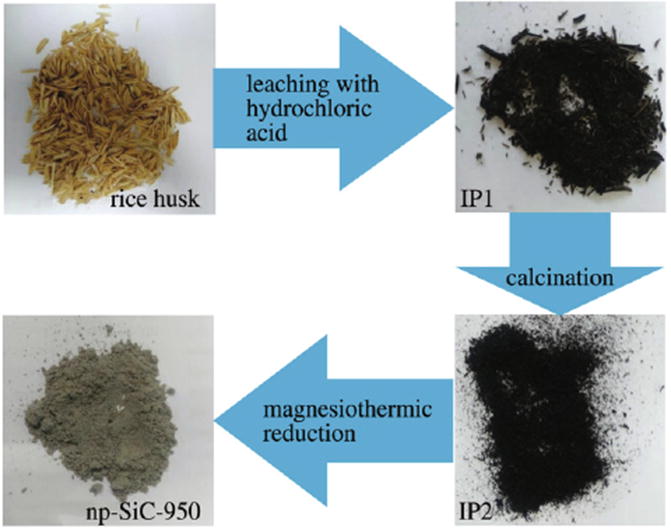
Nanoporous silicon carbide with a specific surface area of up to 186.45 m2 g−1 has been efficiently synthesized from waste rice husk using a magnesiothermic reduction at 950 °C as a key step. Throughout the entire process, the recovery rates of silicon, potassium and phosphorus from rice husk can reach 88.46, 91.5 and 65.5%, respectively. Turning rice husk waste into a real treasure, this promising method for producing porous SiC protects the environment and brings economic benefits.
References
1.

Toktamiş H., Hama P.O.
Applied Radiation and Isotopes,
2019
2.

Rempel A.A., Schaefer H.-.
Applied Physics A: Materials Science and Processing,
1995
3.

Rempel A.A., Sprengel W., Blaurock K., Reichle K.J., Major J., Schaefer H.-.
Physical Review Letters,
2002
4.
Valeeva A.A., Rempel A.A., Rempel S.V., Sadovnikov S.I., Gusev A.I.
Russian Chemical Reviews,
2021
5.
Shcherbakova G.I., Storozhenko P.A., Zhigalov D.V., Varfolomeev M.S., Blokhina M.K., Kutinova N.B.
Russian Chemical Bulletin,
2020
6.
10.1016/j.mencom.2021.09.041_b0030
Makornpan
J. Sci. Technol.,
2014
7.
Chen J., Kong Q., Liu Z., Bi Z., Jia H., Song G., Xie L., Zhang S., Chen C.
ACS Sustainable Chemistry and Engineering,
2019
8.

Radev D.D., Uzunov I.
Solid State Phenomena,
2010
9.
Vlasov A.S., Zakharov A.I., Sarkisyan O.A., Lukasheva N.A.
Refractories and Industrial Ceramics,
1991
10.

Gorthy P., G. M.P.
Journal of the American Ceramic Society,
2004
11.
Singh S.K., Mohanty B.C., Basu S.
Bulletin of Materials Science,
2002
12.
Pereira M.L., Figueira D.S., Girolamo B.R., Vernilli F.
Ceramica,
2020
13.
Alweendo S.T., Johnson O.T., Shongwe M.B., Kavishe F.P., Borode J.O.
Procedia Manufacturing,
2019
14.
Rodriguez-Lugo V., Rubio E., Gomez I., Torres-Martinez L., Castano V.M.
International Journal of Environment and Pollution,
2005