


Abstract
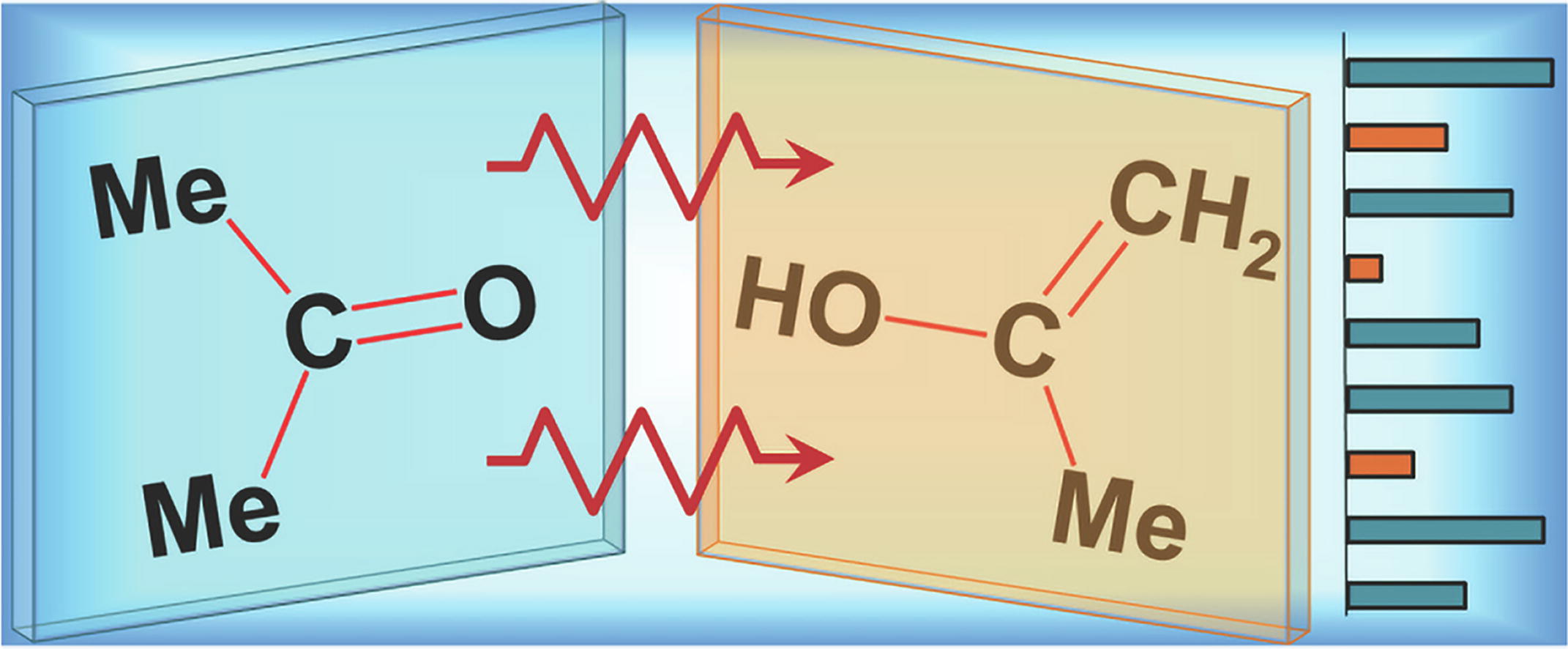
Radiolytic transformations in acetone proceed with the direct participation of its enol tautomer and its derivatives formed as a result of isomerization of excited molecules and ions, as well as chemical reactions catalyzed by acidic products of radiolysis.
References
1.

de Barros A.L., Andrade D.P., da Silveira E.F., Alcantara K.F., Boduch P., Rothard H.
Monthly Notices of the Royal Astronomical Society,
2017
2.

Shokrekhodaei M., Quinones S.
Sensors,
2020
3.

Nobre M., Fernandes A., Ferreira da Silva F., Antunes R., Almeida D., Kokhan V., Hoffmann S.V., Mason N.J., Eden S., Limão-Vieira P.
Physical Chemistry Chemical Physics,
2008
4.

McAdoo D.J.
Mass Spectrometry Reviews,
2000
5.
Bouchoux G.
Mass Spectrometry Reviews,
1988
6.
Grajales-González E., Monge-Palacios M., Sarathy S.M.
Journal of Physical Chemistry A,
2018
7.
Ponomarev A.V., Ershov B.G.
Mendeleev Communications,
2019
8.
Wakamatsu H., Hidaka Y.
International Journal of Chemical Kinetics,
2008
9.
10.1016/j.mencom.2021.07.041_b0045
Wang
ChemPhysChem,
1983
10.
Ponomarev A.V., Kholodkova E.M.
Mendeleev Communications,
2018
11.
Zhestkova T.P., Zhukova T.N., Ponomarev A.V., Tananaev I.G.
Mendeleev Communications,
2008
12.
10.1016/j.mencom.2021.07.041_b0060
Advances in Atmospheric Chemistry,
2017
13.
14.
Feldman V., Sukhov F., Orlov A., Tyulpina I.
Physical Chemistry Chemical Physics,
2003
15.

Ponomarev A.V., Vlasov S.I., Kholodkova E.M., Chulkov V.N., Bludenko A.V.
Radiation Physics and Chemistry,
2019