

Home / Publications / Reverse fragment based drug discovery approach via simple estimation of fragment contributions

Reverse fragment based drug discovery approach via simple estimation of fragment contributions

Nikita Nikolaevich Ivanov 1
Nikita Nikolaevich Ivanov
Vladimir Alexandrovich Palyulin 1
Vladimir Alexandrovich Palyulin
Published 2021-04-28
CommunicationVolume 31, Issue 3, 291-293
2
Share
Cite this
GOST
 | 
Cite this
GOST Copy
Shulga D. A., Ivanov N. N., Palyulin V. A. Reverse fragment based drug discovery approach via simple estimation of fragment contributions // Mendeleev Communications. 2021. Vol. 31. No. 3. pp. 291-293.
GOST all authors (up to 50) Copy
Shulga D. A., Ivanov N. N., Palyulin V. A. Reverse fragment based drug discovery approach via simple estimation of fragment contributions // Mendeleev Communications. 2021. Vol. 31. No. 3. pp. 291-293.
RIS
 | 
Cite this
RIS Copy
TY - JOUR
DO - 10.1016/j.mencom.2021.04.004
UR - https://mendcomm.colab.ws/publications/10.1016/j.mencom.2021.04.004
TI - Reverse fragment based drug discovery approach via simple estimation of fragment contributions
T2 - Mendeleev Communications
AU - Shulga, Dmitry Alexandrovich
AU - Ivanov, Nikita Nikolaevich
AU - Palyulin, Vladimir Alexandrovich
PY - 2021
DA - 2021/04/28
PB - Mendeleev Communications
SP - 291-293
IS - 3
VL - 31
ER -
BibTex
 | 
Cite this
BibTex (up to 50 authors) Copy
@article{2021_Shulga,
author = {Dmitry Alexandrovich Shulga and Nikita Nikolaevich Ivanov and Vladimir Alexandrovich Palyulin},
title = {Reverse fragment based drug discovery approach via simple estimation of fragment contributions},
journal = {Mendeleev Communications},
year = {2021},
volume = {31},
publisher = {Mendeleev Communications},
month = {Apr},
url = {https://mendcomm.colab.ws/publications/10.1016/j.mencom.2021.04.004},
number = {3},
pages = {291--293},
doi = {10.1016/j.mencom.2021.04.004}
}
MLA
Cite this
MLA Copy
Shulga, Dmitry Alexandrovich, et al. “Reverse fragment based drug discovery approach via simple estimation of fragment contributions.” Mendeleev Communications, vol. 31, no. 3, Apr. 2021, pp. 291-293. https://mendcomm.colab.ws/publications/10.1016/j.mencom.2021.04.004.

Keywords

drug discovery
fragment based drug discovery
hit optimization
ligand efficiency
molecular modeling
scoring function

Abstract

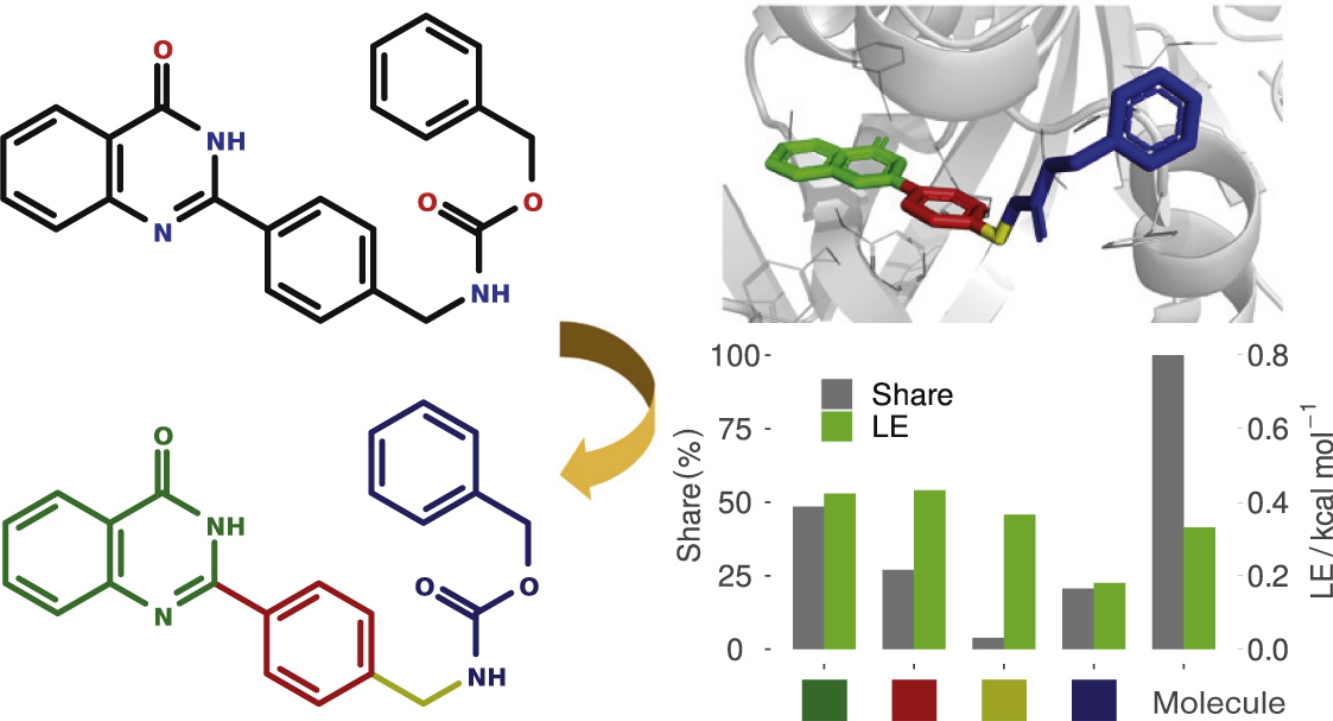
Contributions of different fragments of a ligand into the binding/activity to a specified target are of importance to guide hit-to-lead drug discovery, and fragment based drug discovery (FBDD) approach has proven to be quite fruitful. However, the experimental means of FBDD are generally not affordable to many researchers working in the drug discovery field, especially to small medicinal chemistry groups at universities. To partially solve this problem, we propose a Reversed Fragment Based Drug Discovery (R-FBDD) approach in which the contributions of fragments of a molecule are estimated using scoring functions in order to detect whether a fragment is a ‘binding anchor’ or a ballast, thus guiding further development.

References

1.
10.1016/j.mencom.2021.04.004_bib0005
Congreve
Annu. Rep. Med. Chem., 2007
2.

Fragment-Based Lead Discovery and Design
Joseph-McCarthy D., Campbell A.J., Kern G., Moustakas D.
Journal of Chemical Information and Modeling, 2014
3.
10.1016/j.mencom.2021.04.004_bib0015
Rydzewski
Real World Drug Discovery: A Chemist's Guide to Biotech and Pharmaceutical Research, 2010
4.

Growing PAINS in academic drug discovery
Whitty A.
Future Medicinal Chemistry, 2011
5.
Break Down in Order To Build Up: Decomposing Small Molecules for Fragment-Based Drug Design with eMolFrag
Liu T., Naderi M., Alvin C., Mukhopadhyay S., Brylinski M.
Journal of Chemical Information and Modeling, 2017
6.

The role of ligand efficiency metrics in drug discovery
Hopkins A.L., Keserü G.M., Leeson P.D., Rees D.C., Reynolds C.H.
Nature Reviews Drug Discovery, 2014
8.
AutoDock4 and AutoDockTools4: Automated docking with selective receptor flexibility
Morris G.M., Huey R., Lindstrom W., Sanner M.F., Belew R.K., Goodsell D.S., Olson A.J.
Journal of Computational Chemistry, 2009
9.
Open Babel: An open chemical toolbox
O'Boyle N.M., Banck M., James C.A., Morley C., Vandermeersch T., Hutchison G.R.
Journal of Cheminformatics, 2011
10.

Structure-activity relationships of 2-arylquinazolin-4-ones as highly selective and potent inhibitors of the tankyrases
Nathubhai A., Haikarainen T., Hayward P.C., Muñoz-Descalzo S., Thompson A.S., Lloyd M.D., Lehtiö L., Threadgill M.D.
European Journal of Medicinal Chemistry, 2016
11.
Oxindole-based intraocular pressure reducing agents.
Zaryanova E.V., Lozinskaya N.A., Beznos O.V., Volkova M.S., Chesnokova N.B., Zefirov N.S.
Bioorganic and Medicinal Chemistry Letters, 2017