
Home / Publications / A novel water-soluble BODIPY dye as red fluorescent probe for imaging hypoxic status of human cancer cells

A novel water-soluble BODIPY dye as red fluorescent probe for imaging hypoxic status of human cancer cells

Sergey Aleksandrovich Gorbatov 1, 2
Sergey Aleksandrovich Gorbatov
Denis Yuryevich Uvarov 1
Denis Yuryevich Uvarov
Alexander Mikhailovich Scherbakov 3
Alexander Mikhailovich Scherbakov
Igor Viktorovich Zavarzin 1
Igor Viktorovich Zavarzin
Yulia Alekseevna Volkova 1
Yulia Alekseevna Volkova
Anthony Romieu 2
Anthony Romieu
Published 2020-11-03
CommunicationVolume 30, Issue 6, 750-752
5
Share
Cite this
GOST
 | 
Cite this
GOST Copy
Gorbatov S. A. et al. A novel water-soluble BODIPY dye as red fluorescent probe for imaging hypoxic status of human cancer cells // Mendeleev Communications. 2020. Vol. 30. No. 6. pp. 750-752.
GOST all authors (up to 50) Copy
Gorbatov S. A., Uvarov D. Y., Scherbakov A. M., Zavarzin I. V., Volkova Y. A., Romieu A. A novel water-soluble BODIPY dye as red fluorescent probe for imaging hypoxic status of human cancer cells // Mendeleev Communications. 2020. Vol. 30. No. 6. pp. 750-752.
RIS
 | 
Cite this
RIS Copy
TY - JOUR
DO - 10.1016/j.mencom.2020.11.020
UR - https://mendcomm.colab.ws/publications/10.1016/j.mencom.2020.11.020
TI - A novel water-soluble BODIPY dye as red fluorescent probe for imaging hypoxic status of human cancer cells
T2 - Mendeleev Communications
AU - Gorbatov, Sergey Aleksandrovich
AU - Uvarov, Denis Yuryevich
AU - Scherbakov, Alexander Mikhailovich
AU - Zavarzin, Igor Viktorovich
AU - Volkova, Yulia Alekseevna
AU - Romieu, Anthony
PY - 2020
DA - 2020/11/03
PB - Mendeleev Communications
SP - 750-752
IS - 6
VL - 30
ER -
BibTex
 | 
Cite this
BibTex (up to 50 authors) Copy
@article{2020_Gorbatov,
author = {Sergey Aleksandrovich Gorbatov and Denis Yuryevich Uvarov and Alexander Mikhailovich Scherbakov and Igor Viktorovich Zavarzin and Yulia Alekseevna Volkova and Anthony Romieu},
title = {A novel water-soluble BODIPY dye as red fluorescent probe for imaging hypoxic status of human cancer cells},
journal = {Mendeleev Communications},
year = {2020},
volume = {30},
publisher = {Mendeleev Communications},
month = {Nov},
url = {https://mendcomm.colab.ws/publications/10.1016/j.mencom.2020.11.020},
number = {6},
pages = {750--752},
doi = {10.1016/j.mencom.2020.11.020}
}
MLA
Cite this
MLA Copy
Gorbatov, Sergey Aleksandrovich, et al. “A novel water-soluble BODIPY dye as red fluorescent probe for imaging hypoxic status of human cancer cells.” Mendeleev Communications, vol. 30, no. 6, Nov. 2020, pp. 750-752. https://mendcomm.colab.ws/publications/10.1016/j.mencom.2020.11.020.

Keywords

BODIPY
fluorescent probe
hypoxia
lung cancer
nitroreductase

Abstract

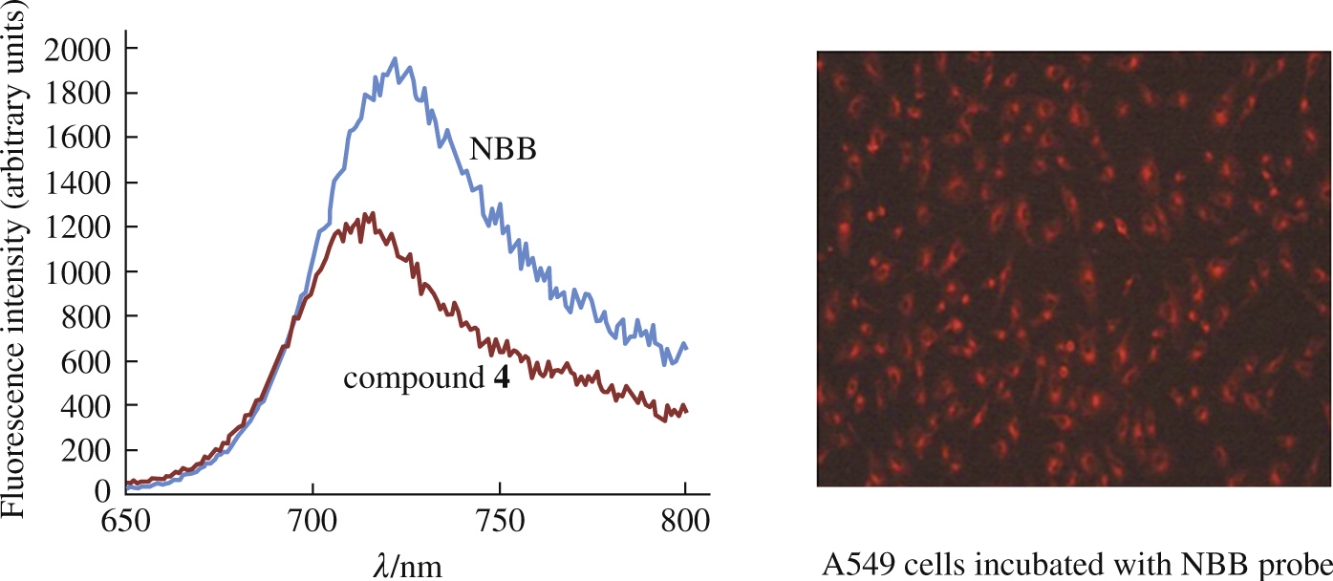
The development of effective methods for real-time monitoring of nitroreductase (NTR) activity is of great significance for medical diagnosis and cancer research. Here, we present a novel water-soluble BODIPY-based chemodosimeter (NBB) for imaging the hypoxic status of human non-small-cell lung cancer A549 cells. We assume that ‘on–off’ response of NBB is activated by the NTRmediated reductive release of meso-phenol BODIPY dye resulting in unusual fluorescence.

References

1.

Tumor Hypoxia Imaging
Sun X., Niu G., Chan N., Shen B., Chen X.
Molecular Imaging and Biology, 2010
2.
10.1016/j.mencom.2020.11.020_bib0010
Vaupel
Cancer Res., 1991
3.
Molecular Imaging of Hypoxia: Strategies for Probe Design and Application
Apte S., T. Chin F., E. Graves E.
Current Organic Synthesis, 2011
7.
A turn-on fluorescent probe for tumor hypoxia imaging in living cells
Cai Q., Yu T., Zhu W., Xu Y., Qian X.
Chemical Communications, 2015
8.
A new aggregation-induced emission fluorescent probe for rapid detection of nitroreductase and its application in living cells
Xu G., Tang Y., Ma Y., Xu A., Lin W.
Spectrochimica Acta - Part A: Molecular and Biomolecular Spectroscopy, 2018
9.

Reduction of polynitroaromatic compounds: the bacterial nitroreductases
Roldán M.D., Pérez-Reinado E., Castillo F., Moreno-Vivián C.
FEMS Microbiology Reviews, 2008
10.

Sensory effects of fluorescent organic dyes
Traven V.F., Cheptsov D.A.
Russian Chemical Reviews, 2020
15.
Recent progress in small molecule fluorescent probes for nitroreductase
Qin W., Xu C., Zhao Y., Yu C., Shen S., Li L., Huang W.
Chinese Chemical Letters, 2018
17.
A BODIPY-based ‘turn-on’ fluorescent probe for hypoxic cell imaging
Wang S., Liu H., Mack J., Tian J., Zou B., Lu H., Li Z., Jiang J., Shen Z.
Chemical Communications, 2015
18.
Targeted Myocardial Hypoxia Imaging Using a Nitroreductase-Activatable Near-Infrared Fluorescent Nanoprobe
Fan Y., Lu M., Yu X., He M., Zhang Y., Ma X., Kou J., Yu B., Tian J.
Analytical Chemistry, 2019
19.
Rational design of fluorescent probes for targeted in vivo nitroreductase visualization
Gao J., Yin X., Li M., Chen J., Tan J., Zhao Z., Gu X.
Organic and Biomolecular Chemistry, 2020
21.
Development of fluorescent probes based on protection–deprotection of the key functional groups for biological imaging
24.
Excimer Emission-Based Fluorescent Probe Targeting Caspase-3
Kim T., Jin H., Bae J., Kim Y.
Analytical Chemistry, 2017
25.
Activatable Formation of Emissive Excimers for Highly Selective Detection of β-Galactosidase
Li Y., Ning L., Yuan F., Zhang T., Zhang J., Xu Z., Yang X.
Analytical Chemistry, 2020
27.
Novel Quinoxaline-2-Carbonitrile-1,4-Dioxide Derivatives Suppress HIF1α Activity and Circumvent MDR in Cancer Cells
Scherbakov A.M., Borunov A.M., Buravchenko G.I., Andreeva O.E., Kudryavtsev I.A., Dezhenkova L.G., Shchekotikhin A.E.
Cancer Investigation, 2018