

Home / Publications / Anisotropic electrostatic models of nitrogen and phosphorus: the variation and the interpretability of the electrostatic parameters in response to structure variation

Anisotropic electrostatic models of nitrogen and phosphorus: the variation and the interpretability of the electrostatic parameters in response to structure variation

4
Share
Cite this
GOST
 | 
Cite this
GOST Copy
Shulga D. A., Shaimardanov A. R., Palyulin V. A. Anisotropic electrostatic models of nitrogen and phosphorus: the variation and the interpretability of the electrostatic parameters in response to structure variation // Mendeleev Communications. 2020. Vol. 30. No. 6. pp. 741-743.
GOST all authors (up to 50) Copy
Shulga D. A., Shaimardanov A. R., Palyulin V. A. Anisotropic electrostatic models of nitrogen and phosphorus: the variation and the interpretability of the electrostatic parameters in response to structure variation // Mendeleev Communications. 2020. Vol. 30. No. 6. pp. 741-743.
RIS
 | 
Cite this
RIS Copy
TY - JOUR
DO - 10.1016/j.mencom.2020.11.017
UR - https://mendcomm.colab.ws/publications/10.1016/j.mencom.2020.11.017
TI - Anisotropic electrostatic models of nitrogen and phosphorus: the variation and the interpretability of the electrostatic parameters in response to structure variation
T2 - Mendeleev Communications
AU - Shulga, Dmitry Alexandrovich
AU - Shaimardanov, Arslan Ramilevich
AU - Palyulin, Vladimir Alexandrovich
PY - 2020
DA - 2020/11/03
PB - Mendeleev Communications
SP - 741-743
IS - 6
VL - 30
ER -
BibTex
 | 
Cite this
BibTex (up to 50 authors) Copy
@article{2020_Shulga,
author = {Dmitry Alexandrovich Shulga and Arslan Ramilevich Shaimardanov and Vladimir Alexandrovich Palyulin},
title = {Anisotropic electrostatic models of nitrogen and phosphorus: the variation and the interpretability of the electrostatic parameters in response to structure variation},
journal = {Mendeleev Communications},
year = {2020},
volume = {30},
publisher = {Mendeleev Communications},
month = {Nov},
url = {https://mendcomm.colab.ws/publications/10.1016/j.mencom.2020.11.017},
number = {6},
pages = {741--743},
doi = {10.1016/j.mencom.2020.11.017}
}
MLA
Cite this
MLA Copy
Shulga, Dmitry Alexandrovich, et al. “Anisotropic electrostatic models of nitrogen and phosphorus: the variation and the interpretability of the electrostatic parameters in response to structure variation.” Mendeleev Communications, vol. 30, no. 6, Nov. 2020, pp. 741-743. https://mendcomm.colab.ws/publications/10.1016/j.mencom.2020.11.017.

Keywords

anisotropic interactions
electrostatic interactions
force fields
molecular mechanics
multipole expansion series
QSPR
quantitative structure–property relationship

Abstract

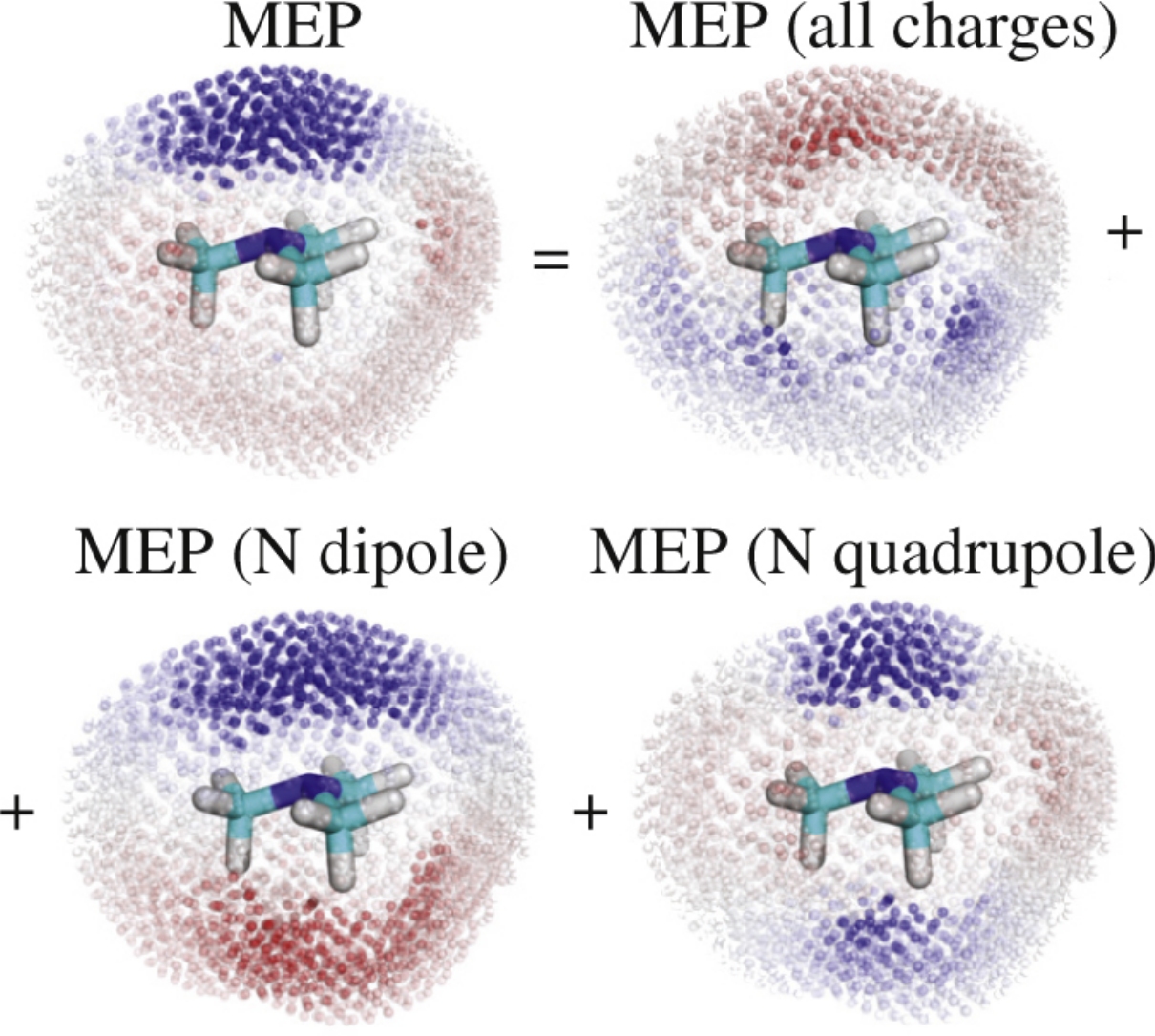
The anisotropic electrostatic parameters of truncated multipole expansion (atomic dipole and quadrupole) obtained for a series of nitrogen and phosphorus containing compounds allow for a reasonable physical interpretation and appear to be predictable in response to chemical substituent variation. These findings will be useful for prediction of anisotropic parameters in next generation force fields without the need to resort to quantum chemical calculations.

References

1.

Molecular dynamics simulations and novel drug discovery
Liu X., Shi D., Zhou S., Liu H., Liu H., Yao X.
Expert Opinion on Drug Discovery, 2017
2.

Molecular dynamics simulations and drug discovery
Durrant J.D., McCammon J.A.
BMC Biology, 2011
3.
Halogens in Protein–Ligand Binding Mechanism: A Structural Perspective
Shinada N.K., de Brevern A.G., Schmidtke P.
Journal of Medicinal Chemistry, 2019
4.

Halogen Bonding: An Interim Discussion
Politzer P., Murray J.S.
ChemPhysChem, 2013
5.

Halogen bonding: an electrostatically-driven highly directional noncovalent interaction
Politzer P., Murray J.S., Clark T.
Physical Chemistry Chemical Physics, 2010
6.
Halogen bonding and other σ-hole interactions: a perspective
Politzer P., Murray J.S., Clark T.
Physical Chemistry Chemical Physics, 2013
7.
Charge Anisotropy: Where Atomic Multipoles Matter Most
Kramer C., Spinn A., Liedl K.R.
Journal of Chemical Theory and Computation, 2014
8.
Charge Anisotropy of Nitrogen: Where Chemical Intuition Fails
Spinn A., Handle P.H., Kraml J., Hofer T.S., Liedl K.R.
Journal of Chemical Theory and Computation, 2020
9.
10.1016/j.mencom.2020.11.017_bib0045
Liu
J. Chem. Theory Comput., 2019
10.
Multipolar electrostatics
Cardamone S., Hughes T.J., Popelier P.L.
Physical Chemistry Chemical Physics, 2014
11.
Multipolar Force Fields and Their Effects on Solvent Dynamics around Simple Solutes
Jakobsen S., Bereau T., Meuwly M.
Journal of Physical Chemistry B, 2015
12.
Multipole models of sulphur for accurate anisotropic electrostatic interactions within force fields
Shulga D.A., Titov O.I., Pisarev S.A., Palyulin V.A.
SAR and QSAR in Environmental Research, 2017
14.
Quadrupole Correction: From Molecular Electrostatic Potential to Free Energies of Halogen Bonding
Titov O.I., Shulga D.A., Palyulin V.A.
Journal of Chemical Theory and Computation, 2018
15.
THE PRINCIPLE OF MAXIMUM HARDNESS
Pearson R.G.
Accounts of Chemical Research, 1993
16.
Fast tools for calculation of atomic charges well suited for drug design
Shulga D.A., Oliferenko A.A., Pisarev S.A., Palyulin V.A., Zefirov N.S.
SAR and QSAR in Environmental Research, 2008