
Home / Publications / Microporous polyphenylenes based on diacetylaromatic compounds

Microporous polyphenylenes based on diacetylaromatic compounds

9
Share
Cite this
GOST
 | 
Cite this
GOST Copy
Khotina I. A., Filippov O. A., Kovalev A. I. Microporous polyphenylenes based on diacetylaromatic compounds // Mendeleev Communications. 2020. Vol. 30. No. 3. pp. 366-368.
GOST all authors (up to 50) Copy
Khotina I. A., Filippov O. A., Kovalev A. I. Microporous polyphenylenes based on diacetylaromatic compounds // Mendeleev Communications. 2020. Vol. 30. No. 3. pp. 366-368.
RIS
 | 
Cite this
RIS Copy
TY - JOUR
DO - 10.1016/j.mencom.2020.05.035
UR - https://mendcomm.colab.ws/publications/10.1016/j.mencom.2020.05.035
TI - Microporous polyphenylenes based on diacetylaromatic compounds
T2 - Mendeleev Communications
AU - Khotina, Irina Anatol'evna
AU - Filippov, Oleg Andreevich
AU - Kovalev, Alexey Ivanovich
PY - 2020
DA - 2020/04/30
PB - Mendeleev Communications
SP - 366-368
IS - 3
VL - 30
ER -
BibTex
 | 
Cite this
BibTex (up to 50 authors) Copy
@article{2020_Khotina,
author = {Irina Anatol'evna Khotina and Oleg Andreevich Filippov and Alexey Ivanovich Kovalev},
title = {Microporous polyphenylenes based on diacetylaromatic compounds},
journal = {Mendeleev Communications},
year = {2020},
volume = {30},
publisher = {Mendeleev Communications},
month = {Apr},
url = {https://mendcomm.colab.ws/publications/10.1016/j.mencom.2020.05.035},
number = {3},
pages = {366--368},
doi = {10.1016/j.mencom.2020.05.035}
}
MLA
Cite this
MLA Copy
Khotina, Irina Anatol'evna, et al. “Microporous polyphenylenes based on diacetylaromatic compounds.” Mendeleev Communications, vol. 30, no. 3, Apr. 2020, pp. 366-368. https://mendcomm.colab.ws/publications/10.1016/j.mencom.2020.05.035.

Keywords

BET surface
cross-linking
diacetyl aromatic compounds
intrinsic microporosity
microporous polyphenylenes
trimerization–cyclocondensation

Abstract

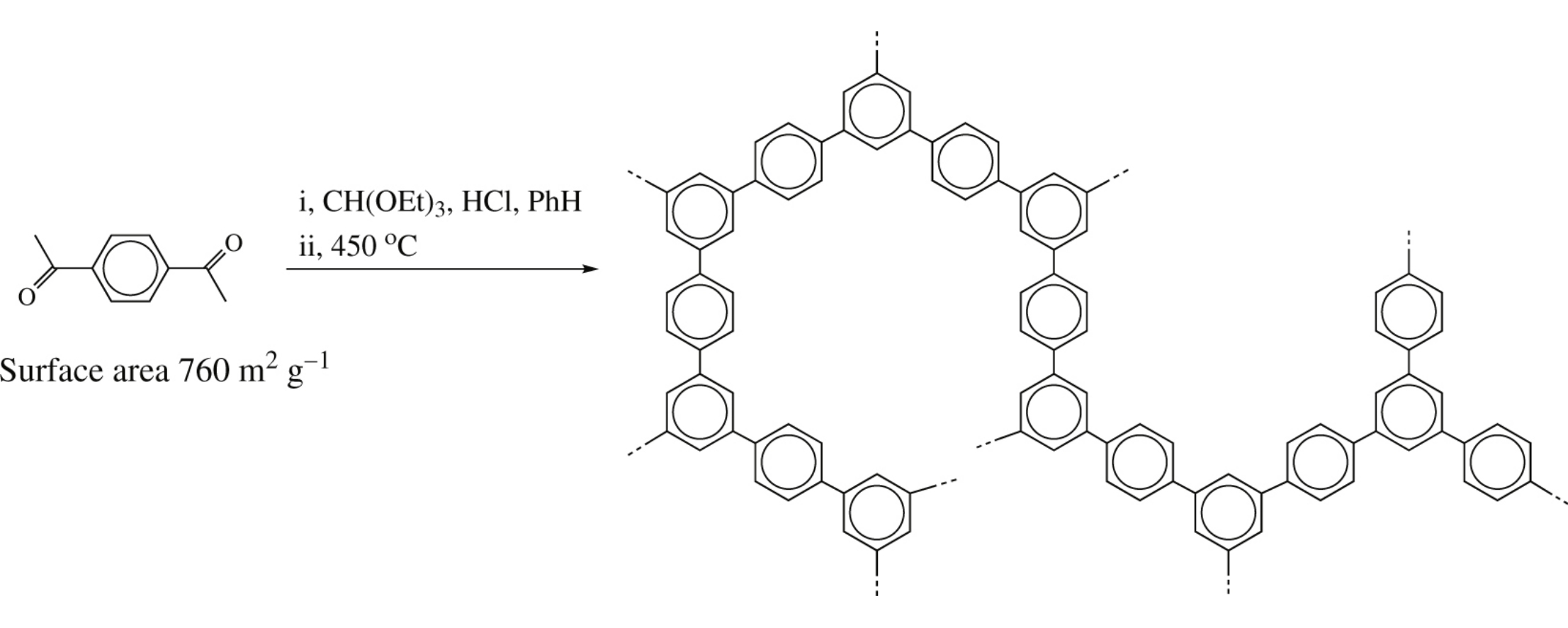
A series of porous polyphenylenes has been synthesized from diacetyl aromatic compounds via two step trimerization–cyclocondensation. The monomer structure influences the value of the polymer porosity. The polyphenylene networks have BET surface up to 760m2g−1

References

2.
10.1016/j.mencom.2020.05.035_bib0010
Handbook of Porous Solids, 2002
4.
Review of polymers of intrinsic microporosity for hydrogen storage applications
Ramimoghadam D., Gray E.M., Webb C.J.
International Journal of Hydrogen Energy, 2016
6.
Koroleva M.Y., Shirokikh S.A., Khasanova L.K., Babusenko E.S., Yurtov E.V.
Mendeleev Communications, 2019
7.

Fluorine in the structure of polymers: influence on the gas separation properties
Yampolskii Y.P., Belov N.A., Alentiev A.Y.
Russian Chemical Reviews, 2019
9.
Kovalev A.I., Shapovalov A.V., Sukhorukova E.V., Sergeev A.M., Peregudov A.S., Rusanov A.L., Khotina I.A.
Mendeleev Communications, 2011
10.

Targeted Synthesis of a Porous Aromatic Framework with High Stability and Exceptionally High Surface Area
Ben T., Ren H., Ma S., Cao D., Lan J., Jing X., Wang W., Xu J., Deng F., Simmons J., Qiu S., Zhu G.
Angewandte Chemie - International Edition, 2009
11.
Conjugated Microporous Polymer Networks via Yamamoto Polymerization
Schmidt J., Werner M., Thomas A.
Macromolecules, 2009
13.
Nanoporous Polymers Containing Stereocontorted Cores for Hydrogen Storage
Yuan S., Kirklin S., Dorney B., Liu D., Yu L.
Macromolecules, 2009
14.

Tetraphenylethylene-based fluorescent porous organic polymers: preparation, gas sorption properties and photoluminescence properties
Chen Q., Wang J., Yang F., Zhou D., Bian N., Zhang X., Yan C., Han B.
Journal of Materials Chemistry A, 2011