

Keywords
catalysis
cobalt
Fischer–Tropsch synthesis
hydrocarbons
multifunctional catalysis
zeolites
Abstract
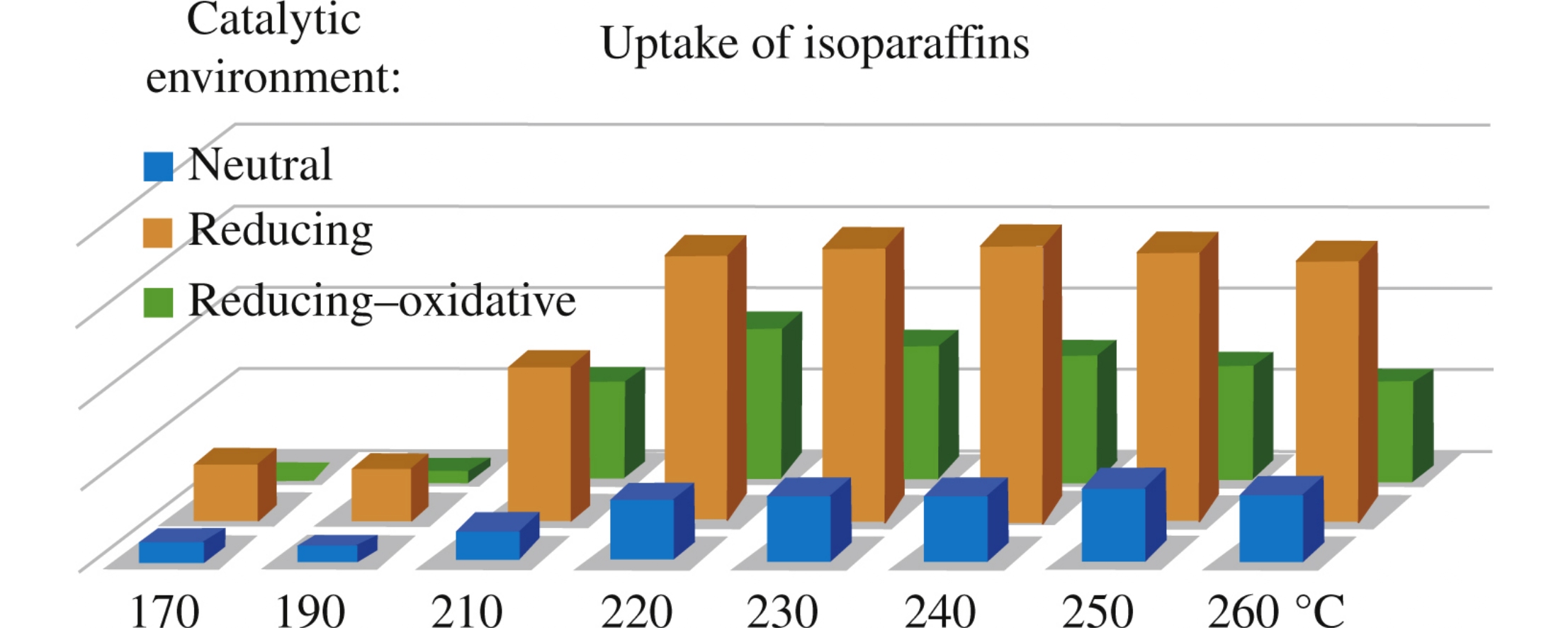
Redox properties of catalytic environment, namely He as neutral, H2 as reducing and H2–H2O as reducing–oxidative one, determine the conversion of hydrocarbons on Co–zeolite catalysts at 170–260°C as well as product distribution. The highest yield of isomerized products was achieved in reducing medium, while the methane formation was suppressed most efficiently in neutral and reducing–oxidative environments. Two distinct ranges can be identified for temperature dependencies of reaction parameters, namely 170–210 and 220–260°C.
References
1.
10.1016/j.mencom.2020.05.034_bib0005
Cheng
2017
2.

Sun B., Qiao M., Fan K., Ulrich J., Tao F.F.
ChemCatChem,
2011
3.

OUKACI R.
Journal of Catalysis,
1988
4.
10.1016/j.mencom.2020.05.034_bib0020
Busca
Heterogeneous Catalytic Materials. Solid State Chemistry, Surface Chemistry and Catalytic Behaviour,
2014
5.
10.1016/j.mencom.2020.05.034_bib0025
Zeolites and Catalysis: Synthesis, Reactions and Applications,
2010
6.
Sineva L.V., Asalieva E.Y., Mordkovich V.Z.
Russian Chemical Reviews,
2015
7.
Sineva L.V., Gorokhova E.O., Kulchakovskaya E.V., Asalieva E.Y., Pushina E.A., Kirichenko A.N., Mordkovich V.Z.
Mendeleev Communications,
2020
8.
Zeolites for Cleaner Technologies, eds. M. Guisnet and J.-P. Gilson (Catalytic Science Series, ed. G. J. Hutchings, vol. 3), Imperial College Press, London, 2002.
9.
Jiang J., Dong Z., Chen H., Sun J., Yang C., Cao F.
Energy & Fuels,
2013
10.

Kim H., Kim D., Park Y., Jeon J.
Research on Chemical Intermediates,
2018
11.
Munirathinam R., Pham Minh D., Nzihou A.
Industrial & Engineering Chemistry Research,
2018
12.
Li Z., Wu L., Han D., Wu J.
Fuel,
2018