

Abstract
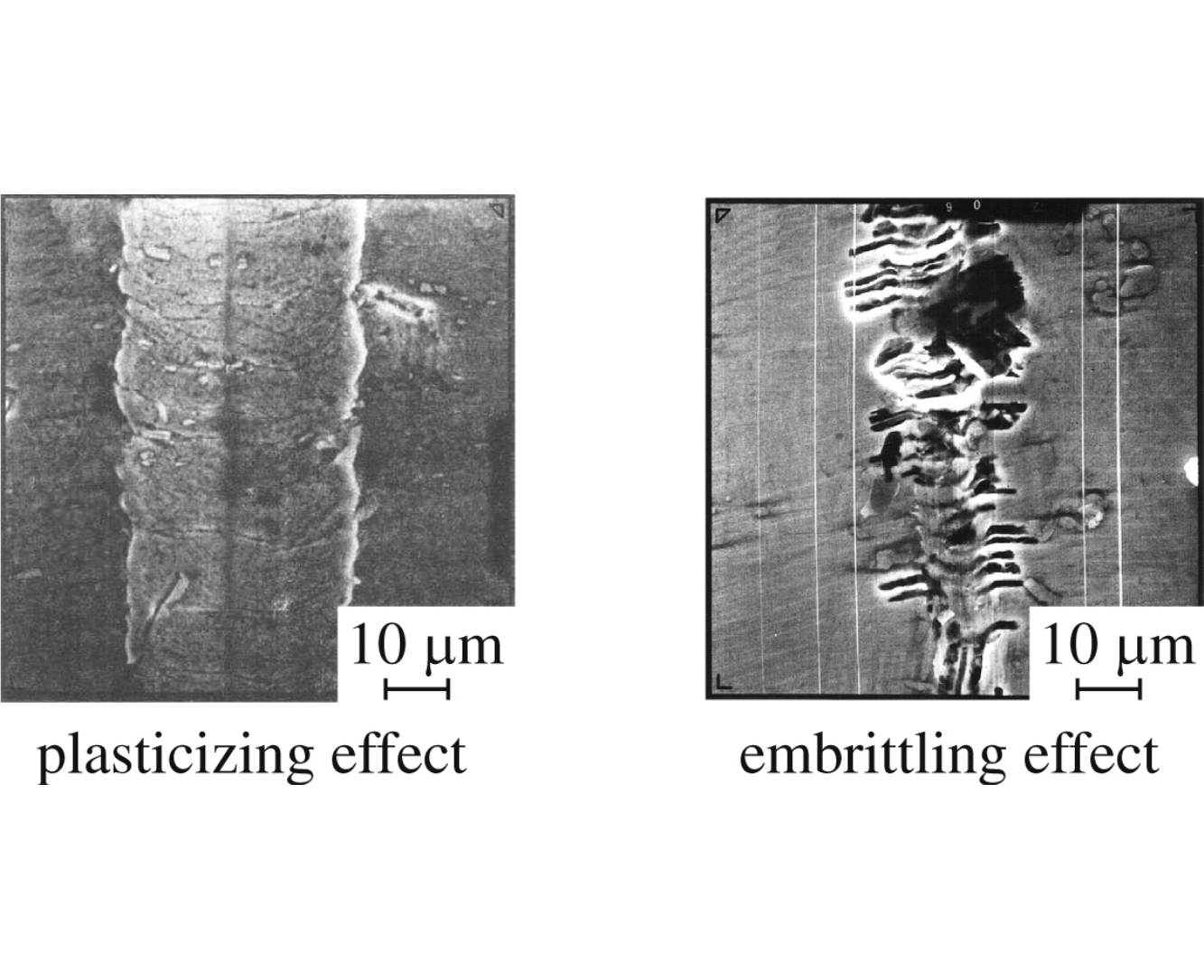
For studying initial surface damages in metals together with the effects caused by active media, the microsclerometry method has been combined with the electrochemical reduction of an active component on the tested surface. The method made it possible to detect a liquid metal embrittlement (LME) effect in the absence of a liquid metal phase.
References
1.
ASTM Standard G171-03, Standard Test Method for Scratch Hardness of Materials Using a Diamond Stylus, ASTM International, West Conshohocken, PA, 2017.
2.

Shchukin E.D., Savenko V.I., Malkin A.I.
Protection of Metals and Physical Chemistry of Surfaces,
2013
3.

Kochanova L.A., Kuchumova V.M., Savenko V.I., Shchukin E.D.
Journal of Materials Science,
1992
4.
10.1016/j.mencom.2019.11.040_bib0020
Shchukin
1993
5.
10.1016/j.mencom.2019.11.040_bib0025
Embrittlement by Liquid and Solid Metals: Proceedings of the Symposium Metallurgical Society of AIME,
1984
6.
10.1016/j.mencom.2019.11.040_bib0030
Kolman
2003
7.
10.1016/j.mencom.2019.11.040_bib0035
Shchukin
Liquid Metal Embrittlement in Solids (LME-effect),
2018
8.
10.1016/j.mencom.2019.11.040_bib0040
Gamburg
Theory and Practice of Metal Deposition,
2011
9.
10.1016/j.mencom.2019.11.040_bib0045
Lynch
Stress Corrosion Cracking: Theory and Practice,
2011
10.
10.1016/j.mencom.2019.11.040_bib0050
Environment-Sensitive Mechanical Behavior,
1966
11.
10.1016/j.mencom.2019.11.040_bib0055
Surface Effects in Crystal Plasticity,
1977