

Home / Publications / Theoretical study of the structure and specific capacity of an organic cathode based on poly(2,5-diaza-1,4-benzoquinone) in a lithiated state

Theoretical study of the structure and specific capacity of an organic cathode based on poly(2,5-diaza-1,4-benzoquinone) in a lithiated state

4
Share
Cite this
GOST
 | 
Cite this
GOST Copy
Shestakov A. F., Litvinenko M. A., Stevenson K. J. Theoretical study of the structure and specific capacity of an organic cathode based on poly(2,5-diaza-1,4-benzoquinone) in a lithiated state // Mendeleev Communications. 2018. Vol. 28. No. 3. pp. 239-241.
GOST all authors (up to 50) Copy
Shestakov A. F., Litvinenko M. A., Stevenson K. J. Theoretical study of the structure and specific capacity of an organic cathode based on poly(2,5-diaza-1,4-benzoquinone) in a lithiated state // Mendeleev Communications. 2018. Vol. 28. No. 3. pp. 239-241.
RIS
 | 
Cite this
RIS Copy
TY - JOUR
DO - 10.1016/j.mencom.2018.05.003
UR - https://mendcomm.colab.ws/publications/10.1016/j.mencom.2018.05.003
TI - Theoretical study of the structure and specific capacity of an organic cathode based on poly(2,5-diaza-1,4-benzoquinone) in a lithiated state
T2 - Mendeleev Communications
AU - Shestakov, Alexander Fedorovich
AU - Litvinenko, Mikhail A
AU - Stevenson, Keith J
PY - 2018
DA - 2018/04/27
PB - Mendeleev Communications
SP - 239-241
IS - 3
VL - 28
ER -
BibTex
 | 
Cite this
BibTex (up to 50 authors) Copy
@article{2018_Shestakov,
author = {Alexander Fedorovich Shestakov and Mikhail A Litvinenko and Keith J Stevenson},
title = {Theoretical study of the structure and specific capacity of an organic cathode based on poly(2,5-diaza-1,4-benzoquinone) in a lithiated state},
journal = {Mendeleev Communications},
year = {2018},
volume = {28},
publisher = {Mendeleev Communications},
month = {Apr},
url = {https://mendcomm.colab.ws/publications/10.1016/j.mencom.2018.05.003},
number = {3},
pages = {239--241},
doi = {10.1016/j.mencom.2018.05.003}
}
MLA
Cite this
MLA Copy
Shestakov, Alexander Fedorovich, et al. “Theoretical study of the structure and specific capacity of an organic cathode based on poly(2,5-diaza-1,4-benzoquinone) in a lithiated state.” Mendeleev Communications, vol. 28, no. 3, Apr. 2018, pp. 239-241. https://mendcomm.colab.ws/publications/10.1016/j.mencom.2018.05.003.

Abstract

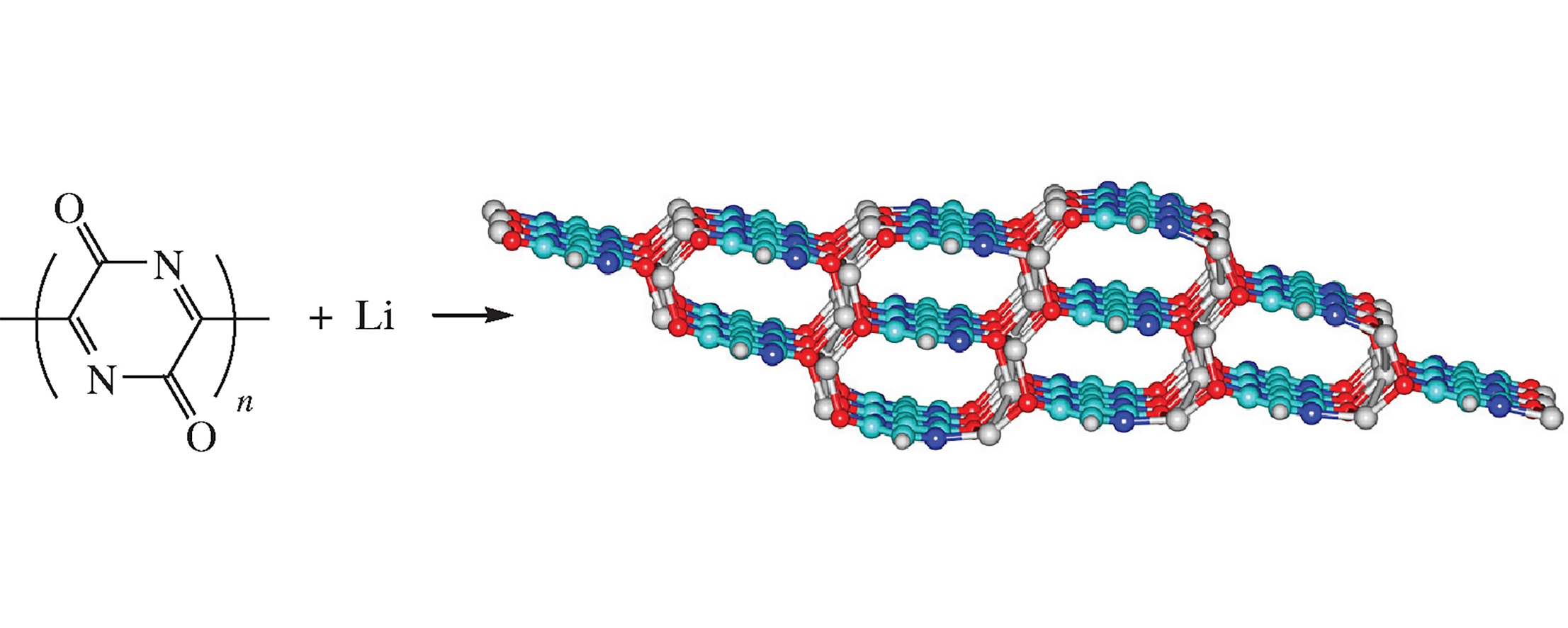
A density functional theory computational study of poly(2,5-diaza-1,4-benzoquinone) as a potential organic cathode is presented. The lithium insertion in one-dimensional, two-dimensional and three-dimensional models was evaluated and yielded energies of 2.38, 3.12 and 3.59eV per Li atom, respectively. These values taken together with the specific capacity of ∼500mAhg−1 make poly(2,5-diaza-1,4-benzoquinone) a promising organic cathode material for Li-ion batteries.

References

1.

Polycarbonyl(quinonyl) organic compounds as cathode materials for sustainable lithium ion batteries
Zeng R., Xing L., Qiu Y., Wang Y., Huang W., Li W., Yang S.
Electrochimica Acta, 2014
2.
A novel polyquinone cathode material for rechargeable lithium batteries
Zhao L., Wang W., Wang A., Yuan K., Chen S., Yang Y.
Journal of Power Sources, 2013
5.
High-capacity organic cathode active materials of 2,2′-bis-p-benzoquinone derivatives for rechargeable batteries
Yokoji T., Kameyama Y., Maruyama N., Matsubara H.
Journal of Materials Chemistry A, 2016
6.
Quinone-formaldehyde polymer as an active material in Li-ion batteries
Pirnat K., Mali G., Gaberscek M., Dominko R.
Journal of Power Sources, 2016
7.
Polyquinoneimines for lithium storage: more than the sum of its parts
Tian B., Ning G., Tang W., Peng C., Yu D., Chen Z., Xiao Y., Su C., Loh K.P.
Materials Horizons, 2016
8.

Polyanthraquinone as a Reliable Organic Electrode for Stable and Fast Lithium Storage.
Song Z., Qian Y., Gordin M.L., Tang D., Xu T., Otani M., Zhan H., Zhou H., Wang D.
Angewandte Chemie - International Edition, 2015
9.

A Novel Coordination Polymer as Positive Electrode Material for Lithium Ion Battery
Xiang J., Chang C., Li M., Wu S., Yuan L., Sun J.
Crystal Growth and Design, 2007
11.
Aromatic Carbonyl Derivative Polymers as High‐Performance Li‐Ion Storage Materials
13.
Polyimides: Promising Energy-Storage Materials
Song Z., Zhan H., Zhou Y.
Angewandte Chemie - International Edition, 2010
15.
10.1016/j.mencom.2018.05.003_bib0075
Hernández-Burgos
J. Phys. Chem., 2014
16.
Designing strategies to tune reduction potential of organic molecules for sustainable high capacity battery application
Araujo R.B., Banerjee A., Panigrahi P., Yang L., Strømme M., Sjödin M., Araujo C.M., Ahuja R.
Journal of Materials Chemistry A, 2017
17.
Power from nature: designing green battery materials from electroactive quinone derivatives and organic polymers
Miroshnikov M., Divya K.P., Babu G., Meiyazhagan A., Reddy Arava L.M., Ajayan P.M., John G.
Journal of Materials Chemistry A, 2016
18.

Synthesis and Characterization of Semiconductive Poly‐1,4‐Dimethoxybenzene and Its Derived Polyquinone
Foos J.S., Erker S.M., Rembetsy L.M.
Journal of the Electrochemical Society, 1986
19.

Generalized Gradient Approximation Made Simple
Perdew J.P., Burke K., Ernzerhof M.
Physical Review Letters, 1996
22.
Bonded-atom fragments for describing molecular charge densities
Hirshfeld F.L.
Theoretical Chemistry Accounts, 1977
23.
Ignatova A.A., Kozlov A.V., Shestakov A.F., Chernyak A.V., Yarmolenko O.V., Troshin P.A.
Mendeleev Communications, 2017
24.
Self-polymerized dopamine as an organic cathode for Li- and Na-ion batteries
Liu T., Kim K.C., Lee B., Chen Z., Noda S., Jang S.S., Lee S.W.
Energy and Environmental Science, 2017
25.
10.1016/j.mencom.2018.05.003_bib0125
Krasnov
Molekulyarnye postoyannye neorganicheskikh soedinenii (Molecular Constants of Inorganic Compounds), 1979