


Abstract
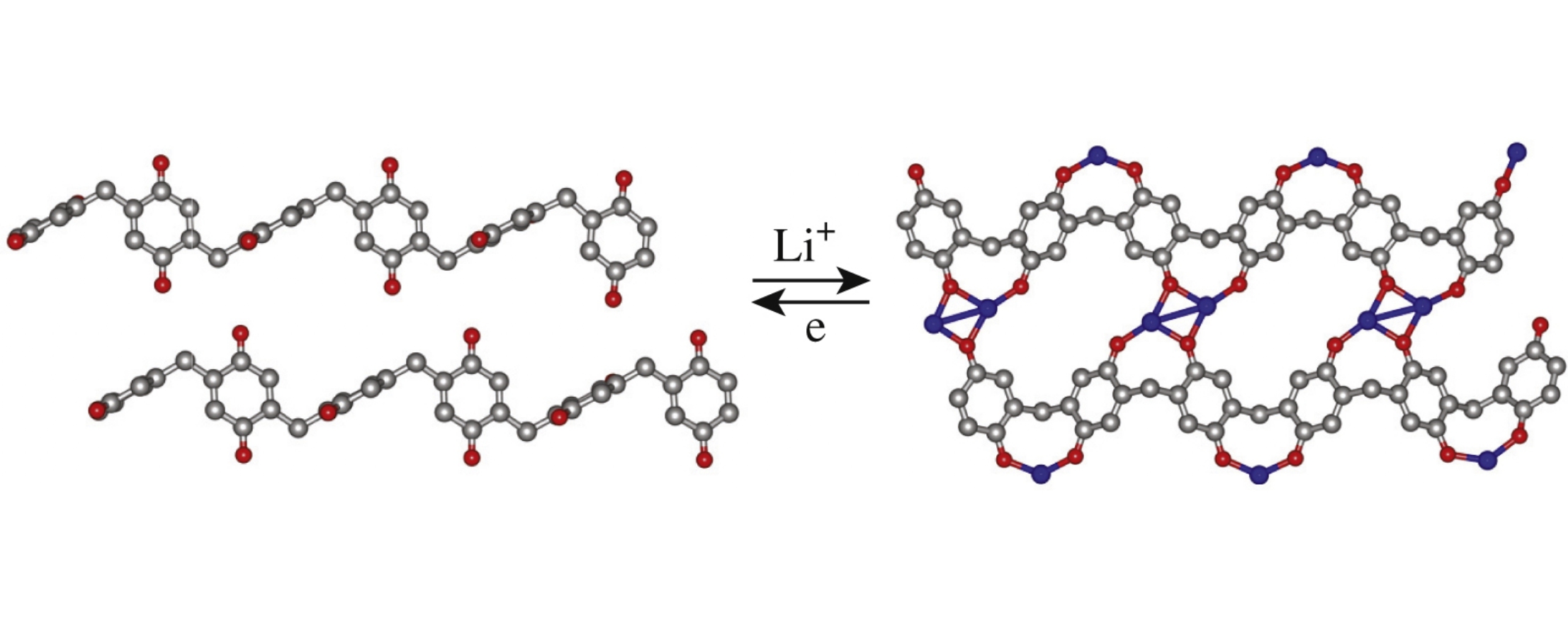
Electrochemical lithiation of organic polyquinone-based cathode material can occur irreversibly leading thus to a rapid deterioration of the battery performance. Carefully controlled degree of lithium intercalation within the defined charge/ discharge potential window provides a stable battery operation within 170 cycles with 100% coulombic efficiency. DFT calculations revealed that deep lithiation results in a strong conformational reorganization of the polymer domains leading to repeatable expansion and shrinkage of the electroactive material and a rapid loss of the cathode integrity.
References
1.

Muench S., Wild A., Friebe C., Häupler B., Janoschka T., Schubert U.S.
Chemical Reviews,
2016
2.

Häupler B., Wild A., Schubert U.S.
Advanced Energy Materials,
2015
3.

Poizot P., Dolhem F.
Energy and Environmental Science,
2011
4.
Hu Y., Sun X.
Journal of Materials Chemistry A,
2014
5.
Kim H., Kim H., Ding Z., Lee M.H., Lim K., Yoon G., Kang K.
Advanced Energy Materials,
2016
6.
Towards sustainable and versatile energy storage devices: an overview of organic electrode materials
Song Z., Zhou H.
Energy and Environmental Science,
2013
7.
Sawicki M., Shaw L.L.
RSC Advances,
2015
8.
10.1016/j.mencom.2017.09.032_bib0040
Chaudhary
IJMMSE,
2016
9.
Baekeland L.H.
Journal of Industrial & Engineering Chemistry,
1909
10.

Perdew J.P., Burke K., Ernzerhof M.
Physical Review Letters,
1996
11.

Stevens W.J., Basch H., Krauss M.
Journal of Chemical Physics,
1984
12.

Laikov D.N.
Chemical Physics Letters,
1997
13.
Yarmolenko O.V., Tulibaeva G.Z., Khatmullina K.G., Bogdanova L.M., Shestakov A.F.
Mendeleev Communications,
2016
14.
Zhou J., Qian T., Wang M., Xu N., Zhang Q., Li Q., Yan C.
ACS applied materials & interfaces,
2016