Home / Publications / Efficiency of singlet oxygen generation by fulvic acids and its influence on UV photodegradation of herbicide Amitrole in aqueous solutions

Efficiency of singlet oxygen generation by fulvic acids and its influence on UV photodegradation of herbicide Amitrole in aqueous solutions

Ivan Pavlovich Pozdnyakov 1, 2
Ivan Pavlovich Pozdnyakov
Victoria Aleksandrovna Salomatova 1
Victoria Aleksandrovna Salomatova
Marina V Parkhats 3
Marina V Parkhats
Boris Mikhailovich Dzhagarov 3
Boris Mikhailovich Dzhagarov
Nikolai Mikhailovich Bazhin 1
Nikolai Mikhailovich Bazhin
Published 2017-06-29
CommunicationVolume 27, Issue 4, 399-401
8
Share
Cite this
GOST
 | 
Cite this
GOST Copy
Pozdnyakov I. P. et al. Efficiency of singlet oxygen generation by fulvic acids and its influence on UV photodegradation of herbicide Amitrole in aqueous solutions // Mendeleev Communications. 2017. Vol. 27. No. 4. pp. 399-401.
GOST all authors (up to 50) Copy
Pozdnyakov I. P., Salomatova V. A., Parkhats M. V., Dzhagarov B. M., Bazhin N. M. Efficiency of singlet oxygen generation by fulvic acids and its influence on UV photodegradation of herbicide Amitrole in aqueous solutions // Mendeleev Communications. 2017. Vol. 27. No. 4. pp. 399-401.
RIS
 | 
Cite this
RIS Copy
TY - JOUR
DO - 10.1016/j.mencom.2017.07.028
UR - https://mendcomm.colab.ws/publications/10.1016/j.mencom.2017.07.028
TI - Efficiency of singlet oxygen generation by fulvic acids and its influence on UV photodegradation of herbicide Amitrole in aqueous solutions
T2 - Mendeleev Communications
AU - Pozdnyakov, Ivan Pavlovich
AU - Salomatova, Victoria Aleksandrovna
AU - Parkhats, Marina V
AU - Dzhagarov, Boris Mikhailovich
AU - Bazhin, Nikolai Mikhailovich
PY - 2017
DA - 2017/06/29
PB - Mendeleev Communications
SP - 399-401
IS - 4
VL - 27
ER -
BibTex
 | 
Cite this
BibTex (up to 50 authors) Copy
@article{2017_Pozdnyakov,
author = {Ivan Pavlovich Pozdnyakov and Victoria Aleksandrovna Salomatova and Marina V Parkhats and Boris Mikhailovich Dzhagarov and Nikolai Mikhailovich Bazhin},
title = {Efficiency of singlet oxygen generation by fulvic acids and its influence on UV photodegradation of herbicide Amitrole in aqueous solutions},
journal = {Mendeleev Communications},
year = {2017},
volume = {27},
publisher = {Mendeleev Communications},
month = {Jun},
url = {https://mendcomm.colab.ws/publications/10.1016/j.mencom.2017.07.028},
number = {4},
pages = {399--401},
doi = {10.1016/j.mencom.2017.07.028}
}
MLA
Cite this
MLA Copy
Pozdnyakov, Ivan Pavlovich, et al. “Efficiency of singlet oxygen generation by fulvic acids and its influence on UV photodegradation of herbicide Amitrole in aqueous solutions.” Mendeleev Communications, vol. 27, no. 4, Jun. 2017, pp. 399-401. https://mendcomm.colab.ws/publications/10.1016/j.mencom.2017.07.028.

Abstract

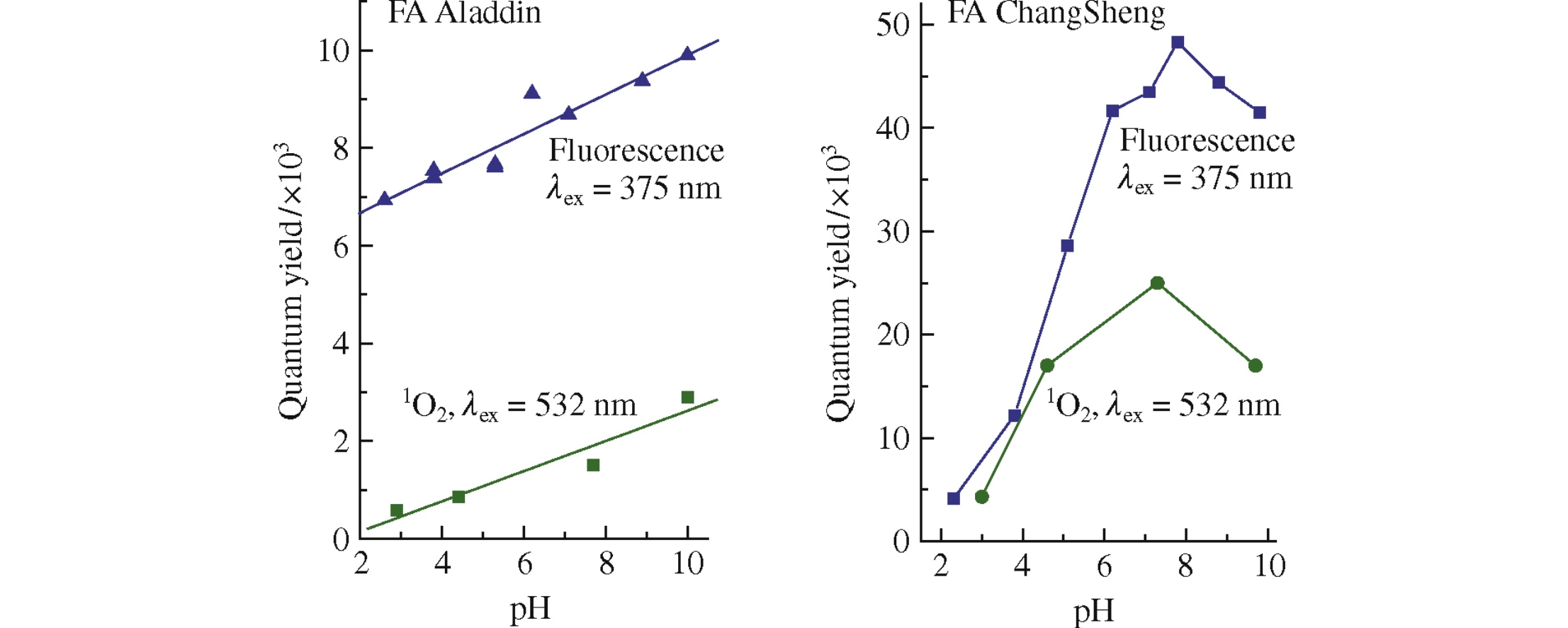
pH-dependent efficiency of singlet oxygen (1O2) generation by fulvic acids (FAs) from different sources was estimated by time-resolved luminescence technique. All FAs turn up the highest quantum yields of 1O2 for neutral and alkali solutions [ϕ532(1O2)] = (0.3•2.5)í10•2] and 3•5-fold decrease in ϕ532(1O2) for acidic solutions. Potential of FA ChangSheng (the best 1O2 generating agent among investigated FAs) in relation to photodegradation of non-UVA-absorbing herbicide Amitrole (3-amino-1,2,4-triazole) was demonstrated.

References

1.
10.1016/j.mencom.2017.07.028_bib0005
McNeill
Environ. Sci.: Processes Impacts, 2016
2.
10.1016/j.mencom.2017.07.028_bib0010
Blough
1995
3.
10.1016/j.mencom.2017.07.028_bib0015
Remucal
Environ. Sci.: Processes Impacts, 2014
5.
Photogeneration of singlet oxygen by humic substances: comparison of humic substances of aquatic and terrestrial origin
Paul A., Hackbarth S., Vogt R.D., Röder B., Kent Burnison B., Steinberg C.E.
Photochemical and Photobiological Sciences, 2004
7.
Herbicide Penetration Through Isolated Periderm and Cuticular Membranes
Ersoz M., Duncan H.J., Lale M., Ucan H.I.
Environmental Technology (United Kingdom), 1996
8.

Photodegradation of pesticides in the presence of humic substances
Jensen-Korte U., Anderson C., Spiteller M.
Science of the Total Environment, 1987
9.
10.1016/j.mencom.2017.07.028_bib0045
Gollnick
1, 4-Cycloaddition Reactions, 1967
12.
Does photodissociation of molecular oxygen from myoglobin and hemoglobin yield singlet oxygen?
Lepeshkevich S.V., Stasheuski A.S., Parkhats M.V., Galievsky V.A., Dzhagarov B.M.
Journal of Photochemistry and Photobiology B: Biology, 2013
13.
Water-Soluble Pyridyl Porphyrins with Amphiphilic N-Substituents: Fluorescent Properties and Photosensitized Formation of Singlet Oxygen
Stasheuski A.S., Galievsky V.A., Knyukshto V.N., Ghazaryan R.K., Gyulkhandanyan A.G., Gyulkhandanyan G.V., Dzhagarov B.M.
Journal of Applied Spectroscopy, 2014
14.
Two-photon photosensitized production of singlet oxygen in water.
Frederiksen P.K., McIlroy S.P., Nielsen C.B., Nikolajsen L., Skovsen E., Jørgensen M., Mikkelsen K.V., Ogilby P.R.
Journal of the American Chemical Society, 2004
15.
Modeling the spectral shape of absorption by chromophoric dissolved organic matter
Twardowski M.S., Boss E., Sullivan J.M., Donaghay P.L.
Marine Chemistry, 2004
16.

Investigation of fulvic acid photochemistry in aqueous solutions by stationary and laser flash photolysis techniques
17.
Photooxidation-Induced Changes in Optical, Electrochemical, and Photochemical Properties of Humic Substances
Sharpless C.M., Aeschbacher M., Page S.E., Wenk J., Sander M., McNeill K.
Environmental Science & Technology, 2014
18.
Laser photolysis study of the triplet states of fulvic acids in aqueous solutions
Sul’timova N.B., Levin P.P., Chaikovskaya O.N., Sokolova I.V.
High Energy Chemistry, 2008
19.
Ding W., Romanova T.E., Pozdnyakov I.P., Salomatova V.A., Parkhats M.V., Dzhagarov B.M., Glebov E.M., Wu F., Shuvaeva O.V.
Mendeleev Communications, 2016