

Abstract
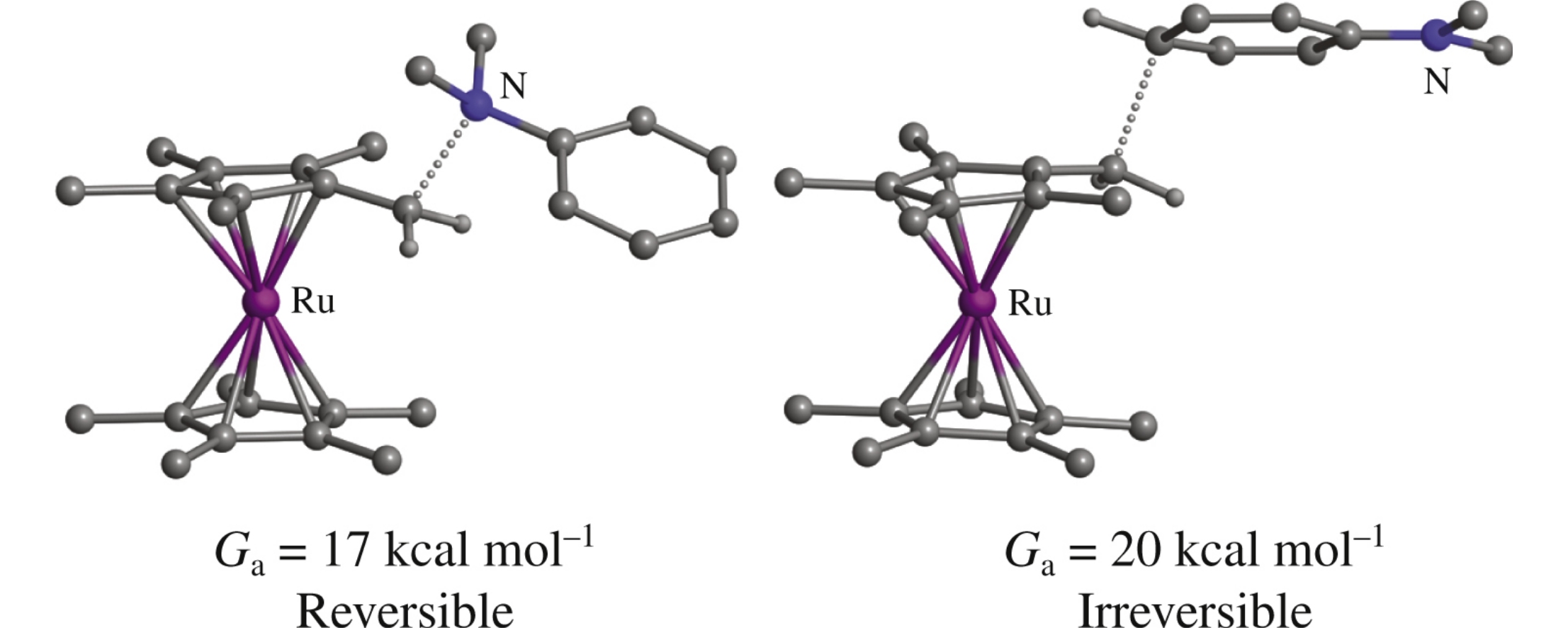
The cationic complex [Cp*Ru(C5Me4CH2)]+ reacts with Et3N primarily giving the ammonium salt [Cp*Ru(C5Me4CH2NEt3)]+. The prolonged standing of the reaction mixture results in the formation of the ether Cp*Ru(C5Me4CH2OCH2C5Me4)RuCp*. The reaction of [Cp*Ru(C5Me4CH2)]+ with PhNEt2 leads to the electrophilic aromatic substitution product [Cp*Ru(C5Me4CH2C6H4NHEt2)]+.
References
1.

Richards J.H., Hill E.A.
Journal of the American Chemical Society,
1959
2.

3.
Kölle V., Grub J.
Journal of Organometallic Chemistry,
1985
4.

Kreindlin A.Z., Rybinskaya M.I.
Russian Chemical Reviews,
2004
5.

Perevalova �.G., Ustynyuk Y.A., Ustynyuk L.A., Nesmeyanov A.N.
Russian Chemical Bulletin,
1963
6.
Nesmeyanov A.N., Sazonova V.A., Drozd V.N., Rodionova N.A., Zudkova G.I.
Russian Chemical Bulletin,
1965
7.
Liles D.C., Shaver A., Singleton E., Wiege M.B.
Journal of Organometallic Chemistry,
1985
8.
Barlow S., Cowley A., Green J.C., Brunker T.J., Hascall T.
Organometallics,
2001
9.

Muratov D.V., Romanov A.S., Petrovskii P.V., Antipin M.Y., Siebert W., Kudinov A.R.
European Journal of Inorganic Chemistry,
2012
10.
APEX2 Software Package, Bruker AXS Inc., Madison, WI, USA, 2005.
11.
10.1016/j.mencom.2015.03.009_bib0055
Sheldrick
SHELXTL v. 5.10, Structure Determination Software Suite,
1998