

Home / Publications / Phosphorescence of a ruthenium(II) hydride-carbonyl complex with 3-hydroxy-2-quinoxalinecarboxylic acid as a co-ligand

Phosphorescence of a ruthenium(II) hydride-carbonyl complex with 3-hydroxy-2-quinoxalinecarboxylic acid as a co-ligand

12
Share
Cite this
GOST
 | 
Cite this
GOST Copy
Malecki J. G., Maron A., Kusz J. Phosphorescence of a ruthenium(II) hydride-carbonyl complex with 3-hydroxy-2-quinoxalinecarboxylic acid as a co-ligand // Mendeleev Communications. 2015. Vol. 25. No. 2. pp. 103-105.
GOST all authors (up to 50) Copy
Malecki J. G., Maron A., Kusz J. Phosphorescence of a ruthenium(II) hydride-carbonyl complex with 3-hydroxy-2-quinoxalinecarboxylic acid as a co-ligand // Mendeleev Communications. 2015. Vol. 25. No. 2. pp. 103-105.
RIS
 | 
Cite this
RIS Copy
TY - JOUR
DO - 10.1016/j.mencom.2015.03.007
UR - https://mendcomm.colab.ws/publications/10.1016/j.mencom.2015.03.007
TI - Phosphorescence of a ruthenium(II) hydride-carbonyl complex with 3-hydroxy-2-quinoxalinecarboxylic acid as a co-ligand
T2 - Mendeleev Communications
AU - Malecki, Jan Grzegorz
AU - Maron, Anna
AU - Kusz, Joachim
PY - 2015
DA - 2015/03/06
PB - Mendeleev Communications
SP - 103-105
IS - 2
VL - 25
ER -
BibTex
 | 
Cite this
BibTex (up to 50 authors) Copy
@article{2015_Malecki,
author = {Jan Grzegorz Malecki and Anna Maron and Joachim Kusz},
title = {Phosphorescence of a ruthenium(II) hydride-carbonyl complex with 3-hydroxy-2-quinoxalinecarboxylic acid as a co-ligand},
journal = {Mendeleev Communications},
year = {2015},
volume = {25},
publisher = {Mendeleev Communications},
month = {Mar},
url = {https://mendcomm.colab.ws/publications/10.1016/j.mencom.2015.03.007},
number = {2},
pages = {103--105},
doi = {10.1016/j.mencom.2015.03.007}
}
MLA
Cite this
MLA Copy
Malecki, Jan Grzegorz, et al. “Phosphorescence of a ruthenium(II) hydride-carbonyl complex with 3-hydroxy-2-quinoxalinecarboxylic acid as a co-ligand.” Mendeleev Communications, vol. 25, no. 2, Mar. 2015, pp. 103-105. https://mendcomm.colab.ws/publications/10.1016/j.mencom.2015.03.007.

Abstract

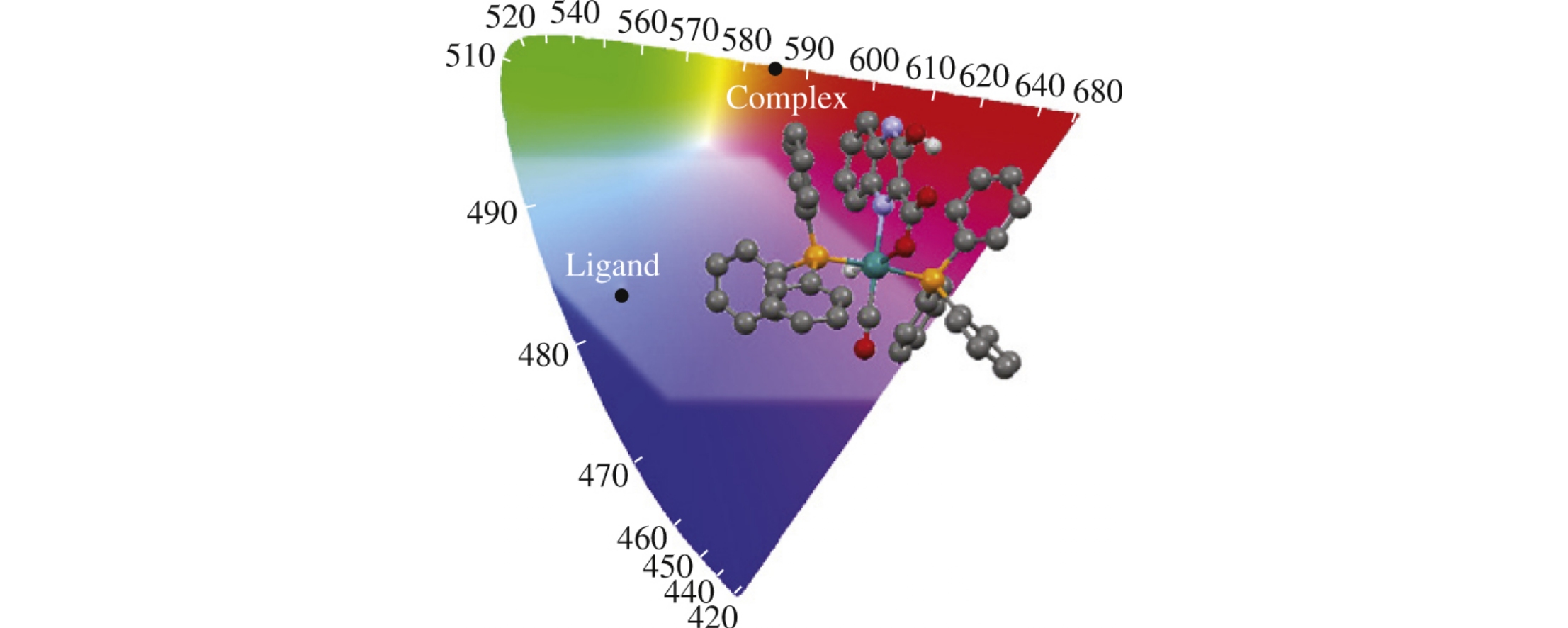
The [RuH(CO)(hqxc)(PPh3)2] complex, where hqxc is 3-hydroxy-2-quinoxalinecarboxylate, exhibits strong phosphorescence (quantum yield F = 0.0078) in the solid state giving rise to a significantly Stokes-shifted spectrum (excitation at 484nm and emission at 687nm); the lifetime of 6.5μs is very long compared with 0.68ns measured for the free hqxc ligand.

References

1.

Mechanochromic and Thermochromic Luminescence of a Copper Iodide Cluster
Perruchas S., Le Goff X.F., Maron S., Maurin I., Guillen F., Garcia A., Gacoin T., Boilot J.
Journal of the American Chemical Society, 2010
2.

Highly Luminescent CuI Complexes for Light‐Emitting Electrochemical Cells
Armaroli N., Accorsi G., Holler M., Moudam O., Nierengarten J.-., Zhou Z., Wegh R. ., Welter R.
Advanced Materials, 2006
3.
Highly Efficient Green Phosphorescent Organic Light-Emitting Diodes Based on CuI Complexes
Zhang Q., Zhou Q., Cheng Y., Wang L., Ma D., Jing X., Wang F.
Advanced Materials, 2004
4.
Dual Emission Caused by Ring Inversion Isomerization of a 4-Methyl-2-pyridyl-pyrimidine Copper(I) Complex
Nishikawa M., Nomoto K., Kume S., Inoue K., Sakai M., Fujii M., Nishihara H.
Journal of the American Chemical Society, 2010
5.

Synthesis and characterization of mono- and dinuclear copper(I) complexes with 3-(2-pyrimidinyl)-1,2,4-triazine
Chen J., Wu B., Gu W., Cao X., Wen H., Hong R., Liao J., Su B.
Transition Metal Chemistry, 2011
7.
Solodukhin N.N., Utochnikova V.V., Lepnev L.S., Kuzmina N.P.
Mendeleev Communications, 2014
8.
13.
Theoretical Perspectives on Proton-Coupled Electron Transfer Reactions
Hammes-Schiffer S.
Accounts of Chemical Research, 2001
14.
Nodal-plane model for excited-state intramolecular proton transfer of o-hydroxybenzaldehyde: substituent effect
Nagaoka S., Nakamura A., Nagashima U.
Journal of Photochemistry and Photobiology A: Chemistry, 2002
15.

Modulation of the solvent-dependent dual emission in 3-hydroxychromones by substituents
Klymchenko A.S., Pivovarenko V.G., Ozturk T., Demchenko A.P.
New Journal of Chemistry, 2003
16.
Imidazole-based excited-state intramolecular proton-transfer materials: synthesis and amplified spontaneous emission from a large single crystal.
Park S., Kwon O., Kim S., Park S., Choi M., Cha M., Park S.Y., Jang D.
Journal of the American Chemical Society, 2005
19.
Tuning excited state intramolecular proton transfer in 3-hydroxyflavone derivative by reaction of its isothiocyanate group with an amine
21.
10.1016/j.mencom.2015.03.007_bib0105
Sheldrick
2008